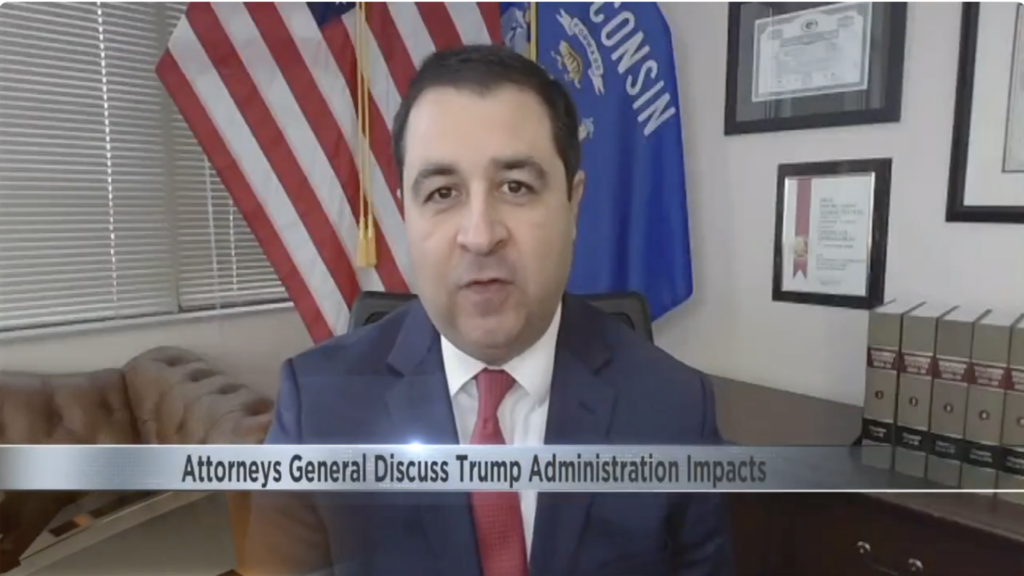
Wisconsin Attorney General Josh Kaul has filed a motion in Dane County court seeking a protective order to restrict public access to discovery documents related to the prosecution of attorneys involved in a controversial alternate electors strategy that emerged following the 2020 presidential election. Critics of this motion argue that it raises significant concerns about transparency and accountability in a case that is already politically charged.
The core issue at hand revolves around the balance between protecting the privacy of individuals involved in the case and ensuring that there is adequate public scrutiny of a prosecution that has drawn national attention. Kaul's motion claims that extensive media coverage has caused concern for victims and witnesses named in the discovery documents, suggesting that their safety could be compromised as a result of this public exposure.
Kaul is prosecuting Jim Troupis and Kenneth Chesebro, two lawyers who represented former President Donald Trump’s campaign in Wisconsin. They face multiple felony charges related to their involvement in a legal strategy that utilized alternate electors to safeguard Wisconsin's electoral votes for Trump amid ongoing legal challenges. Kaul's office has characterized this strategy as a "fake electors" scheme aimed at overturning the election results, a characterization that has been disputed by the defendants and their supporters, who argue that their actions were within the bounds of legal strategy during a contentious election period.
In his motion, Kaul stated, "This matter has generated attention from the media and the public. The attention has caused concern for the victims and witnesses who are named in the discovery and may testify in this matter." However, critics of the prosecution argue that it is politically motivated and that the alternate electors strategy has been employed in previous elections without facing legal repercussions.
Background of the Case
The case has gained prominence as one of the few remaining legal challenges involving alternate electors in swing states. Kaul's announcement of charges came shortly before Trump secured his third consecutive GOP presidential nomination, leading some observers to question the timing and motivations behind the prosecution. Supporters of the prosecution assert that the actions taken by Troupis and Chesebro were unlawful, while opponents maintain that the legal strategy was a legitimate option during election disputes.
Previous investigations into similar cases in other states, such as Arizona and Georgia, have resulted in dismissals, raising doubts about the viability of Kaul's case. In Arizona, for instance, Attorney General Kris Mayes had to drop her case against alternate electors after the state Supreme Court ruled it lacked merit. Critics of Kaul's approach suggest that his case may face similar challenges, given the precedents set in other jurisdictions that have opted not to pursue similar charges.
Allegations of Political Motivation
The prosecution has been characterized by some as a politically motivated effort to target Trump allies. Documents filed in court have suggested that Kaul's office collaborated with outside organizations, including the States United Democracy Center, which has been linked to efforts aimed at challenging Trump and his supporters. According to court filings, the Wisconsin Department of Justice participated in presentations organized by States United, which included discussions on strategies to counter Trump’s influence.
Critics argue that this collaboration raises serious questions about the impartiality of the prosecution. A source familiar with the case indicated that Troupis and his co-defendants plan to file an opposition brief against Kaul's protective order, asserting their right to respond to the prosecution's claims. The defendants have argued that Kaul's request for secrecy is an attempt to suppress evidence that could undermine the prosecution's case and bolster their defense.
Concerns Over Transparency
While Kaul seeks to limit public access to the documents, the defendants and their supporters argue that transparency is crucial in a case with significant political implications. Troupis' attorney, Joe Bugni, has previously described the protective order as a "content-based gag order" that restricts free speech regarding the investigation. As the case unfolds, it remains to be seen how the court will respond to Kaul's motion and whether the prosecution's actions will continue to be scrutinized in the public eye.
The outcome of this case could have implications not only for the defendants but also for the broader political landscape as the 2024 election approaches. The intersection of legal proceedings and political maneuvering in this case underscores the complexities involved in navigating election-related disputes in a highly polarized environment.