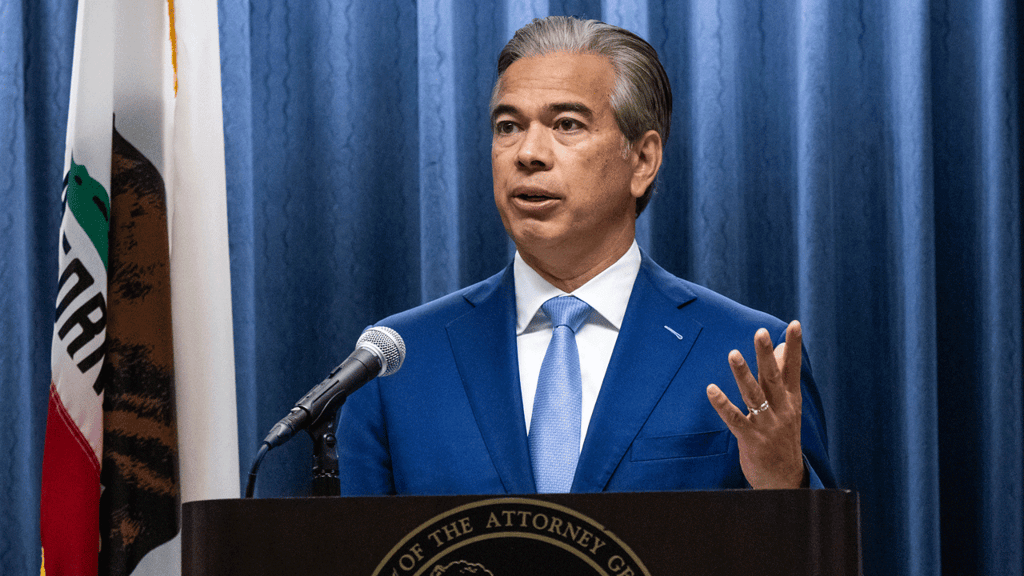
Legal and political fights over the wording of ballot measures are escalating across several states, with courts and election officials facing accusations of bias and manipulation from both sides ahead of key referendums. In California, a Sacramento judge ruled on Aug. 7 in favor of Attorney General Rob Bonta, upholding his revised ballot title for Proposition 39, a voter ID initiative. The Yes on 39 campaign argued the new language was misleading and omitted important provisions, but the court found Bonta's description accurate and lawful. The campaign has appealed the decision.
Explainer Voter ID Laws: Securing Elections While Debating Accessibility and Integrity
The dispute over ballot language is central to the broader debate about how much influence officials and partisans can exert over direct democracy, with critics warning that subtle changes in wording can sway outcomes on contentious issues.
Across the country, similar controversies have emerged. In Arizona, supporters of a voter ID measure sued Secretary of State Adrian Fontes, alleging his office inserted political commentary and left out key details in the ballot summary. Meanwhile, in New England, two ballot measures were removed from the ballot after Democratic officials were accused of issuing misleading descriptions.
California’s Proposition 39 Fight
Proposition 39's original title, "Establishes additional voter identification and citizenship verification requirements," was changed by Bonta to "Prohibits citizens from voting unless they present government-issued identification." The Yes on 39 campaign claimed this shift was not only misleading but also failed to mention new responsibilities for state and county officials to maintain accurate voter rolls. The court, however, sided with Bonta, who stated, "The ballot materials at issue — the ballot title and summary and ballot label — give a true and impartial statement on Proposition 39's chief purpose and points. My office followed the law and fulfilled its duty to provide California voters with clear, accessible, and accurate information. We're pleased that the court agreed with us."
The campaign's lawsuit also named Secretary of State Dr. Shirley Weber, seeking to compel state officials to revise the title before ballots and voter guides are finalized. The Yes on 39 campaign maintained, "Whether you support or oppose this measure, voters deserve a ballot description that is accurate and impartial."
Virginia and Massachusetts Referendum Battles
In Virginia, the Democrat-controlled legislature advanced a redistricting measure that would have shifted the congressional map to a 10-1 Democratic advantage. Republicans challenged the ballot language as biased, leading a state judge to block the measure, but the state Supreme Court allowed the referendum to proceed. The measure passed with 51%, but the state’s high court later ruled the legislature bypassed normal procedures for constitutional amendments, a decision upheld by the U.S. Supreme Court.
Massachusetts saw its own high-profile dispute over a citizen-initiated measure to cut state income taxes from 5% to 4%. With 66% public support in a Boston Globe and Suffolk University poll, the measure faced opposition from Democratic leaders and unions, who warned of budget shortfalls. Attorney General Andrea Campbell's ballot summary stated the capital-gains tax rate would remain unchanged, but opponents argued the initiative would reduce that rate as well. The Massachusetts Supreme Judicial Court found the summary "significantly misleading and likely to influence voters," barring the measure from the 2026 ballot.
Impact of Ballot Language and Expert Perspectives
Political scientists have found that changes in ballot wording can affect voter responses. Craig Burnett of Florida Atlantic University, who co-authored a 2015 study on the subject, said, "Simple changes to the text had significant impacts." However, he noted it is difficult to conclusively prove when language changes alter real election outcomes. Ted Rossier of the University of North Georgia found in a 2021 study that framing effects can reduce support for measures, and that experienced voters are not immune to such effects.
Ryan Byrne, ballots team managing editor for Ballotpedia, said both parties tend to use ballot language to their advantage. "When you have elected officials writing the language for a ballot measure, it will likely be biased or at least be accused of bias," Byrne said. Ballotpedia evaluates readability but not bias, and has found that more complex ballot language is somewhat more likely to pass.
Scrapped Measures and Ongoing Disputes
Two ballot measures that were expected to pass were removed from ballots in Maine and Massachusetts, one due to language disputes. In Maine, Secretary of State Shenna Bellows altered the language of a "Protect Girls’ Sports" measure, prompting objections from supporters. Bellows later removed the measure from the ballot, citing issues with signatures, a decision upheld by the Maine Supreme Judicial Court.
In Missouri, Republican Secretary of State Danny Hoskins approved ballot language for a measure banning gender transition surgeries on minors and restricting some abortion and transgender policies. A state court found the language insufficient for not informing voters it would repeal a "reproductive rights" measure passed in 2024, and the Missouri Court of Appeals rewrote the ballot language.
Ken Cucinelli, chairman of the Election Transparency Initiative and former Virginia attorney general, argued that changing ballot language is a longstanding tactic. "This is a George Soros mentality with Saul Alinsky tactics," Cucinelli said. "Conservatives don’t like those tactics, but we just need to shut up and go win."
Supporters of the contested ballot measures have continued to appeal rulings and press for changes, while election officials have largely defended their actions as impartial and legally sound.