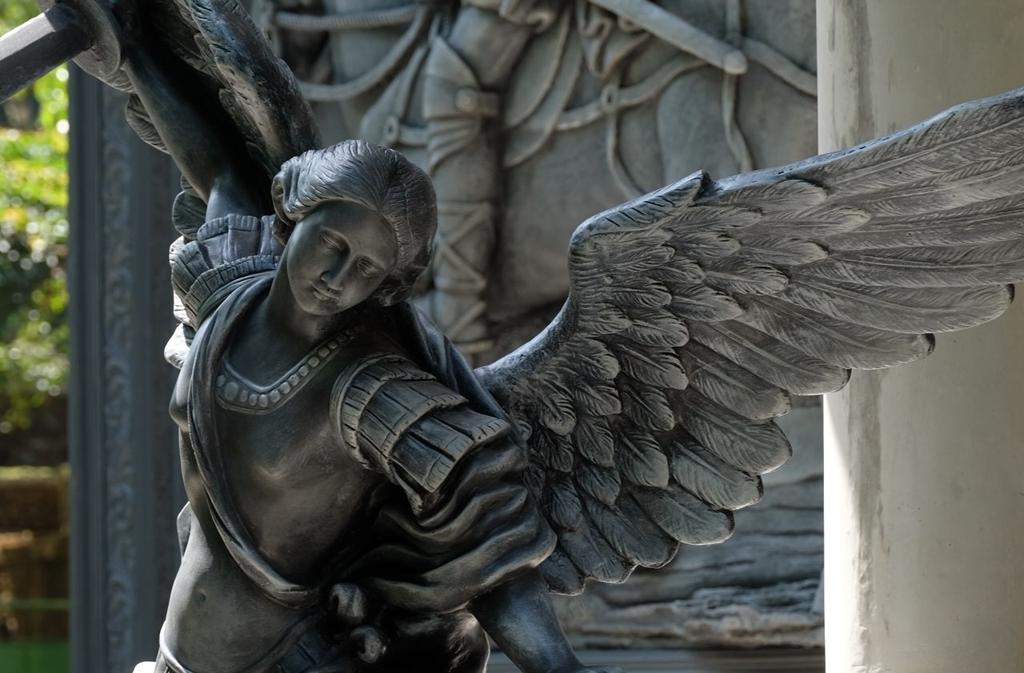
The Massachusetts Supreme Judicial Court has ruled that the city of Quincy cannot install two large bronze statues of St. Michael the Archangel and St. Florian outside its new public safety building, finding that their religious association would amount to government endorsement of Catholicism.
The decision highlights a growing debate over how public institutions may recognize religious heritage without violating constitutional principles of neutrality. The case has drawn attention from legal scholars, religious liberty advocates, and civil rights groups, reflecting broader national tensions over the presence of religious symbols in public spaces.
The court’s unanimous decision upheld a lower court’s preliminary injunction, concluding that the $850,000, 10-foot-tall statues are so closely linked to Catholicism that their placement on public property would signal preferential treatment of a particular religion. The justices wrote that the likelihood of the statues being perceived as an endorsement of Catholic faith—and thus the subordination of other religions—was heightened because the statues were not part of a broader collection including nonreligious or other religious figures.
The Court’s Reasoning
In its 34-page opinion, the court stated that the statues could convey “implicit government support” for Catholicism, potentially violating the state constitution. The justices noted that the statues’ prominent placement and religious symbolism distinguished them from secular commemorations, and that their installation could be interpreted as government endorsement of a specific faith tradition.
The ruling emphasized that the statues’ religious significance, rather than any evidence of coercion or discrimination, was the basis for the violation. The court found that the city’s intent to honor police and firefighters did not outweigh the risk of signaling government preference for Catholicism. The justices made clear that the constitutional issue was not about the city’s motives, but about the message conveyed to the public by the statues’ presence on government property.
The court also noted that the statues’ placement outside a public safety building, a site associated with civic authority, increased the risk that observers would perceive the government as endorsing a particular religious tradition. The justices wrote that the statues’ religious symbolism was not offset by the presence of other secular or religious figures, which might have provided a broader context and reduced the risk of perceived favoritism.
City’s Defense and Broader Implications
Mayor Thomas Koch, who selected the saints as patrons of police and firefighters, argued that the statues were meant to honor courage and service, values associated with the professions for generations. The city contended that acknowledging the religious identity of historical or civic figures has long been part of American tradition and does not equate to establishing a religion.
Andrea Picciotti-Bayer, director of the Conscience Project, defended the city’s plan, stating, “A city honoring its police officers and firefighters with the patron saints those men and women have invoked for generations is not establishing a religion. It is telling the truth about where a tradition of protection comes from.”
Legal scholars Michael McConnell and John Witte Jr., in an amicus brief supporting the city, warned that the court’s approach could revive the discredited Lemon v. Kurtzman test, which the U.S. Supreme Court has moved away from in recent years. They argued that neither the U.S. Constitution nor the Massachusetts Declaration of Rights requires the removal of religious references from public spaces. According to their brief, the court’s reasoning could have far-reaching consequences for how governments commemorate figures whose faith played a significant role in their public service.
The city’s supporters also pointed to the historical role of religious imagery in American public life, noting that many civic monuments and memorials include references to faith. They argued that removing all religious symbols from public spaces would erase important aspects of the nation’s heritage and the personal beliefs of those honored.
Reactions and Next Steps
The American Civil Liberties Union, which supported the plaintiffs, welcomed the decision as a reinforcement of constitutional boundaries between church and state. The ACLU and other civil rights advocates argued that government neutrality on matters of religion is essential to protecting the rights of all citizens, regardless of faith.
The case now returns to a lower state court for further proceedings and could potentially be appealed to the U.S. Supreme Court, according to reporting from the National Catholic Register. Legal experts say the case could become a test of how courts interpret the Establishment Clause in light of recent Supreme Court decisions that have shifted away from the Lemon test and toward a focus on historical practices and understandings.
The ruling comes amid broader national debates over religious imagery in public spaces. Recent years have seen similar controversies, including the removal of statues of religious figures in California and ongoing disputes over the role of faith in civic life. The Massachusetts decision may provide a new legal framework for future challenges to religious symbols on government property, as courts grapple with balancing respect for religious heritage and the constitutional requirement of government neutrality.
Supporters of the statues have argued that the court’s reasoning could be extended to other commemorations of religious figures, such as statues of Martin Luther King Jr., an ordained minister, or other historical leaders whose faith was central to their public roles. The court did not address these broader implications directly, leaving open questions about how similar cases might be resolved in the future.
As the case proceeds, the statues of St. Michael and St. Florian will remain off Quincy’s public safety building. The outcome of further legal proceedings could have implications for how cities and states across the country approach the display of religious symbols in public spaces, and for the ongoing debate over the proper relationship between government and religion.