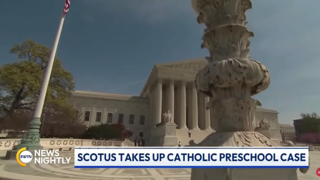
The Supreme Court is set to hear oral arguments on Nov. 3 in the case of St. Mary Catholic Parish v. Roy, a dispute that centers on Colorado’s decision to exclude a Catholic preschool from the state’s universal preschool program. The exclusion is based on the school’s stance regarding LGBTQ issues, specifically its refusal to comply with state requirements that participating schools must admit LGBTQ-identifying children and the children of LGBTQ-identifying parents.
Explainer Understanding the Supreme Court’s Impact on Law and Liberty
This case raises significant questions about the balance between First Amendment religious protections and state nondiscrimination policies. It reflects broader national debates and legal divisions over how far religious liberty extends when it intersects with laws designed to protect against discrimination based on sexual orientation and gender identity. Federal and state courts have issued differing rulings on similar issues, highlighting the ongoing legal uncertainty.
Supreme Court Sets Argument Date
The Supreme Court included St. Mary Catholic Parish v. Roy on its November argument calendar, which was released on Tuesday. The case is scheduled alongside other high-profile matters, such as an affirmative action lawsuit and a death row appeal. The plaintiffs in the case include two Catholic parishes, two Catholic parents, and the Catholic Archdiocese of Denver. They argue that Colorado’s rules amount to religious discrimination by effectively penalizing the preschool for adhering to its religious beliefs.
Religious Freedom and Legal Precedents
St. Mary’s Catholic Parish preschool, located in Littleton, contends that its exclusion from the universal preschool program violates the First Amendment’s protections for religious exercise. The school points to the Supreme Court’s 2012 decision in Hosanna-Tabor Evangelical Lutheran Church and School v. Equal Employment Opportunity Commission, which affirmed that religious institutions have the right to make employment decisions about ministers without government interference. The plaintiffs also reference the 2025 case of Mahmoud v. Taylor, where a preliminary injunction allowed parents to opt their children out of reading school books with explicit gender and sexual content, as further support for their position.
On the other side, Colorado’s defense relies on the Supreme Court’s 1990 ruling in Employment Division v. Smith. That decision held that neutral, generally applicable laws do not violate the First Amendment’s guarantee of religious freedom, even if they incidentally burden religious practices. Both a district court and the 10th U.S. Circuit Court of Appeals sided with Colorado, citing this precedent as justification for upholding the state’s nondiscrimination requirements.
In response to the 1990 Smith decision, Congress enacted the Religious Freedom Restoration Act (RFRA) in 1993. RFRA requires that any law restricting religious exercise must meet strict scrutiny, meaning the government must show a compelling interest and use the least restrictive means. The plaintiffs in the Colorado case note that two federal appeals courts and two state supreme courts have issued rulings that differ from the 10th Circuit’s interpretation, underscoring the lack of consensus in the judiciary on these questions.
Arguments From Both Sides
Lisa Roy, executive director of the Colorado Department of Early Childhood, represents the state in this case. She argues that the Catholic parish is seeking an exemption that would allow it to receive public funding while turning away preschoolers because of their or their parents’ gender identity or sexual orientation. Roy maintains that the state’s nondiscrimination policy is a neutral and generally applicable law designed to ensure equal access to public benefits for all families.
"an exemption from this law to allow them to receive public funding while turning away preschoolers because of their, or their parents’, gender identity or sexual orientation."
— Lisa Roy, executive director, Colorado Department of Early Childhood
The plaintiffs counter that Colorado’s policy forces religious organizations to choose between their faith-based beliefs and participation in a public benefit program. They argue that the state’s rules are not truly neutral in practice, as they disproportionately impact religious schools whose beliefs do not align with the state’s nondiscrimination requirements. The plaintiffs are asking the Supreme Court to clarify the legal standard for when and how religious organizations can participate in public programs without being compelled to violate their beliefs.
Broader Legal and Policy Context
The Supreme Court’s decision to take up this case comes at a time when courts across the country are grappling with the intersection of religious freedom and LGBTQ rights. The outcome of St. Mary Catholic Parish v. Roy could have significant implications for how states design and enforce nondiscrimination requirements for publicly funded programs. It may also affect the ability of religious organizations to participate in such programs without compromising their religious convictions.
Legal observers expect the Court’s ruling to clarify the extent to which states can enforce nondiscrimination policies in public benefit programs without running afoul of constitutional protections for religious exercise. The decision could set a precedent for similar disputes nationwide, shaping the landscape for religious liberty and LGBTQ rights for years to come.