Virginia Governor Abigail Spanberger has signed an executive order launching what her office calls the nation's most comprehensive data center accountability standards, aiming to increase transparency, strengthen environmental protections, and lower energy costs as the state’s energy demand surges.
Explainer Virginia's Legal Battles Over Gun Control, Abortion, and Redistricting Explained
The move has intensified debate over whether Virginia can maintain reliable power for its expanding data center industry while advancing clean energy goals and limiting on-site natural gas generation.
Virginia’s energy policy has become a flashpoint as the state hosts over a third of the world’s hyperscale data centers and anticipates further growth. The 2026 Virginia Energy Plan, required by law, sets a course for a net-zero carbon energy economy by 2045 and calls for broad stakeholder input to balance affordability, reliability, and environmental goals 2026 Virginia Energy Plan.
Spanberger’s Executive Order and Framework
Governor Spanberger’s Data Center Accountability Framework, announced September 18, includes immediate directives to state agencies and proposed legislation for the next General Assembly session. The framework seeks to end data center secrecy, enforce strong environmental standards, and protect Virginians from higher energy bills. It also creates a new AI Task Force to address risks from artificial intelligence, including workforce displacement and data privacy Governor's news release.
Spanberger said previous administrations lacked a coordinated plan to address the impact of data centers on electric bills, water, land, air, and quality of life. “Virginia’s Data Center Accountability Framework is about delivering a better deal for Virginians and holding data center companies, developers, and operators accountable,” Spanberger said in her announcement.
The framework would limit the amount of electricity data centers can generate from on-site natural gas or behind-the-meter gas generation, a provision that has drawn criticism from both Republicans and some Democrats.
Criticism Over Natural Gas Limits
House Minority Leader Terry Kilgore, a Republican, argued that restricting on-site natural gas generation could undermine grid reliability during peak demand. “The governor’s proposal is internally contradictory and raises serious questions about whether it can actually work,” Kilgore told Fox News Digital. “What reliable, dispatchable source of power is supposed to fill the gap? That’s not a political question: it’s how the grid works.”
State Sen. Louise Lucas, a Democrat, also questioned the framework, noting it does not end $2 billion in sales tax exemptions for data centers.
Steve Haner of the Thomas Jefferson Institute, an energy policy expert, said that an “all of the above” energy policy requires continued use of fossil fuels for now. Haner noted that former Governor Glenn Youngkin supported expanded natural gas use and opposed the Virginia Clean Economy Act, while Spanberger supports the Act and is pushing utilities to meet its mandates. “There is no sign she supports ‘all of the above,’” Haner said.
Data Centers and Future Energy Sources
The PJM grid operator, which serves Virginia and 12 other states, has asked federal regulators to require large-load customers like data centers to supply their own power during peak times. This has increased pressure on data centers to find reliable energy sources.
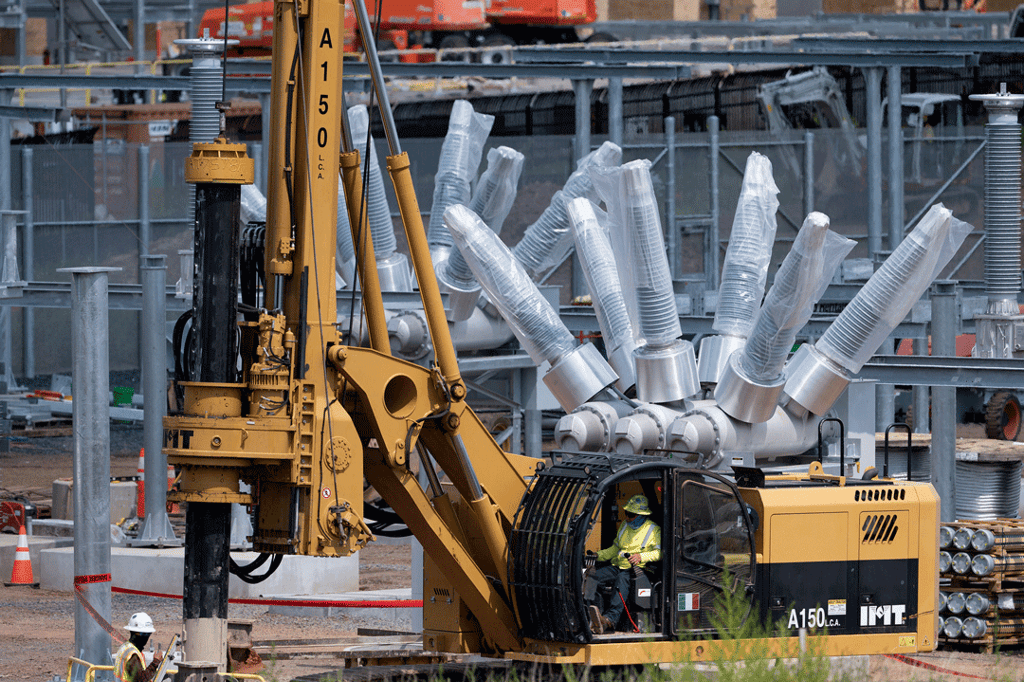
Virginia is also positioning itself as a leader in advanced energy technologies. In Chesterfield County, Commonwealth Fusion Systems is building the Fall Line Fusion Power Station, which could generate up to 400 megawatts of electricity when operational. The company has raised $4 billion for the project, and spokeswoman Christine Dunn said the plant remains on track to connect to the grid in the 2030s.
Drew Bond, executive chairman of C3 Solutions, credited former Governor Youngkin’s free market policies for attracting innovative companies like Commonwealth Fusion. Bond predicted, “When it happens, it will be the biggest energy gamechanger since the invention of fire. Not only is it clean, firm, base load power, but it’s the safest possible option.”
Fusion energy remains in development, with other startups like Helion Energy recently delaying initial operations. For now, Virginia’s energy plan continues to weigh the need for reliable fossil fuel generation against long-term clean energy ambitions.
The 2026 Virginia Energy Plan is expected to be released in October, following months of stakeholder engagement and public input 2026 Virginia Energy Plan.