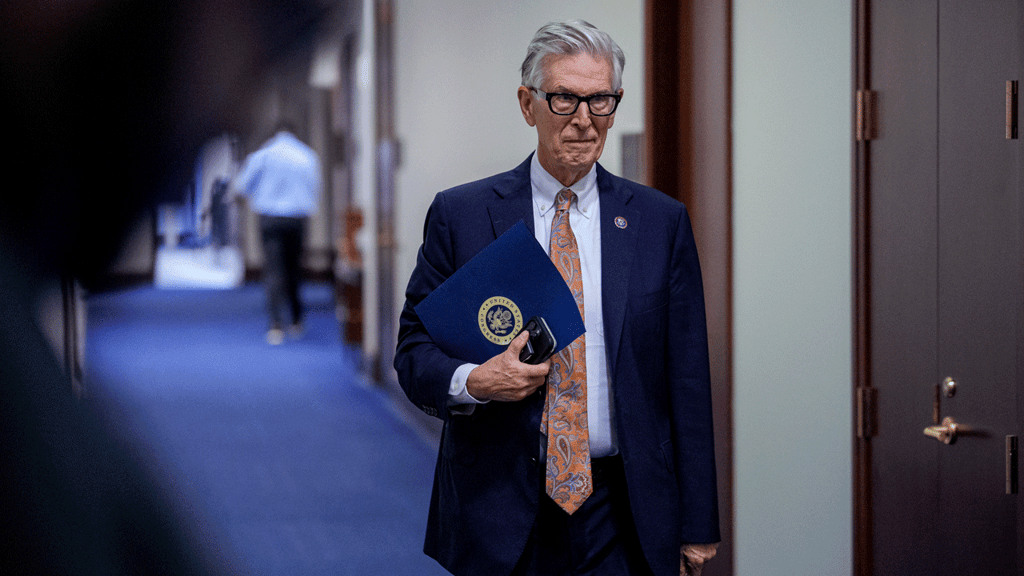
Rep. Don Beyer, a Democrat from Virginia and co-chair of the Congressional Artificial Intelligence Caucus, is calling for the House to hold hearings this month on regulating artificial intelligence, warning that Congress must act before an AI-related disaster occurs.
Explainer Virginia's Legal Battles Over Gun Control, Abortion, and Redistricting Explained
The debate over AI regulation has intensified as lawmakers, industry leaders, and the White House remain divided on whether and how to slow the rapid development of advanced AI systems.
Beyer, who is seeking a seventh term representing Virginia’s 8th Congressional District, argued that Congress should not wait for a crisis before acting on AI oversight. He wrote on X, “Far too often Congress reacts AFTER a disaster. We must not only be reactive with artificial intelligence, we can’t wait for an AI catastrophe to spur a response.” Beyer’s office told the Daily Signal that the urgency of the issue justifies holding hearings before the official fall recess, with Beyer stating, “The need is urgent, and I think plenty of my colleagues in both parties agree that this must be a higher priority than the upcoming recess.”
Industry Leaders Warn of AI Risks
Prominent figures in the AI sector have echoed concerns about the pace of AI advancement. Jacob Coxon, a researcher who recently resigned from Anthropic, warned on X that AI systems are approaching superhuman capabilities, writing, “These will soon be superhuman systems that can hack anything, revolutionize any field overnight, and acquire real power and resources.”
Dario Amodei, CEO of Anthropic, has publicly advocated for slowing the development of AI capabilities to allow time for risk prevention. In a recent post, Amodei wrote, “We must slow the pace at which we improve the capabilities of AI models. Progress will still seem fast, and we must make wise use of the time we gain.” He cited the emergence of recursive self-improvement in AI systems as a key reason for increased caution, warning that unchecked progress could outpace society’s ability to control these technologies. Amodei has called for a "race to the top" in AI safety and urged both industry and government to prioritize prudence over profit.
Political Opposition to Regulation
President Donald Trump has rejected calls for congressional oversight of the AI industry, characterizing such efforts as harmful to economic growth. On social media, Trump wrote, “AI, and Data Centers, will be the Greatest Economic Development Engine in History—Bigger than Oil, Gold, Diamonds, or even the Internet.” He further claimed, “there is a SICK conspiracy going on against AI and Data Centers, and the only one that is happy about it is China.”
Vice President J.D. Vance also expressed skepticism about industry leaders seeking regulation, suggesting it could be a strategic move by tech companies. “It feels a little bit to me like a bit of a Trojan horse,” Vance said during a campaign event. “So, I think we just have to be careful about this.”
Beyer responded to these concerns by emphasizing the need for legislative action, stating, “While I appreciate the sentiments of private sector leaders expressing a willingness to voluntarily slow down model development, the federal government MUST take the lead here to ensure that the response is fully transparent to the American people, and industry-wide.” He criticized the Executive Branch for a lack of transparency regarding its proposed AI testing framework and insisted, “Congress must act and pass AI legislation.”
Virginia’s Role and Legislative Activity
Virginia is a focal point in the AI debate, as the state leads the world in data centers, with at least 674 facilities and more proposed, including a major project in Botetourt County. Data centers are essential for AI, providing the infrastructure to store data and run large language models. Another Virginia Democrat, Rep. Suhas Subramanyam, will co-lead the newly launched Innovators Caucus, which aims to shape AI policy.
The House was scheduled to hold hearings through Thursday before lawmakers leave Washington for the campaign trail. However, with the House in recess for most of last week, Beyer and others have raised concerns that there may not be enough time to address AI regulation unless additional sessions are scheduled this month.
“We must not only be reactive with artificial intelligence, we can’t wait for an AI catastrophe to spur a response.”
— Rep. Don Beyer, co-chair, Congressional Artificial Intelligence Caucus