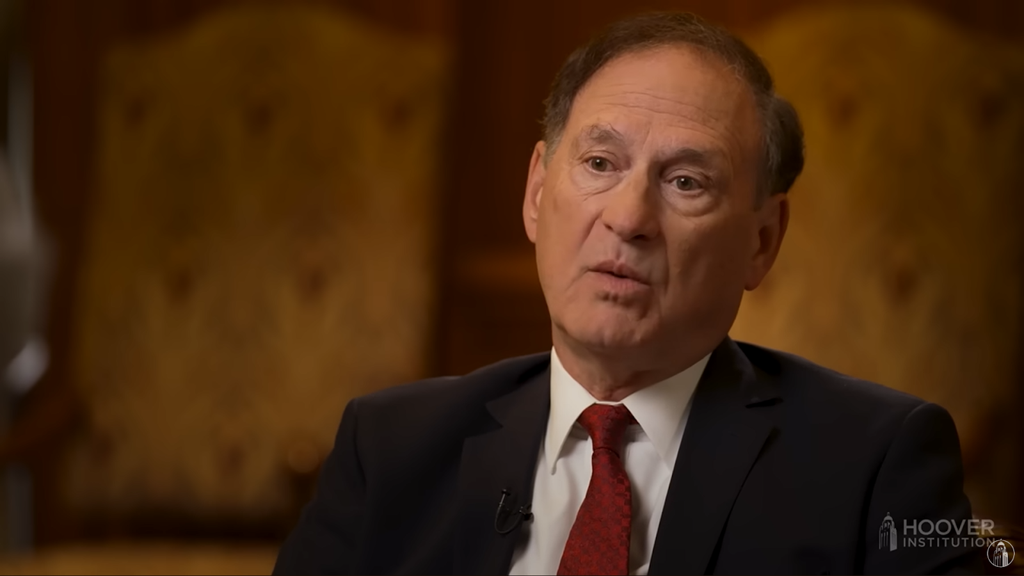
Associate Justice Samuel Alito challenged the constitutionality of a Colorado law banning so-called "conversion therapy" (U.S. Supreme Court) for minors during oral arguments in the Supreme Court case Chiles v. Salazar on Tuesday.
The case centers on Kaley Chiles, a licensed therapist in Colorado who argues that the state's law infringes on her First Amendment rights by restricting the discussions she can have with her minor clients regarding sexual orientation and gender identity.
"One viewpoint is that a minor should be able to obtain talk therapy to overcome same-sex attraction, if that’s what he or she wants."
— Samuel Alito, Associate Justice of the Supreme Court
During the proceedings, Alito posed hypothetical scenarios that highlighted what he described as "viewpoint discrimination" (U.S. Supreme Court) inherent in the law. He questioned Colorado Solicitor General Shannon Stevenson about the implications of the law, which allows therapists to support a child's exploration of homosexual or transgender identities while prohibiting them from offering counseling aimed at helping a child overcome those feelings.
Alito presented two scenarios involving an adolescent male who expresses feelings of attraction to other males. In one case, the boy seeks help to lessen those feelings, while in the other, he seeks support to embrace his identity as a gay individual. Alito noted that Colorado's law would yield opposite outcomes based on the viewpoint expressed by the minor, which he argued constitutes blatant viewpoint discrimination.
"One viewpoint is that a minor should be able to obtain talk therapy to overcome same-sex attraction, if that’s what he or she wants," (U.S. Supreme Court) Alito stated. "The other is that the minor should not be able to obtain talk therapy to overcome same-sex attraction, even if that is what he or she wants."
Stevenson responded that both scenarios would be permissible under Colorado's law, arguing that the goal in both cases did not appear to be changing sexual orientation. She emphasized that the law is designed to prevent harm associated with conversion therapy practices.
Justice Elena Kagan, appointed by former President Barack Obama, echoed Alito's concerns, suggesting that the law's differential treatment of the two scenarios could indeed reflect viewpoint discrimination. Kagan remarked, "If a doctor says, ‘I know you identify as gay, and I’m going to help you accept that,’ and another doctor says, ‘I know you identify as gay, and I’m going to help you to change that,’ and one of those is permissible and the other is not, that seems like viewpoint discrimination." (U.S. Supreme Court)
Stevenson did not dispute Kagan's point but defended the law by asserting that medical treatment must be regulated differently due to the potential harms associated with certain practices. She argued that excluding harmful practices inherently implies that other practices are allowed because they are deemed non-harmful.
The Supreme Court's deliberation on this case could have significant implications for the intersection of free speech rights and state regulations concerning therapy practices for minors. The arguments presented reflect ongoing national debates surrounding conversion therapy and the rights of therapists to provide diverse forms of counseling.
Shawn Fleetwood is a staff writer for The Federalist and a graduate of the University of Mary Washington. He has previously contributed to various outlets, including RealClearPolitics and Conservative Review. Follow him on Twitter @ShawnFleetwood.