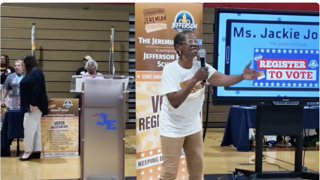
A voter registration drive in Leavenworth County, Kansas, conducted by the local League of Women Voters chapter is under scrutiny after photographs surfaced showing a sign offering a $5 Starbucks gift card to individuals who registered to vote. The incident has prompted an inquiry by Kansas Attorney General Kris Kobach and a criminal referral to the U.S. attorney in Kansas.
Explainer Wisconsin Elections: Understanding Recent Changes and Challenges
The case highlights a core legal question: whether offering something of monetary value in exchange for voter registration violates federal election law, which carries significant penalties.
Photographs from the event, including one posted on the League’s Facebook page, show students holding Starbucks gift cards and a sign stating, “Register to vote. Get a $5 Starbucks Gift Card.” The offer was not presented as a general giveaway but was explicitly tied to registering to vote. Federal law, specifically Section 10307(c) of Title 52, prohibits knowingly or willfully offering or paying, or accepting payment, for voter registration or voting, with penalties of up to five years in prison and a $10,000 fine. The Justice Department’s guidance in its Federal Prosecution of Election Offenses clarifies that payments can include items of monetary value, not just cash, and distinguishes between rewards for participation and assistance that facilitates voting, such as transportation.
Legal Framework and Precedents
Case law supports the broad application of the statute. In United States v. Lewin, the 7th Circuit affirmed that the law applies to both those who pay and those who accept payment for registering to vote, though it reversed the convictions on other grounds. More recently, the 2nd Circuit in United States v. Smilowitz upheld a conviction involving conspiracy to buy voter registrations, confirming that the statute can reach practices affecting eligibility for future federal elections. Conspiracies to violate this statute may also be prosecuted under the general federal conspiracy law, 18 U.S.C. § 371, which allows for penalties of up to five years in prison for conspirators if the underlying offense is a felony 18 U.S. Code § 371.
The Justice Department’s manual further explains that the intent requirement—"knowingly or willfully"—means prosecutors must show knowledge of the facts constituting the prohibited conduct, not necessarily knowledge of the law itself. The presence of a sign and distribution of gift cards provides concrete evidence of the offer, but further investigation is needed to determine who organized the program, who funded the cards, and whether recipients were explicitly required to register to receive them.
State and Organizational Responses
Kansas Attorney General Kris Kobach has issued a cease and desist order to the Leavenworth County League and referred the matter for federal investigation. The League of Women Voters of the United States responded in a public statement that it is aware of the allegations and that Kansas League leadership is cooperating fully with the inquiry. The national League emphasized its commitment to complying with all federal and state election laws League statement.
"The League is committed to complying with all federal and state election laws and takes these allegations seriously."
— League of Women Voters of the United States, official statement
The League describes itself as nonpartisan and stated that it supports lawful voter registration efforts. The organization did not address specific details about the Leavenworth County event or the decision to offer gift cards.
Broader Context and Next Steps
The investigation comes amid heightened scrutiny of election law enforcement and concerns about the politicization of such cases. Federal law encourages voter registration but draws a clear line at offering payments or rewards for registering or voting. The Justice Department’s guidance and prior prosecutions underscore that the law applies regardless of the political identity of the organization involved.
The inquiry will focus on determining the intent and actions of the organizers, including who conceived and approved the program, who purchased the cards, and how many were distributed. Officials have indicated that the investigation should prioritize those who organized the program rather than students who received the gift cards. No charges have been filed, and the outcome will depend on the findings of state and federal authorities.
The Justice Department’s Federal Prosecution of Election Offenses provides further detail on how such cases are evaluated and prosecuted DOJ guidance.