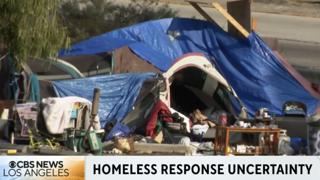
Three federal agencies have announced a new 'treatment first' strategy in San Diego, aiming to address California's ongoing homelessness crisis. This marks a significant shift from the state's longstanding 'housing first' approach. The initiative is being led by the U.S. Department of Housing and Urban Development (HUD), the Department of Health and Human Services (HHS), and the Office of National Drug Control Policy (ONDCP). The new strategy pairs addiction and mental health treatment with housing support, seeking to address the complex needs of people experiencing homelessness.
Explainer California Elections: Low Turnout, Vote Counting Controversies, and Political Implications
The announcement comes as California continues to grapple with a rising homeless population. Since 2019, homelessness in the state has increased by about 20%, despite California's substantial investment in housing programs. The core debate centers on whether prioritizing housing alone is sufficient, or if mandatory treatment is needed to address underlying issues such as addiction and mental illness.
California adopted the 'housing first' model in 2016 under then-Governor Jerry Brown. This model required state-funded programs to focus on providing immediate housing to those in need, regardless of their participation in treatment programs. Since the adoption of this approach, the state has spent an estimated $37 billion on homelessness and housing initiatives. Major programs under this umbrella include the Homeless Housing, Assistance and Prevention (HHAP) program, Homekey, and Encampment Resolution Funding. Under Governor Gavin Newsom, overall homelessness in California rose from 151,278 in 2019 to 181,934 in 2025, according to HUD's Point-in-Time counts.
Details of the New Federal Approach
HUD Secretary Scott Turner described the new program as a 'totally different mindset,' emphasizing the importance of combining treatment and housing to foster self-sufficiency among people experiencing homelessness. The federal agencies released a toolkit outlining a seven-step process. This process includes street-level outreach, recovery-oriented housing, partnerships with faith-based and community organizations, and targeted support for families and children.
According to the toolkit, about 75% of homeless individuals struggle with addiction, and 78% face mental illness. The approach aims to move people from the streets into recovery programs, then through structured housing, employment, and ultimately independence. The strategy includes clear accountability for outcomes, with the goal of reducing recidivism and promoting long-term stability. The toolkit highlights organizations such as Haven for Hope, Helping Up Mission, and The Mission at Kern County as examples of effective models that combine treatment with housing support.
"It’s not just treatment. What they’re used to is just housing. This is a totally different mindset. It’s treatment with housing. They have to go together. You can’t just house people and then leave them. That’s how you create a homeless industrial complex."
— Scott Turner, HUD Secretary
Haven for Hope, a San Antonio-based organization cited in the toolkit, conducted a 15-year review and found that 65% of clients needed only one stay, and over 90% of those did not return to homelessness at one, five, and ten years. The Mission at Kern County reported placing 216 people into permanent housing in 2025, with 32 program graduates. In a job-training cohort, 90% of graduates received job offers within 30 days, and 82% remained employed later. These examples are presented as evidence that integrating treatment and housing can lead to more sustainable outcomes for people experiencing homelessness.
Reactions and State Response
Secretary Turner said he had not yet received feedback from the Newsom administration but emphasized the importance of collaboration with public-private and faith-based partners. He stated, "If Gov. Newsom, if Mayor [Karen] Bass, if they want to come to the table and talk about transformation, if they want to talk about treatment first and not housing first, I would welcome them."
A spokesperson for Governor Newsom defended the state's record, citing what they described as the "largest drop in unsheltered homelessness in 16 years." The spokesperson attributed the current mental health crisis in part to policies from former Governor Ronald Reagan. Newsom's office pointed to a 6.8% decrease in unsheltered homelessness between 2024 and 2025, according to HUD data. However, overall unsheltered homelessness has increased by roughly 6.8% since Newsom took office, rising from 108,432 to 115,583 by 2025.
Despite the federal push for a new model, the Newsom administration maintains that its approach is producing results. State officials argue that the 'housing first' strategy has led to measurable progress, while federal officials contend that combining treatment with housing is necessary for long-term success. The debate over the most effective way to address homelessness in California continues, with both sides pointing to data and outcomes to support their positions.
The new federal initiative in San Diego is expected to serve as a pilot for the 'treatment first' approach. Its progress will likely be closely watched by policymakers, service providers, and advocates across the state and nation as they seek solutions to the persistent challenge of homelessness.