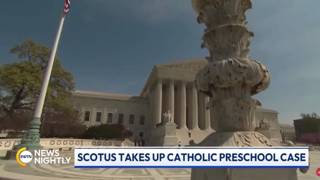
The U.S. Supreme Court is set to hear oral arguments Tuesday in St. Mary Catholic Parish v. Roy, a case challenging Colorado’s exclusion of Catholic preschools from the state’s universal preschool program due to their religious beliefs on marriage and gender identity.
Explainer Understanding the Supreme Court’s Impact on Law and Liberty
The case centers on whether Colorado’s requirement that participating preschools agree to nondiscrimination on sexual orientation and gender identity unlawfully burdens religious exercise, and whether the state can deny public benefits to religious organizations that uphold traditional Catholic doctrine.
The dispute follows a series of high-profile clashes between Colorado and the Supreme Court over religious liberty, including cases involving a Christian baker and a web designer. The outcome could set a precedent for how states structure public benefit programs and the extent to which religious organizations can be excluded for adhering to their beliefs.
Colorado’s Preschool Program and Legal Battle
Colorado’s universal preschool program, established after a 2020 ballot measure and codified by the state legislature, requires all participating schools to sign an agreement pledging equal access regardless of identity-based characteristics, including sexual orientation and gender identity. Catholic parishes, their preschools, two parents, and the Archdiocese of Denver filed suit, arguing the mandate violates their First Amendment rights by forcing them to act against their religious convictions.
A federal district court ruled against the Catholic plaintiffs in June 2024, rejecting their First Amendment claims and denying an injunction against the state. The court did bar Colorado from enforcing the nondiscrimination requirement as to religious affiliation when a congregation preference existed, a point not challenged on appeal. The 10th Circuit Court of Appeals upheld the state’s policy in September 2025, finding it consistent with the First Amendment.
The Catholic plaintiffs then petitioned the Supreme Court, which agreed to hear the case but declined to consider whether to overrule the 1990 Employment Division v. Smith precedent.
The Smith Precedent and Religious Exercise
At issue is whether Colorado’s policy is a neutral law of general applicability under Employment Division v. Smith, which held that the First Amendment does not require religious exemptions from such laws. Critics, including Becket Fund for Religious Liberty counsel Amanda Dixon, argue that Smith has been misapplied by lower courts to allow governments to burden religious exercise as long as laws are facially neutral.
"This case is important because it’s an example of the ways that governments have been trying to evade the protections that the Supreme Court has spent decades reaffirming for religious exercise."
— Amanda Dixon, counsel, Becket Fund for Religious Liberty
Dixon and the plaintiffs contend that the Supreme Court should revise the Smith framework to align with more recent decisions, such as Carson v. Makin, which barred Maine from excluding religious schools from tuition assistance programs. Their brief argues that denying public benefits based on religious exercise imposes a particularly severe burden on free exercise rights.
What the Justices Are Considering
The Supreme Court has previously declined to fully overturn Smith, notably in Fulton v. Philadelphia, where only three justices supported doing so. In the current case, the Court agreed to address whether Colorado’s policy violates the Free Exercise Clause, but not whether Smith should be overruled entirely. Justices Amy Coney Barrett, Brett Kavanaugh, and Chief Justice John Roberts have expressed reservations about discarding Smith without a clear replacement.
Dixon suggested the Court may be preparing to gradually narrow Smith’s reach, as it did with other precedents, rather than overturning it outright in this case. She said the justices may seek to provide clearer guidance to lower courts to avoid continued confusion over religious liberty claims.
Colorado officials have defended the program as a neutral, generally applicable policy that ensures equal access for all families. The state’s position, upheld by lower courts, is that the nondiscrimination requirement does not target religious groups but applies uniformly to all participating preschools.
Oral arguments in St. Mary Catholic Parish v. Roy are scheduled for Tuesday at 10 a.m. ET, according to the Supreme Court’s official calendar.