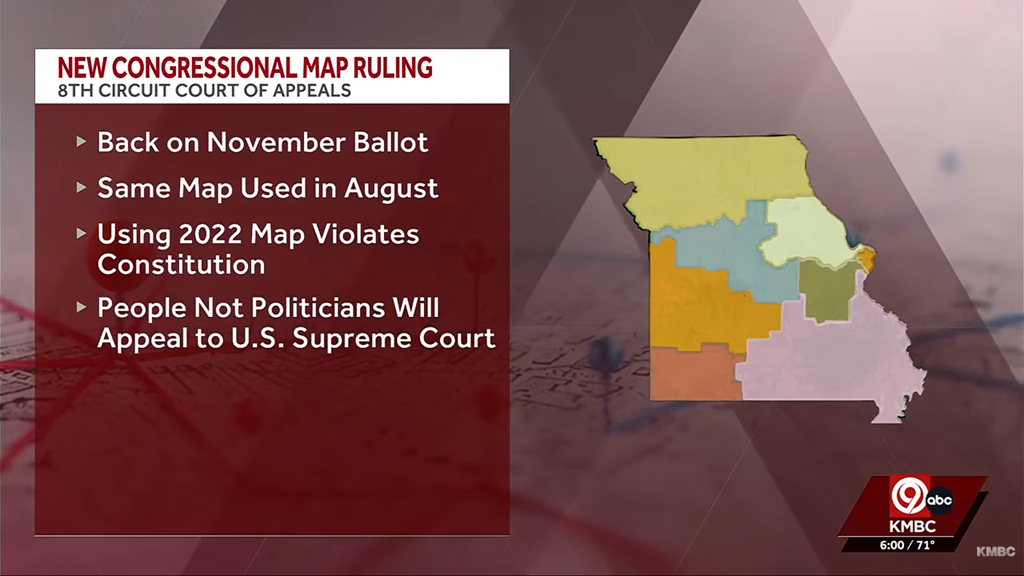
A three-judge panel of the 8th Circuit Court of Appeals has ordered Missouri to use its new Republican-backed congressional map for the 2026 midterm elections, reversing a prior Missouri Supreme Court directive to use an older map. The decision escalates a long-running redistricting dispute in the state and sets up a direct clash between federal and state courts over which map will govern Missouri’s congressional elections. At stake is the partisan makeup of Missouri’s congressional delegation and control of a key House seat.
Explainer Understanding the Supreme Court’s Impact on Law and Liberty
Missouri’s redistricting battle has drawn national attention. Under the 2022 map, the state’s congressional delegation consisted of six Republicans and two Democrats. The new map, set to take effect for the 2026 elections, would shift that balance to seven Republicans and one Democrat. The dispute began when the Missouri Supreme Court ordered the state to use the 2022 map for the midterms and to place a referendum on the 2025 map on the November 2026 ballot. That order followed a challenge led by the advocacy group People Not Politicians (PNP), which has argued that the new map constitutes partisan gerrymandering.
Federal Court’s Decision
The 8th Circuit panel—composed of Judges James Loken, David Stras, and Justin Smith—ruled that using the 2022 map in the November 2026 general election would violate the U.S. Constitution, specifically Article I, Section 2. The court found that more than 1.4 million Missourians would not be able to vote for the congressional district nominees who would appear on their general election ballot. In addition, over a quarter-million voters who participated in the August 2026 primary would have cast ballots for candidates who could not represent them under the 2022 map.
"Missouri cannot deprive more than 1.4 million of its residents of their choice in half of that process without violating Article I, Section 2."
— 8th Circuit Court of Appeals, per curiam opinion
The panel ordered Chief District Judge Stephen Clark to issue a permanent injunction requiring the state to use the 2025 map for the midterms. However, the court directed that the order be paused until 5 p.m. on September 28 to allow for possible Supreme Court review. This pause gives parties time to seek further judicial intervention before the new map is implemented for the 2026 elections.
Judge Stras, in a partial dissent, argued that PNP and its co-challenger lacked standing and said he would have dismissed the appeal for that reason. Despite this dissent, the majority’s decision stands unless overturned by a higher court.
State Court Actions and Political Response
Earlier this month, the Missouri Supreme Court had ruled in favor of using the 2022 map and placing a referendum on the 2025 map on the fall ballot. This decision came after PNP’s efforts to get the referendum included were initially rejected by Secretary of State Denny Hoskins. In response to the state court’s order, Chief District Judge Clark issued a temporary restraining order in a federal challenge brought by several congressional candidates, mandating use of the 2025 map instead.
The U.S. Supreme Court, through Justice Brett Kavanaugh, temporarily froze Clark’s order, pending further appeals. However, the 8th Circuit’s new ruling is not subject to the previous Supreme Court stay, as it involves a new permanent injunction. PNP has indicated it will appeal the appellate court’s decision to the Supreme Court again, signaling that the legal battle is likely to continue.
The ongoing litigation has prompted a range of political responses. The Missouri Freedom Caucus and other state Republicans have called for judicial reforms in response to the redistricting lawsuits. As of Monday evening, PNP confirmed plans to seek Supreme Court review of the 8th Circuit’s order. Missouri officials have not yet issued a public response to the latest federal ruling.
Broader Redistricting Dispute
People Not Politicians, described as a left-leaning advocacy group, has led efforts to challenge the Republican-drawn map. The group argues that the new map constitutes partisan gerrymandering and undermines fair representation. PNP’s push includes advocating for a referendum and the creation of an independent redistricting commission, which supporters say would make the process less partisan.
Critics of PNP’s efforts, including some Missouri Republicans, contend that the group’s proposals would make the redistricting process less responsive to voters and could shift control away from elected officials. PNP’s funding has included support from national organizations such as Unite America, reflecting broader national interest in the outcome of Missouri’s redistricting fight.
The dispute over Missouri’s congressional maps is part of a wider national debate over redistricting, gerrymandering, and the role of courts in shaping electoral boundaries. The outcome of the ongoing litigation could have significant implications for the balance of power in Missouri’s congressional delegation and may set precedents for other states facing similar legal battles.
As the legal process continues, the 8th Circuit’s order stands to shape the 2026 midterm elections in Missouri, unless the U.S. Supreme Court intervenes. Observers across the country are watching closely as the state’s courts, federal judiciary, and advocacy groups continue to vie for control over the redistricting process.