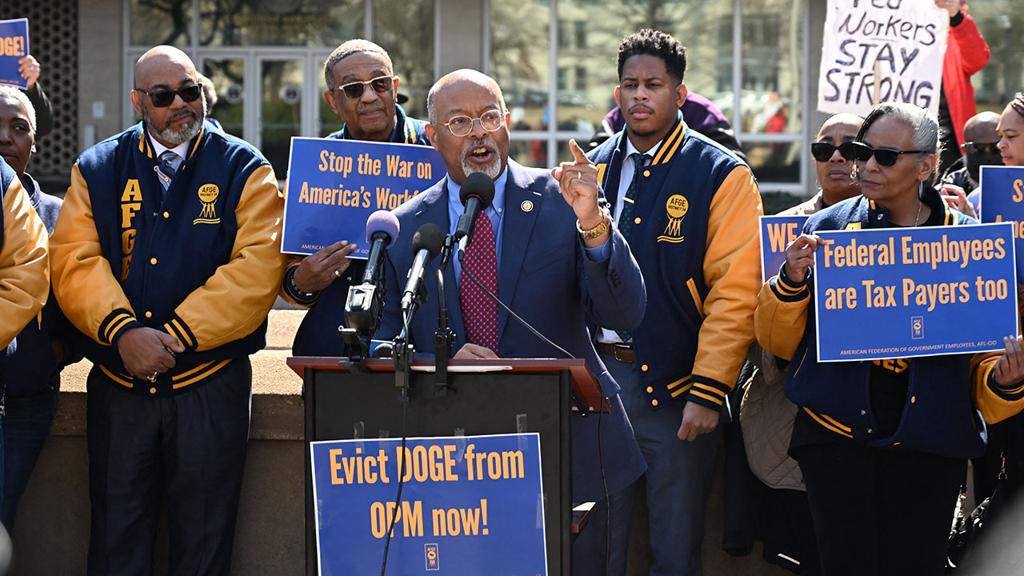
The American Federation of Government Employees (AFGE) and other major unions have escalated their legal campaign against the Trump administration, filing a series of lawsuits to halt new rules and executive orders that would overhaul how federal employees are classified, disciplined, and removed from their positions.
The core dispute centers on whether the president or career federal employees and their unions ultimately shape the direction and operation of the executive branch.
This legal battle is part of a broader struggle over the scope of presidential authority to reorganize federal agencies and reshape the civil service, with unions arguing that many reforms exceed executive power and threaten established workforce protections.
Lawsuits Targeting Workforce Reforms
Last month, AFGE sued the White House’s Office of Personnel Management (OPM) to block recently finalized rules that change how federal employees are evaluated and removed. The union, joined by AFSCME and other labor groups, claims these rules expand OPM’s authority over employee suitability and performance ratings, making it easier to discipline or terminate workers. OPM Director Scott Kupor defended the changes, stating they are intended to address longstanding difficulties in removing employees for serious misconduct, noting that the government has "had stronger tools to prevent someone with serious misconduct from entering public service than to address the same misconduct once that individual is already employed." OPM finalized rule
The AFGE’s latest lawsuit is the nineteenth it has filed against the Trump administration since January 2025, according to a July summary posted by the union. These legal actions have challenged a range of initiatives, including government-wide reorganizations, reductions in workforce, restrictions on collective bargaining, and changes to employee classification systems.
Executive Orders Under Challenge
Among the most significant cases is the challenge to Executive Order 14210, which established the Department of Government Efficiency (DOGE) and aimed to reduce the federal workforce. AFGE, joined by a coalition of unions and advocacy groups, argues that the president lacks authority to reorganize or downsize agencies created by Congress. The case remains ongoing after a federal judge denied the administration’s motion to dismiss.
Another lawsuit targets Executive Order 14251, which exempts certain agencies from collective bargaining rules on national security grounds. AFGE and allied unions contend that this order improperly curtails bargaining rights for more than 950,000 employees. Democracy Forward and Altshuler Berzon represent the unions in these cases, with additional support from advocacy groups and local governments.
A third major lawsuit challenges Executive Order 14171, which created the "Schedule Policy/Career" classification for policy-influencing civil servants, making it easier to remove employees deemed not aligned with administration priorities. Trump administration officials argue the reform is necessary, citing figures that only 41% of civil service supervisors felt confident in their ability to fire insubordinate employees. Unions, represented by Democracy Forward and Citizens for Responsibility and Ethics in Washington, claim the order undermines the independence of the civil service.
Arguments and Responses
Critics of the unions’ litigation, such as Michael Watson of the Capital Research Center, argue that AFGE and its allies are using the courts to advance their own policy preferences and resist the agenda of elected officials. Watson described the union’s actions as “the representative organ of the federal civil service attempting to enact its own policy preferences through litigation.”
"The federal government has had stronger tools to prevent someone with serious misconduct from entering public service than to address the same misconduct once that individual is already employed."
— Scott Kupor, OPM Director
AFGE rejects the characterization of its lawsuits as institutional resistance, with a union spokesman stating that issues of "politicization of government, corruption, and the refusal to recognize legally valid union contracts" are inseparable from the daily experience of federal workers. The spokesman accused the administration of "illegal and retaliatory union-busting" and efforts to "rig the system."
Unions maintain that their legal actions are not limited to traditional labor disputes over pay or benefits, but instead challenge sweeping changes to how the federal bureaucracy operates. OPM declined to comment on pending litigation, and representatives for Altshuler Berzon, Democracy Forward, and AFSCME did not respond to requests for comment by publication time.
Broader Context and What’s Next
The ongoing litigation highlights the deep divide over the future of the federal workforce, with the Trump administration seeking to expand executive authority to reshape agencies and unions fighting to preserve established protections. The outcome of these cases could determine the balance of power between elected officials and career civil servants, as well as the future structure of the federal bureaucracy. Several lawsuits remain active in federal court, with no immediate resolution in sight.