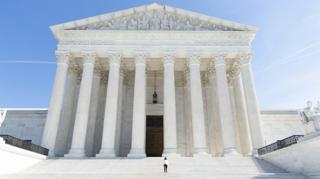
The U.S. Supreme Court indicated on Monday that it may recognize the president's authority to control the executive branch, a move that could significantly alter the balance of power within the federal government. During oral arguments in the case of Trump v. Slaughter, justices expressed a favorable view toward the Trump administration's stance on the president's ability to remove members of independent agencies, specifically regarding the firing of Federal Trade Commission member Rebecca Slaughter.
The core issue at stake is whether the Supreme Court will overturn the 1935 precedent set by Humphrey’s Executor v. U.S., which established limitations on presidential removal powers. U.S. Solicitor General John Sauer argued that the precedent infringes upon the president's constitutional authority, advocating for a doctrine known as the unitary executive theory, which asserts that the president has absolute control over the executive branch.
Sauer described Humphrey’s as a “decaying husk” that threatens the constitutional structure and the liberty of the American people. He cited a previous ruling, Seila Law LLC v. Consumer Financial Protection Bureau, which suggested that the expansion of the federal bureaucracy necessitates a strong presidential oversight of the executive branch.
Diverging Opinions Among Justices
While the court's Republican appointees appeared supportive of Sauer's arguments, the Democratic appointees expressed concerns about the implications of such a ruling. Justices Sonia Sotomayor and Elena Kagan raised alarms about the potential for excessive presidential power over bureaucratic rulemaking. Kagan specifically questioned the extent of authority that presidents would wield if the court adopted Sauer’s theory.
Justice Ketanji Brown Jackson emphasized the importance of having issues managed by experts rather than concentrating power in a single individual. She argued that too much power in the hands of one person could undermine the public interest. In contrast, Agarwal maintained that the president's duty to execute the law does not equate to having the authority to violate it at will.
Arguments for and Against
Agarwal, representing Slaughter, contended that the president's removal of Slaughter was unlawful, asserting that multi-member commissions have historically enjoyed some form of removal protection. He argued, "No tool of interpretation clearly supports the president’s assertion of an unrestricted and indefeasible authority to fire the heads of traditional independent agencies."
The justices questioned Agarwal's claims, with Justice Samuel Alito challenging him to clarify the limits of his argument regarding presidential removal authority. Alito posed hypothetical scenarios about cabinet-level departments being led by multi-member commissions that are not subject to presidential removal, suggesting that such a structure could disrupt governance.
Agarwal acknowledged that many executive departments possess significant authority, but he did not categorically rule out the possibility of Congress and the president collaborating to establish multi-member bodies for certain functions. He stated, "I don’t think that you should categorically rule out that possibility as a matter of constitutional law."
Implications of the Court's Decision
The court's conservative justices, including Amy Coney Barrett and Brett Kavanaugh, expressed skepticism about Agarwal's position. Barrett pointed out the lack of historical support for his argument, while Kavanaugh raised concerns about the potential for independent agency commissioners to undermine future presidents' authority.
Kavanaugh warned that if a political party controlled both the White House and Congress, it could create new independent agencies to thwart the will of opposing presidents. He stated, "I don’t think we can just say, ‘Oh, that hasn’t happened, so it’ll never happen.’"
The justices' deliberations reflect a significant moment in the ongoing debate over the extent of presidential power and the role of independent agencies in the federal government. A decision in Trump v. Slaughter is expected sometime next year, which could redefine the relationship between the presidency and independent regulatory bodies.