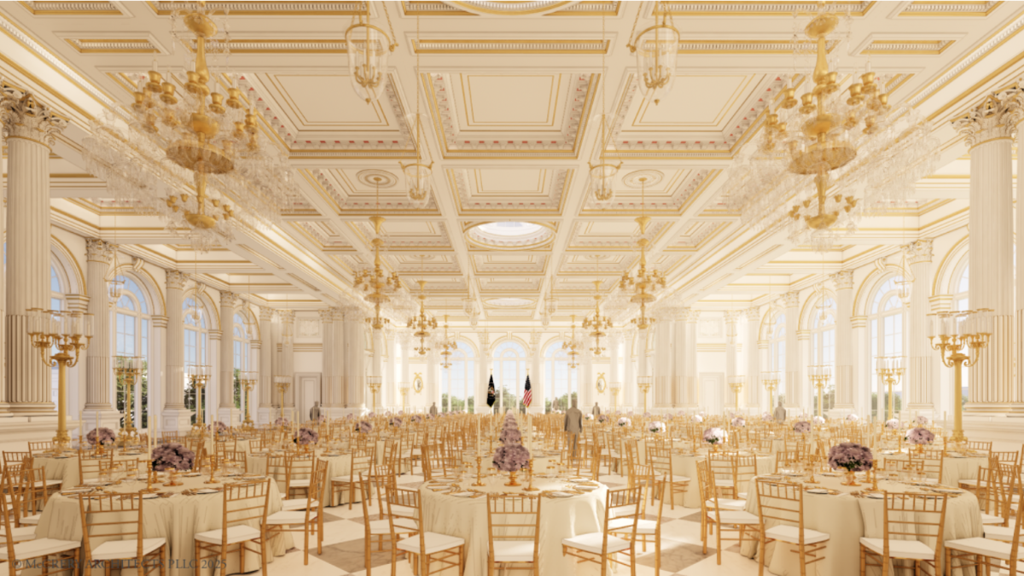
The White House, often referred to as the People’s House, has faced limitations in hosting large events due to its capacity constraints. The East Room can accommodate only 200 guests, a situation that has persisted for over 150 years, according to the Trump administration. In response, former President Donald Trump is utilizing approximately $300 million in private funding to modernize the White House, a move that has sparked significant backlash from some left-leaning critics.
The planned renovations include a complete modernization and rebuilding of the East Wing, alongside the construction of a new ballroom that will span 90,000 square feet and accommodate up to 650 guests. Critics have expressed their discontent, with some going so far as to compare the renovation to the tragic events of September 11, 2001, which claimed nearly 3,000 lives.
On October 23, 2025, a tweet by Mike Lamb highlighted the controversy surrounding the renovations, stating, "The East Wing survived Osama bin Laden's 9/11/2001 attacks. The East Wing has not survived Trump's attack of October 2025."
In a legal challenge, Charles K. Voorhees and Judith A. Voorhees filed a case in the U.S. District Court for the District of Columbia, seeking a temporary restraining order (TRO) to halt the construction. They argue that the White House must first obtain approvals from five oversight entities before proceeding with the renovations. Their demands include submitting final plans to the National Capital Planning Commission (NCPC) and consulting with the Advisory Council on Historic Preservation (ACHP) to ensure compliance with the National Historic Preservation Act (NHPA).
The Voorheeses also seek consultations with the D.C. State Historic Preservation Office (SHPO) and the Commission of Fine Arts (CFA) to review the design and aesthetics of the proposed modifications. This bureaucratic process is reminiscent of the challenges faced by homeowners in historic districts who must navigate complex regulations for even minor renovations.
Critics of the left's legal maneuvering argue that such actions are indicative of a broader trend of obstructionism aimed at hindering progress. Davis Ingle, a White House spokesman, emphasized that Trump possesses the legal authority to modernize the White House, similar to actions taken by previous presidents. Ingle stated, "President Trump has full legal authority to modernize, renovate, and beautify the White House – just like all of his predecessors did."
The ongoing renovations are positioned as an opportunity for the public to engage with the White House in new ways. Unlike previous administrations that undertook projects primarily for personal enjoyment, the Trump administration aims to create spaces that can be utilized by a broader audience, including world leaders and members of the public.
As the legal challenges unfold, the future of the White House renovations remains uncertain. However, the Trump administration continues to assert its commitment to enhancing the People’s House without using taxpayer dollars. The outcome of this dispute may set a precedent for how future administrations approach renovations and expansions of the historic residence.
Beth Brelje, an elections correspondent for The Federalist, has reported extensively on this issue, highlighting the complexities surrounding the renovation process and the political implications of the ongoing legal battles.