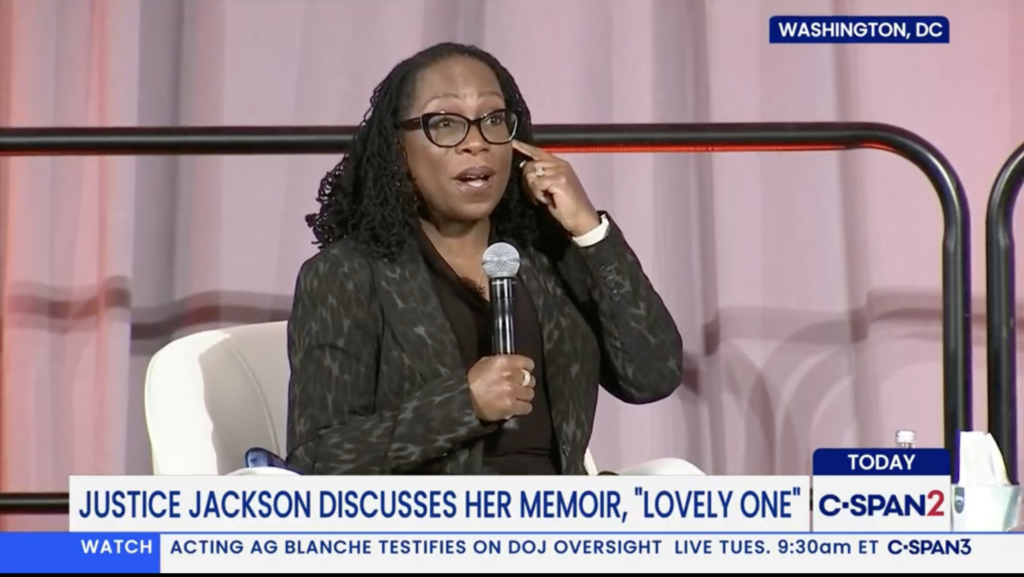
Supreme Court Justice Ketanji Brown Jackson stated it is a "legitimate question" whether lower court judges should defy the Supreme Court's emergency orders, raising concerns about judicial compliance with high court directives. Jackson's remarks came during an interview with U.S. District Judge Richard Gergel at the American Law Institute earlier this month, where he expressed confusion over how to reconcile brief emergency decisions with longstanding Supreme Court precedent.
The core tension lies in the balance between judicial independence and adherence to the Supreme Court's authority, particularly when emergency rulings appear to contradict established legal principles. Jackson's comments have sparked debate over the role of lower courts in interpreting and applying Supreme Court decisions, especially in cases where those decisions may seem abrupt or lacking in detailed rationale.
During the interview, Gergel noted the perplexity faced by district judges when confronted with emergency docket decisions that may countermand decades of precedent. He asked, "Are we to apply the brief, the short stay decision, or denial of stay? Or are we to follow 50 years of precedent?" Jackson agreed, stating, "It’s absolutely a legitimate question and a legitimate concern."
Context of Emergency Orders
Jackson's remarks come in the wake of a recent Supreme Court ruling in Louisiana v. Callais, where the court determined that Section 2 of the Voting Rights Act does not compel states to create majority-minority districts. The ruling, which was decided 6-3, found that Louisiana's congressional map was an unconstitutional racial gerrymander. Following this decision, the Supreme Court issued an 8-1 order to expedite the transmission of its ruling to lower courts, allowing Louisiana to implement new congressional maps mid-election cycle.
In her dissent regarding the expedited order, Jackson criticized the Supreme Court's actions, claiming they "have spawned chaos in the State of Louisiana." She argued that the court's decision to influence the implementation of its ruling undermines judicial restraint, stating, "The Court unshackles itself from both constraints today and dives into the fray."
Responses from the Court
Justice Samuel Alito, joined by Justices Clarence Thomas and Neil Gorsuch, responded to Jackson's dissent, asserting that her position would necessitate holding the 2026 congressional elections under a map deemed unconstitutional. Alito characterized Jackson's dissent as offering a "trivial" reason for her stance and described her claims of the court appearing partial as "baseless and insulting."
Alito emphasized that Jackson's insistence on strict adherence to procedural norms could create the appearance of partiality, particularly if it delays necessary changes to electoral maps. He stated, "What principle has the Court violated? The principle that Rule 45.3’s 32-day default period should never be shortened even when there is good reason to do so?"
Implications for Judicial Authority
Jackson's comments and dissent have raised questions about the authority of lower courts in light of Supreme Court decisions, particularly in emergency situations. Critics argue that her remarks may reflect a misunderstanding of the judicial hierarchy, where lower courts are traditionally bound to follow the Supreme Court's guidance, including emergency orders.
Supporters of Jackson's perspective argue that her concerns highlight the complexities judges face when navigating between established precedent and the Supreme Court's evolving interpretations. However, some legal experts caution that questioning the legitimacy of emergency orders could undermine the stability of judicial authority and the rule of law.
As the debate continues, it remains to be seen how Jackson's views will influence future discussions on the role of lower courts in relation to the Supreme Court's emergency decisions.