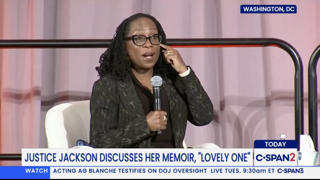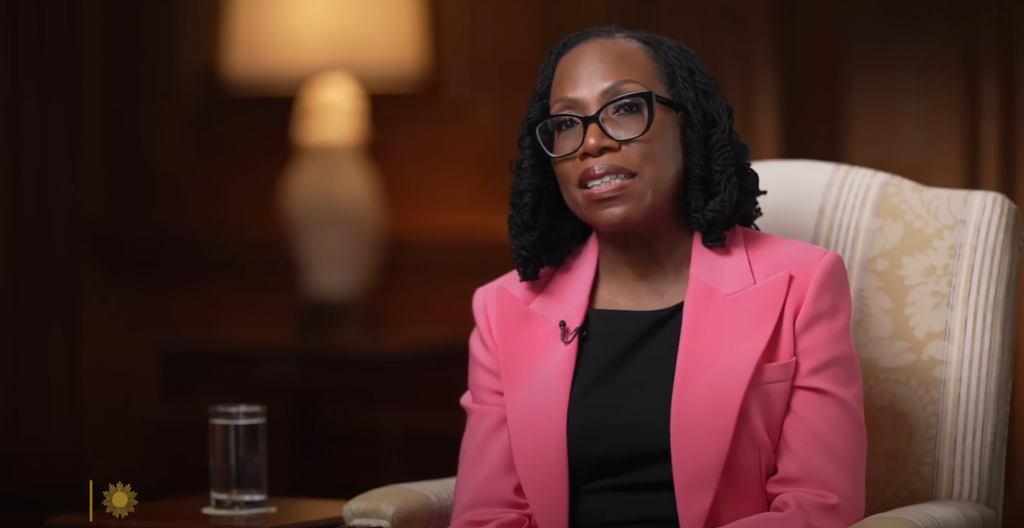
During oral arguments for a significant case regarding race-based gerrymandering, Justice Ketanji Brown Jackson, appointed by Democrats, suggested that race should be considered in congressional district drawings because black individuals are systemically 'disabled' in terms of access to voting systems.
Jackson compared the redistricting cases, Louisiana v. Callais and Robinson v. Callais, to accessibility issues under the Americans with Disabilities Act, implying that minorities, particularly black individuals, face systemic barriers to voting. She argued that this situation mirrors the challenges faced by disabled individuals in accessing buildings.
'Congress passed the Americans with Disabilities Act against the backdrop of a world that was generally not accessible to people with disabilities, and so it was discriminatory in effect because these folks were not able to access these buildings,' Jackson stated. She maintained that the intent behind such discrimination is irrelevant.
'I guess I don’t understand why that’s not what’s happening here. … We are responding to current-day manifestations of past and present decisions that disadvantage minorities and make it so that they don’t have equal access to the voting system, right? They’re disabled. … We say that’s a way in which you see that these processes are not equally open,' she added.
The case examines potential violations of the 14th Amendment concerning a congressional district map in Louisiana. According to reports, the origins of the case trace back to 2022 when the Louisiana Legislature created a congressional map with only one black-majority district. This prompted a lawsuit from plaintiffs represented by groups such as the ACLU, who claimed the map violated Section 2 of the 1965 Voting Rights Act by diluting black voting strength.
After a district court judge issued an injunction against the map's implementation, further litigation led to the state redrawing the map to include a second black-majority district. This resulted in another lawsuit from a different group of plaintiffs, asserting that the state had unlawfully prioritized race in the map's creation, violating the 14th Amendment's equal protection clause.
The Supreme Court was initially set to decide the case during its 2024-2025 term but announced in June that it would rehear the case this fall.
During the recent oral arguments, counsel for Louisiana argued that 'race-based redistricting is fundamentally contrary to our Constitution,' suggesting it relies on 'racial stereotypes' that assume a black voter shares the same interests as other black voters.
Janai Nelson, representing the second majority-black district, contended that several lower court judges had recognized discriminatory practices in Louisiana’s maps. She argued that 'Louisiana’s creation of a district to remedy that discrimination and to ensure that black Louisianans have an equal opportunity to participate in the process is constitutional.'
Notably, Nelson, who serves as president and director-counsel of the NAACP Legal Defense and Educational Fund, Inc., referred to the late Assata Shakur, a convicted cop killer and FBI’s most wanted terrorist, as a 'freedom fighter' and an 'example of undaunted resistance and resilience.'