Sen. John Cornyn, R-Texas, who recently lost his party's primary to Attorney General Ken Paxton, has come under fire for blocking the nomination of T. Elliot Gaiser to a federal district court in Texas. Cornyn employed the Senate's blue slip process, a long-standing tradition that allows home-state senators to approve or block judicial nominees, to halt Gaiser's confirmation. This move comes as Republicans face a narrowing window to confirm President Donald Trump's nominees before Democrats are set to take control of the Senate.
Explainer Attorney General Ken Paxton’s Legal Impact on Texas Policies and Public Safety
Cornyn's actions have deepened divisions within the Texas Republican Party. Critics argue that by blocking Trump-backed nominees, Cornyn is undermining the party's ability to advance conservative priorities in the final weeks of GOP Senate control. The controversy highlights the internal rifts that have emerged following Cornyn's primary defeat.
Cornyn was defeated in the Republican primary by Paxton by a margin of roughly 28 points, according to reporting from The Federalist and NPR's coverage of the primary results. The loss followed President Trump's endorsement of Paxton, which bypassed Cornyn and shifted the race's momentum. After the primary, Cornyn reportedly withdrew support for several Trump-backed initiatives and nominees, including the SAVE America Act and the confirmation of Todd Blanche as attorney general.
Blocking Judicial and Executive Nominees
Cornyn's use of the blue slip process to halt Gaiser's nomination has drawn criticism from within his own party. Many Texas Republicans see the move as an obstruction of the Trump administration's agenda. According to The Federalist, Cornyn, along with Sen. Thom Tillis, R-N.C., also opposed the confirmation of Todd Blanche as attorney general. The report alleges that Cornyn and Tillis sought the removal of an anti-weaponization fund in exchange for their support of Blanche's nomination.
Further allegations from The Federalist claim that Cornyn demanded $1 billion in foreign aid to Africa in return for not blocking the nominations of Kari Lake and Doug Mastriano for ambassadorships. Cornyn's office has not publicly addressed these claims, and no official statements have been released regarding the alleged negotiations.
"he basically is not offering a very compelling case for his election."
— John Cornyn, U.S. Senator
Shifting Positions After Primary Loss
Following his primary defeat, Cornyn ended efforts to rename U.S.-287 as "Interstate 47" or "Trump Interstate," a bill he had introduced to honor President Trump. According to the bill summary, the legislation sought to designate nearly 1,800 miles of highway from Texas to Montana as I-47, with the aim of advancing economic growth and honoring Trump's legacy. The initiative was dropped after Cornyn's loss in the primary.
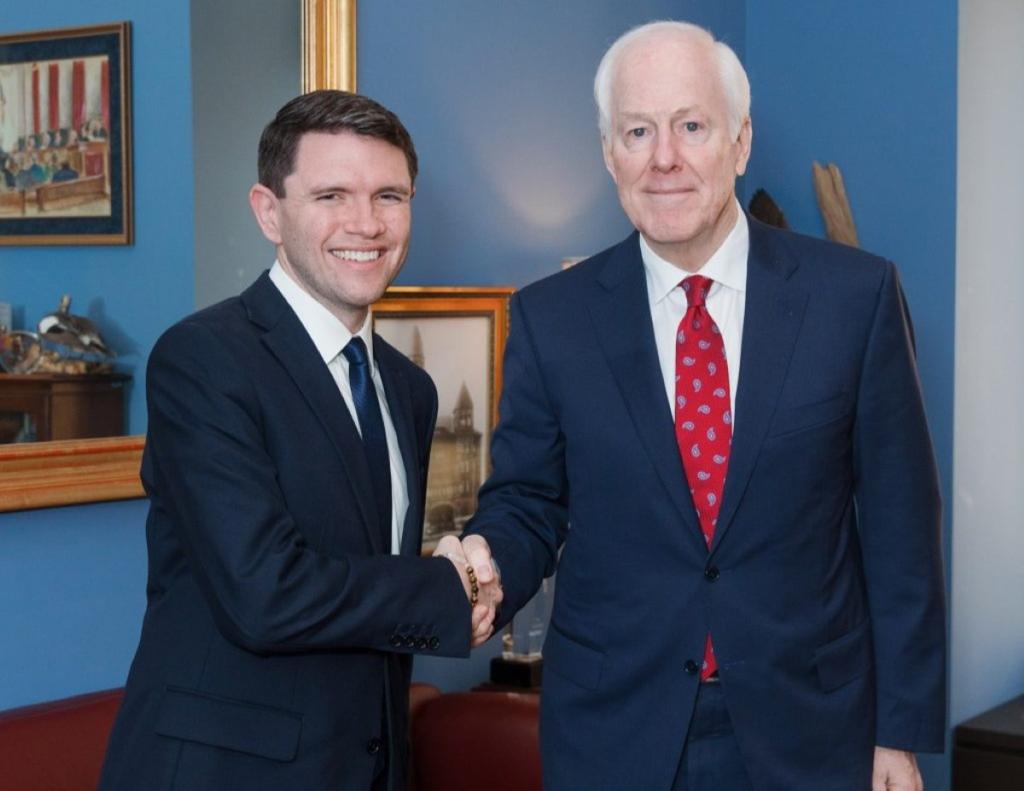
Cornyn also publicly criticized Paxton, calling him "lazy" and a "poor campaigner." Despite the harsh words, Cornyn congratulated Democratic Sen.-elect James Talarico and stated he looked forward to assisting with the transition. Cornyn's office released a photo of his meeting with Talarico to discuss transition plans, signaling a willingness to work across party lines during the upcoming change in Senate representation.
Cornyn’s Public Statements and Party Critique
In a recent op-ed for The Wall Street Journal, Cornyn attributed Republican losses in Texas and nationally to what he described as "obsessing over 'RINOs' and political theater" and "hyperaggressive immigration enforcement." He argued that the party's focus on divisive issues and personal scandals has alienated voters, and called for a return to coalition-building and the selection of more broadly appealing candidates.
Cornyn has a history of supporting bipartisan measures, including a gun control package passed in 2022. He has also advocated for expanding the H-1B visa program, supported legal status for DACA recipients, and voted in favor of increased aid to Ukraine. These positions have drawn criticism from some conservatives, who argue that Cornyn's stances are out of step with the party's base.
What the I-47 Future Interstate Act Proposed
The I-47 Future Interstate Act, introduced by Cornyn, would have designated US-287 as Interstate 47, also known as Trump Interstate. The bill stated, "Texas is Trump Country, and this bill cements that legacy by designating nearly 1,800 miles of open-road from Texas’ Gulf Coast to the edge of the U.S.-Canadian border as I-47 to forever be remembered as Trump Interstate." The legislation cited economic and safety benefits, including an estimated $5.4 billion in travel cost savings and a projected 46,885 increase in jobs by 2050, based on a Texas Department of Transportation study.
Despite the controversy, Cornyn's supporters have not publicly responded to the recent criticisms. His office has also not addressed the allegations regarding nominee negotiations or foreign aid demands. As Cornyn prepares to leave office, the debate over his legacy and his recent actions continues to shape the conversation within the Texas GOP and the broader Republican Party.