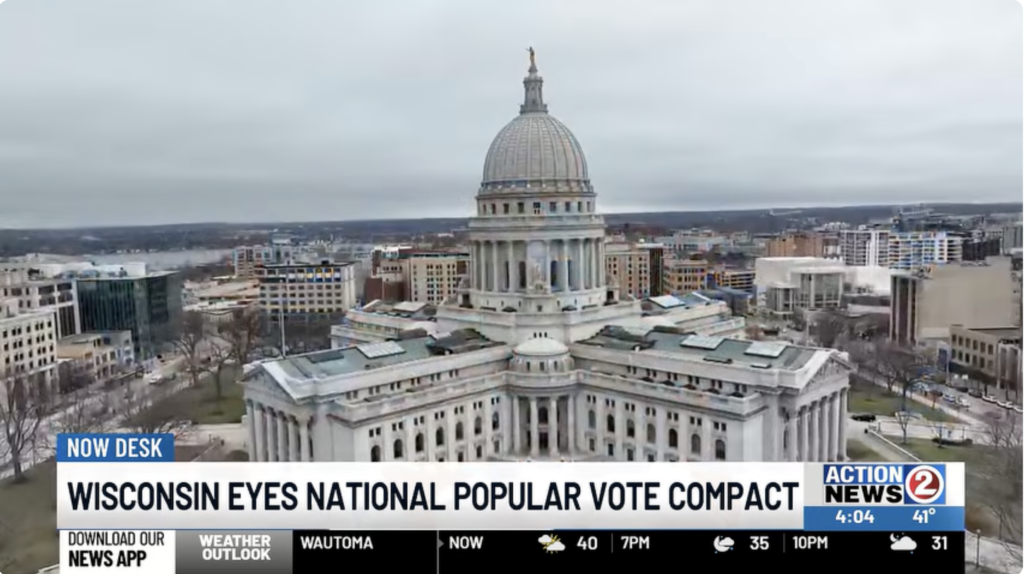
Democratic leaders in several battleground states are preparing legislation to join the National Popular Vote Interstate Compact (NPVIC), a move that would commit their states' electoral votes to the winner of the national popular vote and could fundamentally alter the presidential election system in the United States.
Explainer Election Integrity in Pennsylvania: Challenges, Legal Battles, and Reform Imperatives
The push to expand the compact has intensified following recent Democratic victories that secured control of legislatures and governorships in states considered critical to reaching the 270 electoral vote threshold required for the agreement to take effect. The NPVIC, which has been under discussion for more than two decades, aims to bypass the traditional Electoral College system by having participating states pledge their electoral votes to the candidate who wins the national popular vote, regardless of the outcome within their own state.
According to the National Conference of State Legislatures, 18 states and the District of Columbia have already enacted NPVIC legislation. Together, these jurisdictions account for 222 electoral votes. The compact will only take effect once states totaling at least 270 electoral votes—the minimum needed to win the presidency—have joined. Recent Democratic gains in states such as Pennsylvania, Michigan, Wisconsin, and Nevada have brought the compact within striking distance of this majority, raising the prospect of a significant shift in how presidential elections are decided.
State Leaders Signal Support
Support for the NPVIC among Democratic leaders has become more vocal in recent months. Pennsylvania Governor Josh Shapiro, a Democrat, has publicly endorsed the national popular vote approach. Speaking on the "Pod Save America" podcast, Shapiro said he believes "the national popular vote makes sense" and that he will work with lawmakers to determine the best path forward for Pennsylvania. In Nevada, newly elected Governor Aaron Ford told KOLO 8 that after further research, he now supports joining the compact, signaling a potential shift in the state's approach to presidential elections.
In Arizona, incoming Senate Majority Leader Priya Sundareshan told Politico that her caucus is prepared to move forward with NPVIC legislation, emphasizing that the effort aligns with campaign priorities and the desire to reflect the will of the national electorate. Wisconsin has also seen renewed interest in the compact. State Senator Kelda Roys said in a 2023 press release that the NPVIC would "make every vote equal, and ensure that the candidate who earns the most votes wins." Roys, along with Representative Clinton Anderson, has announced plans to prioritize joining the compact following their party's recent electoral gains in the state.
These developments reflect a broader trend among Democratic-controlled states to reconsider their approach to allocating electoral votes. Proponents argue that the current system, in which most states award all their electoral votes to the statewide winner, can result in a president being elected without winning the national popular vote. Supporters of the NPVIC contend that the compact would ensure the presidency goes to the candidate who receives the most votes nationwide, making every vote count equally regardless of state.
Criticism and Legal Uncertainty
Despite growing support among Democrats, the NPVIC faces significant criticism and legal uncertainty. Opponents argue that the compact undermines the constitutional structure of presidential elections. Jason Snead, Executive Director of the Honest Elections Project, warned, "We are playing with fire," describing the NPVIC as an attempt to "end run around the Constitution to essentially nullify the Electoral College and to transfer the power to decide the presidency from the swing states to the blue states."
Akhil Reed Amar, Sterling Professor of Law and Political Science at Yale University and an early proponent of the national popular vote concept, has recently expressed concerns about the compact. Amar cautioned that the NPVIC could "backfire big time" and noted that it lacks bipartisan support, as few Republican-led states have joined. He also highlighted the risk of inconsistent election rules across states, which could intensify partisan competition and create confusion. "There could be chaos," Amar warned, pointing to the potential for disputes and legal challenges if the compact is activated without broad consensus.
Some critics also argue that eliminating the Electoral College would reduce attention to smaller or less populous states. Former Wisconsin Governor Jim Doyle, a Democrat, warned that if the Electoral College were eliminated, "nobody would spend any time in Wisconsin. They’d be in California, Texas, New York and Florida full time," suggesting that the interests of smaller states could be overlooked in a national popular vote system.
Legal and Constitutional Challenges Ahead
Legal scholars remain divided on whether the NPVIC is constitutional. Patrick C. Valencia, writing in the Harvard Law School Journal on Legislation, argued that the compact is "unconstitutional and completely against the Framers’ intent," describing it as a "constitutional crisis-in-waiting." Critics contend that the agreement effectively circumvents the constitutional amendment process required to change the method of electing the president.
Proponents of the compact, however, cite Article II, Section 1 of the Constitution as the legal basis for states to allocate their electoral votes as they choose. This section grants state legislatures the authority to determine how their electors are appointed, and supporters argue that the NPVIC is consistent with this constitutional provision. (For more, see: https://constitution.congress.gov/browse/article-2/section-1)
Jason Snead of the Honest Elections Project predicted that if the compact reaches the 270-vote threshold, it will face immediate legal challenges, with no certainty about how courts, including the Supreme Court, will rule. The outcome of such challenges could have far-reaching implications for the future of presidential elections in the United States.
As of now, the compact remains short of activation, but Democratic leaders in key states have signaled that advancing the NPVIC will be a legislative priority in the coming year. The debate over the compact reflects broader questions about the balance between state and national interests, the role of the Electoral College, and the evolving nature of American democracy. Whether the NPVIC ultimately succeeds or faces insurmountable legal obstacles, the effort has already sparked a nationwide conversation about how the country chooses its president.
For a historical overview of the Electoral College, see: https://www.archives.gov/electoral-college/history