Cole Tomas Allen, 31, now faces an additional federal charge of terrorism while armed in connection with the attempted first-degree murder of President Donald Trump at the White House Correspondents’ Association Dinner. This new charge was revealed in a superseding indictment unsealed Thursday in U.S. District Court, intensifying the legal consequences Allen could face if convicted.
The terrorism charge adds to a series of serious federal counts already pending against Allen. These include attempting to assassinate the president, assaulting a federal officer or employee with a deadly weapon, transporting a firearm and ammunition across state lines with intent to commit a felony, and discharging a firearm during a crime of violence. Prosecutors say that if Allen is convicted of the terrorism charge, he could receive a maximum sentence of life in prison.
Details of the Incident
The shooting took place on April 25 at the Washington Hilton, the site of the annual White House Correspondents’ Association Dinner. This event is a major gathering that draws the sitting president, members of the press, and public officials from across the country. Security at the dinner is typically extensive, with the Secret Service and other law enforcement agencies coordinating to protect attendees.
According to prosecutors, the incident began shortly after 8:30 p.m., when Allen ran through a magnetometer at a Secret Service checkpoint located on the hotel’s Terrace Level. He then moved toward a set of stairs leading to the ballroom, where President Trump and hundreds of guests were present. Allen allegedly fired a 12-gauge shotgun, striking a Secret Service officer in the chest. The officer, who was wearing body armor, returned fire, discharging five shots at Allen. Allen was not struck by the gunfire but fell and was immediately restrained by law enforcement officers. He reportedly suffered a minor knee injury during the altercation.
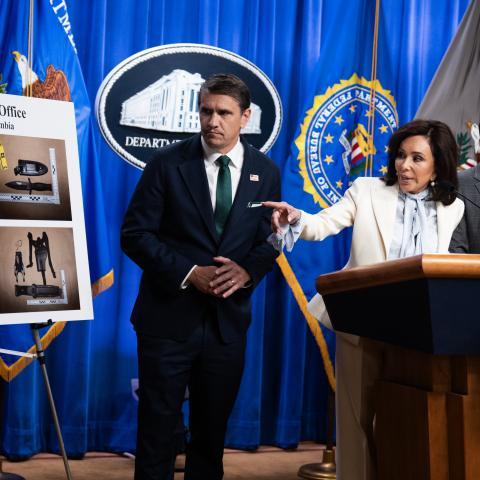
When Allen was arrested, authorities found him in possession of a shotgun with a spent cartridge, a .38-caliber pistol, additional ammunition, two knives, four daggers, holsters, sheaths, needle-nose pliers, and wire cutters. These items were recovered at the scene and catalogued as evidence by investigators.
Charges and Legal Proceedings
The superseding indictment, announced by U.S. Attorney Jeanine Ferris Pirro, formally adds the terrorism charge to Allen’s list of alleged offenses. The terrorism count specifically relates to the alleged attempted first-degree murder of President Trump, elevating the seriousness of the case. Allen’s previous charges already included attempting to assassinate the president and assaulting a federal officer with a deadly weapon, among others.
"Allen faces a maximum penalty of life in prison, if convicted."
— U.S. Attorney Jeanine Ferris Pirro
The case is being prosecuted in U.S. District Court. As of Thursday, Allen had not entered a plea on the new terrorism charge. The Secret Service officer who was shot during the incident survived and was treated for injuries. No other attendees at the dinner were reported injured as a result of the shooting.
Context and Response
The White House Correspondents’ Association Dinner is one of the most high-profile events in Washington, D.C., known for bringing together journalists, government officials, and the president. Security at the dinner is typically tight, given the prominence of the attendees and the potential risks involved. The shooting has renewed public and official attention on the adequacy of protective measures for public figures at such events.
Officials have not publicly commented on whether any changes to security protocols will be implemented as a result of the incident. The Secret Service and other agencies routinely review and update their procedures following security breaches, but no specific adjustments have been announced in this case. Representatives for Allen have not responded to requests for comment regarding the new terrorism charge or the ongoing legal proceedings.
The case against Allen continues to unfold in federal court, with the added terrorism charge underscoring the gravity of the allegations and the potential consequences if he is found guilty. The outcome of the case may have broader implications for security at high-profile political events in the future.