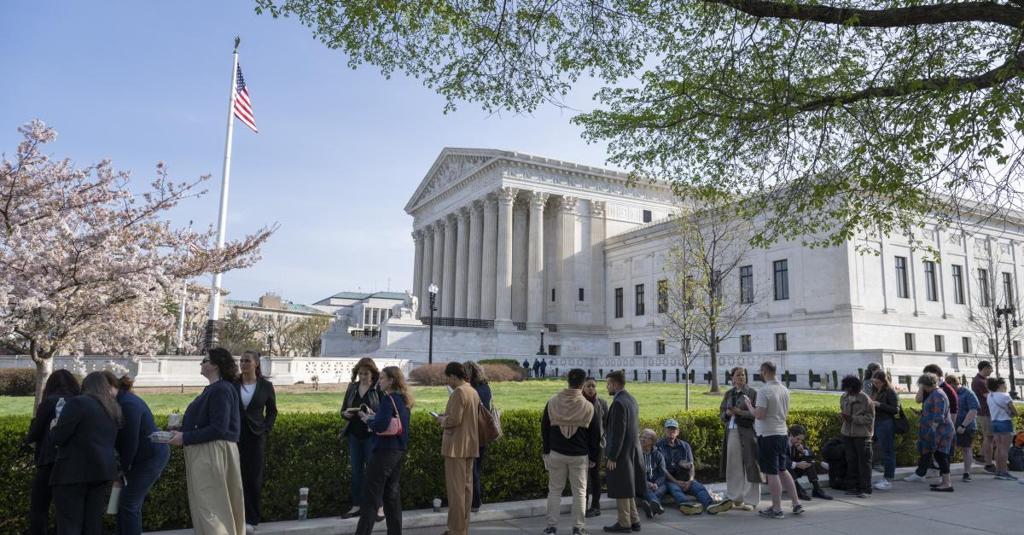
The U.S. Supreme Court is preparing to hear arguments in several high-profile cases that could reshape gun rights, voter registration laws, and jury requirements across the country, according to legal analysts who spoke at The George Washington University Law School’s Supreme Court Preview.
Explainer Election Integrity in America: Safeguarding Voter Trust and Ballot Security
The central issue is whether state bans on semi-automatic weapons in Illinois and Connecticut violate the Second Amendment, a decision that could set a precedent for gun regulation nationwide.
Legal scholars say the consolidated cases, Viramontes v. Cook County and Grant v. Higgins, challenge state laws enacted after mass shootings that prohibit the sale, delivery, manufacture, purchase, and import of semi-automatic firearms, including AR-15s. The outcome is expected to clarify how far states can go in restricting access to such weapons under the Constitution.
Gun Ban Challenges in Illinois and Connecticut
Law professors highlighted that the Supreme Court’s ruling will test the boundaries set by Bruen v. New York Rifle and Pistol Association, which requires lawmakers to justify gun restrictions based on the nation’s history and tradition. Robert Cottrol, a law professor at George Washington University, cited the Militia Act of 1792 as historical precedent, noting it required white men between 18 and 45 to enroll in militias and purchase military-grade weapons.
"I would think that one of the best conditions of what the framers thought of military weapons was not even that they abandoned them, they required them."
— Robert Cottrol, professor of law at George Washington University
Cottrol predicted the court may overturn the Illinois and Connecticut bans but emphasized that the justices’ reasoning will be crucial for future Second Amendment cases. He also noted the National Firearms Act of 1934, which mandates registration of fully-automatic weapons, could complicate the court’s logic if it draws a distinction between semi-automatic and automatic firearms.
Cottrol raised concerns about how the court will address magazine capacity limits, as the current cases do not cover restrictions on large-capacity magazines. He suggested that future litigation will likely address those issues.
Voter Registration Laws Under Review
The Supreme Court will also hear RNC v. Mi Familia Vota, a case challenging Arizona’s requirement that voters provide proof of citizenship in state elections. Federal elections do not require such documentation. Arizona’s law, enacted in 2022, mandates that voters submit specific documents to register for state elections, while a separate federal form does not require proof of citizenship.
Alan Morrision, a lecturer in law at George Washington University, explained that Arizona can remove ineligible voters from its rolls based on state registration data, but federal law bars states from purging voter rolls within 90 days of an election. Morrision said, “They will still be able to look for people who are not citizens but they would have to do it before the start of the 90 days.”
Jury Size Requirements in State Courts
Another case, Kian v. Florida, will determine whether states must use 12-person juries in criminal trials. Florida, along with Arizona, Connecticut, Indiana, Massachusetts, and Utah, currently allows six-member juries for non-death penalty cases. Renee Lerner, a research professor at George Washington University, expects the court to uphold the 12-member jury requirement.
She warned that changing the rule could force states to retry numerous cases, creating significant logistical and financial burdens. Lerner said, “In cases that were decades old, you're asking witnesses to come back to the court. Witnesses have forgotten, they've died, you know, any number of other things. It's hard to assemble evidence again. That would have been a really tricky problem.”
Broader Legal and Political Context
These cases arrive as the Supreme Court continues to interpret the reach of the Second Amendment and voting rights in light of recent rulings. The decisions are expected to influence state and federal policies on firearms, election integrity, and criminal justice procedures. Supporters of the gun bans and voting requirements have not yet publicly responded to the legal analysts’ predictions or the court’s upcoming review.