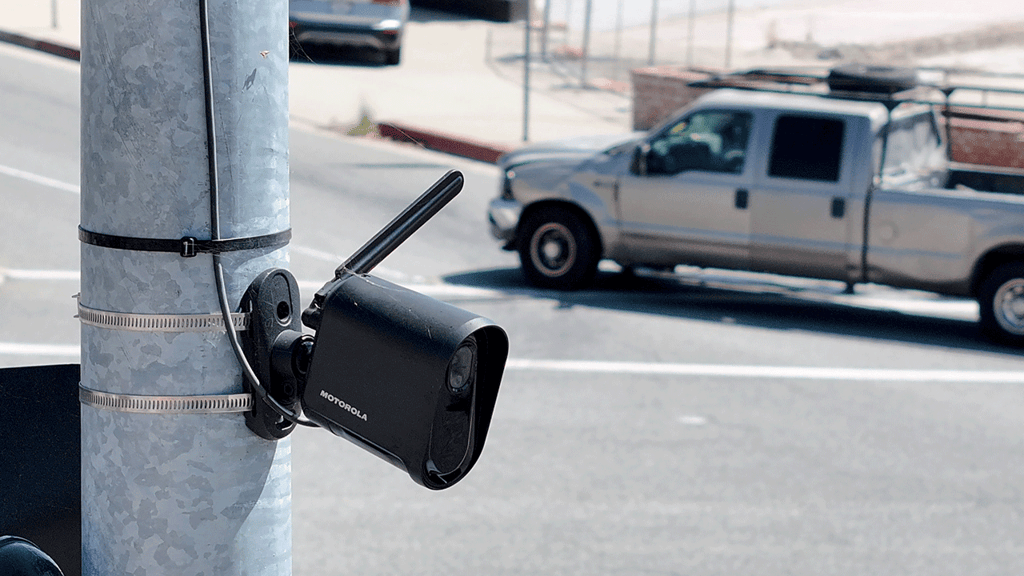
West Virginia Republican lawmakers are intensifying their inquiry into Flock Safety, the nation’s largest automated license plate reader provider, after accusing the company of a pattern of providing inaccurate information to government officials about its data security practices.
Explainer Understanding Public Safety Trends: Crime Declines and Rising Challenges for Law Enforcement
The dispute centers on whether Flock Safety has been transparent about when it began requiring multi-factor authentication for users, a key issue as lawmakers weigh privacy safeguards for the company’s surveillance technology.
The controversy comes as Flock Safety, valued at over $8 billion, faces mounting scrutiny from both state and federal officials over its handling of sensitive data and its communication with public agencies. The company’s license plate readers are promoted as crime-fighting tools but have drawn bipartisan concern about privacy and government surveillance.
Lawmakers Challenge Flock’s Testimony
On Aug. 9, Flock Director of Government Affairs Kevin Kane told the West Virginia House Joint Standing Committee on Government Organization that Flock cameras had never been hacked and that two-step verification had been in place “for a long time.” However, in a letter sent five days later, Delegates Patrick Lucas, Tristan Leavitt, and Ryan Browning questioned the accuracy of Kane’s statements, citing a company blog post that announced multi-factor authentication (MFA) had only recently become mandatory for all users.
The lawmakers wrote to Flock CEO Garrett Langley that the announcement "contradicts sworn testimony" from Kane. During the hearing, Kane said two-factor authentication was a standard practice and had been so for a long time, but later clarified that it had been optional and only recently made mandatory. Flock’s Chief Legal Officer Dan Haley responded that the company always aims to provide "full, complete, and truthful answers" and suggested another meeting to clarify any misunderstandings.
"They keep giving bad information in setting after setting, and people are losing a lot of trust for Flock."
— Tristan Leavitt, West Virginia Delegate
Disputed Security Practices and Federal Attention
The debate over Flock’s security protocols has become a legislative flashpoint. Lawmakers argue that mandatory two-step verification is essential to prevent unauthorized access and potential abuse of surveillance data. The issue has drawn attention beyond West Virginia. In November, U.S. Sen. Ron Wyden and Rep. Raja Krishnamoorthi called on the Federal Trade Commission to investigate Flock Safety, alleging the company failed to require local police to use multi-factor authentication for accessing its system, as detailed in their public letter.
Flock’s spokesperson stated the company "has addressed the questions raised by West Virginia lawmakers and is offering to meet with them again," emphasizing its commitment to transparency and constructive engagement with the legislature.
Allegations of Misleading Statements
The West Virginia lawmakers’ concerns are not isolated. Their correspondence cites several instances where Flock allegedly provided misleading or incomplete information to public officials in other states. In April, a Flock representative told the Oshkosh, Wisconsin, City Council that its cameras did not create heat maps to track vehicles, but law enforcement later contradicted this, leading the council to rescind a contract renewal. In March, Kane testified before Connecticut lawmakers that Flock had never received a data-sharing request from a federal agency, but a subsequent company blog post acknowledged limited pilot programs with U.S. Customs and Border Protection and Homeland Security Investigations.
Haley, in a Sept. 1 letter to the West Virginia lawmakers, argued that there is a "meaningful difference" between optional and mandatory security controls, and between limited pilot access and formal data-sharing agreements with federal agencies. He maintained that Flock’s statements were not contradictory but reflected evolving practices and distinctions in data access arrangements.
Next Steps for Oversight
The three West Virginia delegates have given Flock a deadline of Sept. 17 to provide further information or face a subpoena. Delegate Leavitt said the legislature will consider new "guardrails" for Flock cameras during the regular session early next year. Flock has indicated its willingness to continue discussions and clarify its practices.
The outcome of this inquiry could influence how state and federal lawmakers approach oversight of surveillance technology providers and the privacy protections required for their deployment.