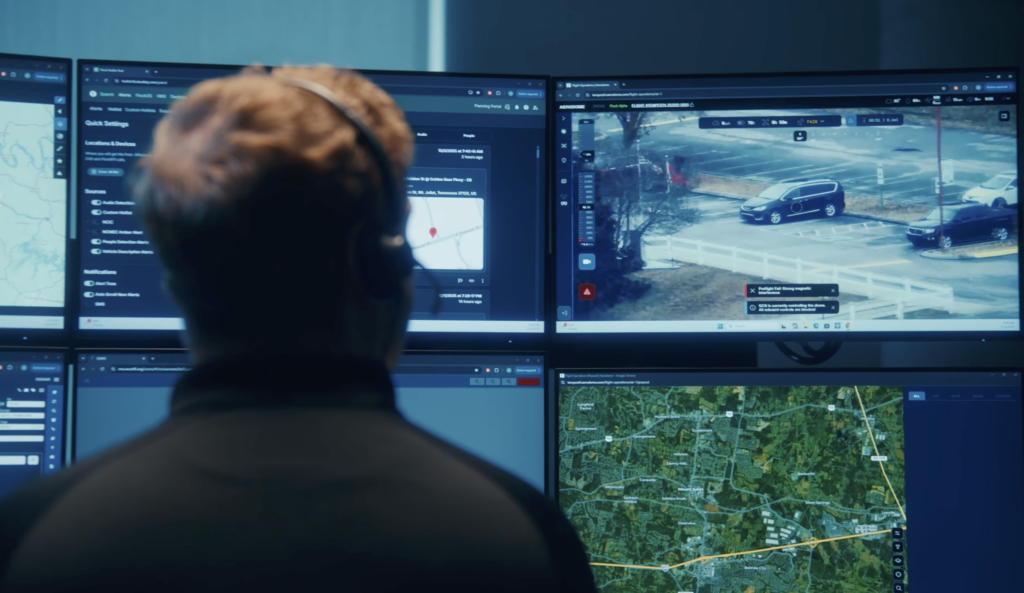
Police departments across the United States, including the California Highway Patrol (CHP), are conducting over a million monthly searches of Flock Safety surveillance cameras installed in Elm Grove, Wisconsin, according to public records obtained by the Wisconsin Institute for Law and Liberty.
Explainer Understanding Public Safety Trends: Crime Declines and Rising Challenges for Law Enforcement
The widespread use of automated license plate readers and AI-powered surveillance tools has sparked debate over privacy rights and the scope of law enforcement access to location data.
Elm Grove, a village of about 6,500 residents near Milwaukee, installed six Flock cameras to monitor local streets. While local officers reportedly use the system only a few dozen times each month for minor infractions, audit logs show that the vast majority of searches—often exceeding a million monthly—originate from outside agencies.
Nationwide Police Searches
Records indicate that once an Elm Grove officer conducts a national search, reciprocal access is triggered, allowing thousands of agencies nationwide to include Elm Grove’s camera feeds in their own searches. The audit logs show that CHP is the most frequent user, running approximately 50,000 nationwide searches per month through the Flock network. The FBI follows with about 20,000 monthly searches, while agencies such as Louisville Metro PD, the Hillsborough County Sheriff’s Office in Florida, the Texas Department of Public Safety, and the Michigan State Police each conduct between 13,000 and 16,000 monthly queries.
Most CHP searches reportedly relate to traffic violations, theft, or hit-and-run investigations, but records show searches are sometimes conducted for incidents far removed from Elm Grove, such as crimes on the Pacific Coast Highway. Other agencies often cite vague reasons for their searches, with over 50,000 monthly queries labeled as “other,” “investigation,” or “not applicable.”
Unusual and Unregulated Use
Audit logs from July 2026 detail a range of unconventional uses. Indianapolis Police ran 70 nationwide searches to monitor attendees at the funeral of rapper “Lil E.” Hanover County, North Carolina, Police conducted 385 searches for a “K9 investigation.” Other examples include searches for homemade fireworks sales, stolen funeral home gurneys, and illegal casinos. Harrison County, Texas, reportedly ran 28 searches for a stolen lawn mower, despite no evidence the item was in Elm Grove.
Flock Safety CEO Garrett Langley described law enforcement’s use of the system as “addicted,” noting the platform’s ability to track vehicles nationwide, review up to 30 days of movement history, and predict future travel patterns. Department policies typically permit searches for “official use” or “law enforcement purposes,” but critics argue these standards lack sufficient oversight.
"Flock is a precise nationwide surveillance tool. With a click, police can track anyone nationwide, see up to 30 days of past movements, and predict future ones."
— Garrett Langley, Flock Safety CEO
Legal and Constitutional Challenges
The expansion of police access to private surveillance networks has drawn legal scrutiny. In June 2026, the Supreme Court ruled that police searches of Google’s Location History constitute a Fourth Amendment search, requiring a warrant. The Institute for Justice is currently litigating two cases related to Flock systems in Norfolk, Virginia, and San Jose, California. Meanwhile, the Wisconsin Institute for Law and Liberty has filed a lawsuit against a dozen Waukesha County agencies, alleging warrantless searches of the Flock database.
Dan Lennington, Vice President and Deputy Counsel at the Wisconsin Institute for Law and Liberty, argued that police should be required to obtain warrants before accessing such comprehensive surveillance data. "When a company builds a virtual panopticon, police should need a warrant to search it," Lennington wrote.
Supporters of Flock’s technology and law enforcement agencies have not publicly addressed the recent criticism or the ongoing lawsuits. Flock Safety has promoted its AI-powered tools as a means to help agencies solve crimes more efficiently, as reported by Police1.
Broader Context and What’s Next
The use of Flock Safety’s AI-driven surveillance tools has rapidly expanded, with over 120,000 cameras deployed nationwide in government, commercial, and residential settings. The debate over balancing public safety and privacy rights is intensifying as law enforcement agencies increasingly rely on automated data collection and analysis. Courts are expected to play a central role in determining the legal boundaries for police use of such technology, with several high-profile cases pending.