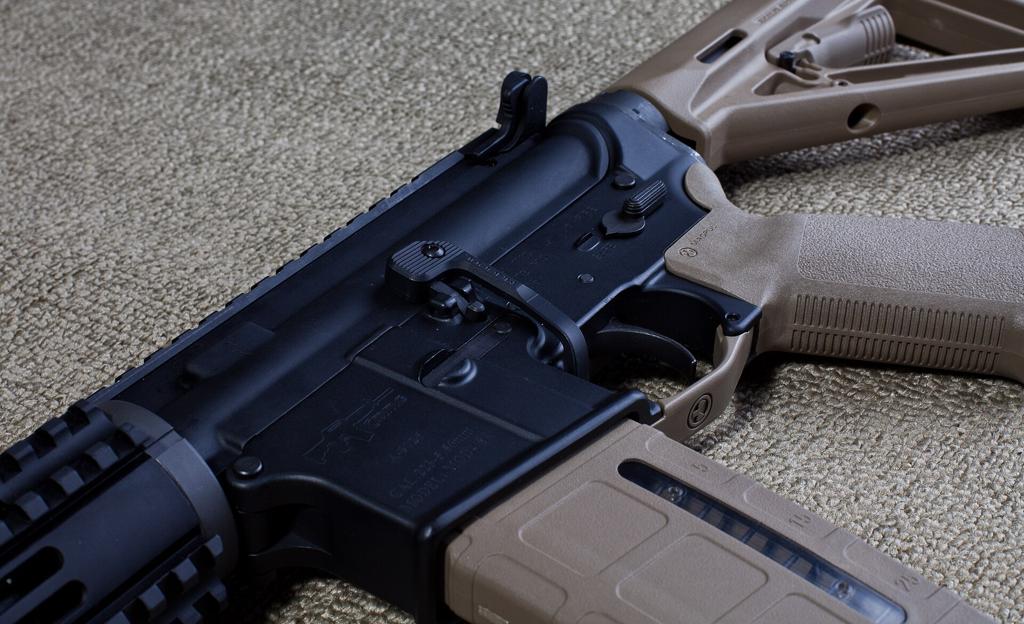
The Supreme Court is set to hear oral arguments next week in two cases challenging bans on AR-15 and similar semiautomatic rifles in Cook County, Illinois, and Connecticut, marking the first time the justices will directly address the constitutionality of such laws.
Explainer Second Amendment Rights and Federal Courts: Balancing Liberty and Regulation
The outcome could determine whether state and local restrictions on popular semiautomatic rifles violate the Second and 14th Amendments, with potential consequences for gun laws nationwide.
The cases, Khaya v. Cook County and Grant v. Higgins, focus on whether Americans have a constitutional right to possess AR-15 platform and similar rifles. The court's decision follows years of debate over so-called "assault weapons" bans, which have been enacted in roughly a dozen states and Washington, D.C., according to Newsweek. The Supreme Court previously declined to hear a challenge to Maryland's law, but several justices signaled interest in revisiting the issue after more lower court rulings.
What the Cases Argue
Petitioners in both cases contend that the bans violate the Second Amendment, citing the Supreme Court's 2022 decision in NYSRPA v. Bruen, which established a two-step test for evaluating gun restrictions. Under Bruen, courts must first determine if the regulated conduct is covered by the Second Amendment's text, and then assess whether the regulation aligns with the nation's historical tradition of firearm regulation. The petitioners' brief argues that AR-15s are "in common use" and not "dangerous and unusual," referencing language from the court's 2008 D.C. v. Heller decision. Petitioners' brief further contends that the bans do not withstand scrutiny under the Bruen framework.
Former Virginia Attorney General Ken Cuccinelli, who filed an amicus brief on behalf of the National Association for Gun Rights and Texas Gun Rights, told The Federalist that the bans are "really not driven by numbers or harm. It's driven by a political agenda that is just anti-gun in general."
"Possession of protected arms has always implied the ammunition and equipment that make them effective, and the governing test is facilitation of the right’s lawful exercise, not ‘necessity.’"
— Amicus brief, National Association for Gun Rights and Texas Gun Rights
The Court’s Scope and Limits
The Supreme Court has agreed to consider only whether the Second and 14th Amendments guarantee the right to possess AR-15 platform and similar semiautomatic rifles. The question of bans on magazines holding more than 10 rounds is not at issue in these cases, as noted in the petitioners' filings. However, Cuccinelli expressed hope that the court might still address the magazine question, though he acknowledged it could be deferred to future litigation.
Michael Williams, general counsel for the American Suppressor Association, said that data on gun-related deaths does not support targeting rifles like the AR-15, pointing to FBI figures showing that handguns are used in the majority of gun-related homicides, while rifles account for a small percentage. Williams argued that efforts to ban AR-15s conflate semiautomatic civilian rifles with military firearms, despite important functional differences.
What to Watch at Oral Arguments
Oral arguments in Khaya v. Cook County and Grant v. Higgins are scheduled for 10 a.m. ET on Dec. 2. Both Cuccinelli and Williams predicted that the court could rule the bans unconstitutional, with Cuccinelli suggesting a possible 6-3 split along ideological lines. He also noted that Justice Elena Kagan could potentially concur in the judgment for institutional reasons, while Justices Sonia Sotomayor and Ketanji Brown Jackson are expected to dissent.
Williams said attention will be on justices who have sometimes sided with the court's center, specifically Justice Brett Kavanaugh and Chief Justice John Roberts. The outcome could clarify the scope of the Second Amendment's protections for semiautomatic rifles and set a precedent for future challenges to similar laws.
Supporters of the bans have argued in lower courts that restricting AR-15s is necessary for public safety, but the Supreme Court's decision will hinge on constitutional interpretation under Bruen and Heller. No statements from Cook County or Connecticut officials were included in the available filings.