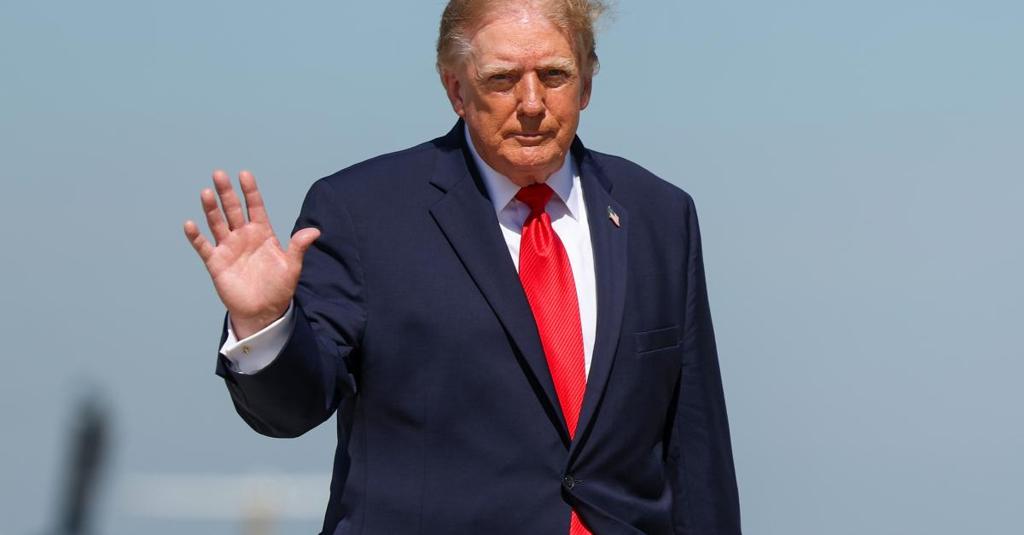
Former President Donald Trump said Thursday that the United States could launch strikes against Iran's Pickaxe Mountain nuclear facility and other nuclear-related sites, but emphasized that any military action would not involve nuclear weapons.
Explainer Understanding Iran's Complex Political Landscape and Global Influence
The comments come as reports indicate the Pentagon is preparing plans that would use the GBU-43/B Massive Ordnance Air Blast Bomb, known as the "mother of all bombs" or MOAB, in potential strikes against Iranian nuclear targets. The MOAB is the largest non-nuclear bomb in the U.S. arsenal and has only been used once in combat, during a 2017 strike against an Islamic State tunnel complex in Afghanistan.
Trump told Newsmax that the MOAB, while powerful, is not a nuclear weapon. He stated, "No, it's not nuclear at all. This is just an extremely large bomb. It's like a tiny nuclear bomb. The mother of all bombs is one big bomb, but it's not nuclear." Trump described the MOAB as an "extremely large bomb" and drew a clear distinction between it and nuclear arms, underscoring that the U.S. would not resort to nuclear weapons in any potential strike on Iran.
Pentagon Strike Planning
Reports preceding Trump's interview said Pentagon officials were considering the MOAB for use against Iran's nuclear infrastructure. The MOAB weighs approximately 21,600 pounds and is typically delivered by a Lockheed C-130 Hercules cargo aircraft. Its use in Afghanistan in April 2017 marked a significant escalation in U.S. conventional military capabilities, demonstrating the bomb's ability to destroy fortified targets and underground facilities.
The Pentagon has not publicly confirmed any specific plans to use the MOAB against Iran, but the consideration of such a weapon signals the seriousness of current military planning. The focus on non-nuclear options reflects ongoing efforts to deter Iran's nuclear ambitions without crossing the threshold into nuclear warfare. Trump confirmed that any U.S. military action would target nuclear facilities but reiterated that nuclear weapons would not be used.
Context and Broader Tensions
The possibility of U.S. strikes on Iranian nuclear sites comes amid ongoing concerns over Iran's nuclear program and its potential to develop nuclear weapons capabilities. The U.S. and its allies have repeatedly warned Iran against advancing its nuclear activities, while Iran maintains its program is for peaceful purposes. Tensions between Washington and Tehran have persisted for years, with periodic escalations over Iran's uranium enrichment and ballistic missile development.
The use of the MOAB in Afghanistan was seen as a demonstration of U.S. conventional firepower and a warning to adversaries about the range of options available to the military. Its consideration for use against Iran's nuclear infrastructure highlights the gravity of the situation and the desire to have credible, non-nuclear deterrent options on the table.
International efforts to limit Iran's nuclear program have included diplomatic negotiations, economic sanctions, and, at times, threats of military action. The 2015 Iran nuclear deal, known as the Joint Comprehensive Plan of Action (JCPOA), placed limits on Iran's nuclear activities in exchange for sanctions relief, but the U.S. withdrew from the agreement in 2018 under Trump's administration. Since then, Iran has gradually reduced its compliance with the deal, leading to renewed concerns about its nuclear intentions.
Responses and Clarifications
Trump's remarks sought to clarify that the U.S. would not escalate to nuclear warfare, despite the scale of the weapon under consideration. He emphasized that the MOAB, while sometimes described as being similar to a small nuclear bomb due to its size and destructive power, is strictly a conventional weapon. There was no immediate response from Iranian officials or the Pentagon regarding the reported plans or Trump's statements.
Supporters of the administration's approach argue that maintaining a credible threat is necessary to deter Iran from advancing its nuclear program. They contend that demonstrating the capability and willingness to use powerful conventional weapons like the MOAB can strengthen diplomatic efforts and reinforce red lines. Critics, however, warn of the risks of military escalation in the region, noting that any strike on Iranian nuclear facilities could provoke retaliation and further destabilize the Middle East.
The situation remains fluid, with U.S. officials continuing to monitor Iran's nuclear activities and evaluate potential responses. The debate over how best to address the challenge posed by Iran's nuclear program is likely to continue, with military options remaining a subject of discussion alongside diplomatic and economic measures.