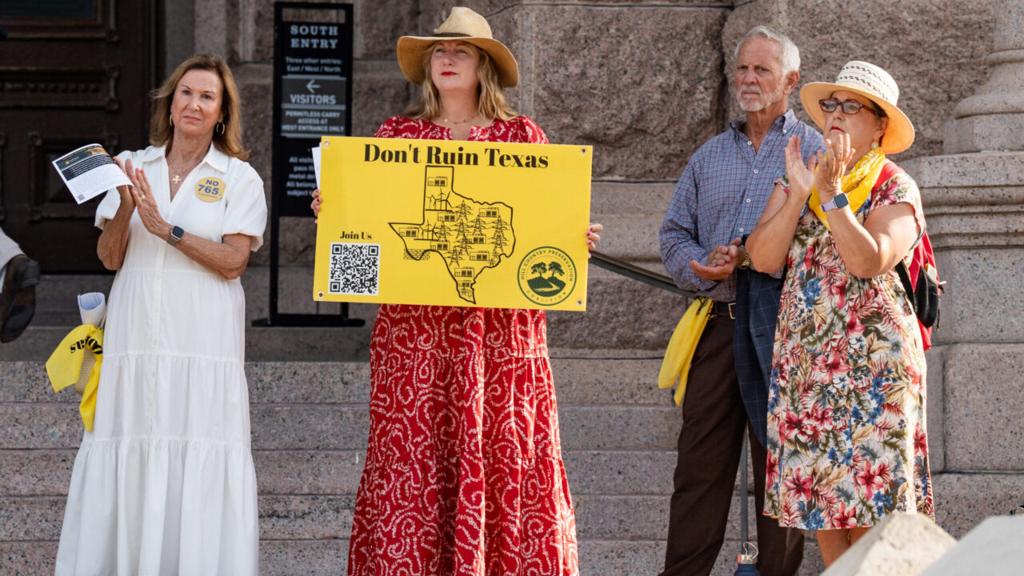
Thousands of data center projects across the United States have been halted or restricted as state and local governments respond to mounting public opposition over their impact on energy grids, water supplies, and utility costs.
Explainer Redistricting Battles: How Maps Shape American Political Power
Americans’ concerns about data centers’ heavy resource consumption have driven lawmakers in states like Texas, Pennsylvania, and New York to impose new limits or outright moratoriums, reflecting a sharp shift in public sentiment and regulatory approach.
The rapid expansion of data centers has become a flashpoint in debates over energy affordability and infrastructure strain, with critics linking the facilities to rising utility bills and grid reliability risks. Local resistance has led more than 530 counties and municipalities to enact bans or restrictions, according to a report by Heatmap.
Texas Moratorium and Industry Response
Texas Governor Greg Abbott, a Republican, issued a sweeping moratorium in early August, halting up to 1,800 data center projects. Abbott said the move was necessary to protect local water supplies and prevent excessive strain on the Texas power grid. "My directive has halted up to 1,800 data center projects. I established guidelines & guardrails to protect Texas communities," Abbott wrote on social media.
"Data centers must not take water needed by local communities, they must not take power needed by the Texas power grid, they must lower the cost..."
— Greg Abbott, Governor of Texas
Abbott’s press secretary, Andrew Mahaleris, stated that data centers must invest their own money, provide their own power, reuse water, and ensure the grid gains power from their operations. Mahaleris said, "Data centers across the state have announced their full compliance with those standards, which provide guardrails that protect our communities."
Industry leaders voiced concern over the moratorium. Brian Armstrong, CEO of Coinbase, called the policy "unfortunate" and argued that requiring data centers to bring their own power could be a net positive. Former President Donald Trump also criticized the move, saying, "For Texas to say 'no' to data centers, is a mistake—in the sense that it could be bigger than oil. Data centers could be bigger than oil."
Energy and Grid Impacts
The U.S. Energy Information Administration has projected that Texas’s moratorium could cut the state’s electricity demand in half. The state’s grid previously suffered major outages during Winter Storm Uri, which killed more than 240 people, and large data centers have failed reliability tests, raising concerns about grid stability. Data centers often disconnect from the grid during electrical fluctuations, sometimes causing surges that disrupt power supply.
Governor Abbott said the Texas Public Utility Commission requested data from all operating or prospective data centers about their power usage, but received less than a 10% response rate. Abbott also claimed that the grid was projected to add "five times the amount of power that we have available" due to data center growth, but concluded, "This simply is not going to work."
The Data Coalition, representing data center companies, responded that its members remain committed to protecting ratepayers, strengthening grid reliability, and promoting responsible water stewardship.
New York and Pennsylvania Restrictions
New York became the first state to block construction of any data center project producing more than 50 megawatts, reportedly affecting at least 12 projects, according to TechCrunch. In Pennsylvania, Democratic Governor Josh Shapiro signed an executive order requiring AI data center developers to obtain state permits, pay for electricity costs, hire and train local workers, and meet strict environmental standards. The order also removes AI data centers from fast-track permitting and prohibits nondisclosure agreements for such projects. Governor Shapiro’s executive order directs agencies to enforce the Governor’s Responsible Infrastructure Development (GRID) Requirements, which demand commitments to energy affordability, environmental protection, workforce development, and community engagement.
Governor Shapiro stated, "If you can’t agree to our strict requirements and get the community where you want to build to say ‘yes,’ you’re not going to have the Commonwealth’s support either."
Public Opinion and Local Bans
A recent Heatmap survey conducted by Embold Research found that 75% of American registered voters disapprove of data center construction near their neighborhoods, while only 15% approve. Robinson Meyer, founding executive editor of Heatmap, described the shift as "faster and deeper...than I would have once thought possible on any issue."
More than 530 counties and localities have enacted bans or restrictions on data center construction, reflecting bipartisan skepticism. While many politicians previously supported data center expansion, constituent opposition has led to a reversal in policy across party lines.
Oracle, a major AI developer in Texas, stated it is committed to being a "true partner" in every community, protecting ratepayers and promoting responsible resource use. Supporters of data center development argue that with proper regulation, the industry can contribute to economic growth and technological advancement.