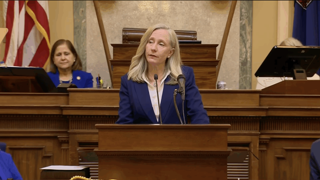
Georgia political candidates gathered Wednesday at the Athens Chamber of Commerce Congressional Luncheon, outlining their visions for the state’s economic future and addressing pressing issues such as business development, affordability, and the impact of data centers on local communities.
The annual luncheon drew a crowd of business leaders, local officials, and reporters, providing a platform for candidates for governor and U.S. Senate to share their priorities. As Georgia continues to experience rapid economic growth, the state also faces challenges related to rising costs of living, infrastructure demands, and the increasing presence of large-scale data centers. These topics dominated the discussion, reflecting broader debates about how to balance growth with sustainability and affordability.
Candidates on Business and Affordability
U.S. Senate candidate Rep. Mike Collins, a Republican currently challenging incumbent Democrat Sen. Jon Ossoff, emphasized his legislative experience and business credentials. Collins highlighted his bipartisan achievements in Congress, referencing the TRANQ Research Act and the Laken Riley Act, both of which he said were signed into law under different presidential administrations. He argued that his background as a business owner gives him practical insight into the needs of Georgia’s economy.
“We need more businesspeople in Washington who know how to get things done,” Collins told attendees, underscoring his belief that private sector experience is crucial for effective governance.
Gubernatorial candidate Rick Jackson, a health care CEO, focused his remarks on supporting small businesses and tackling supply chain disruptions as a way to lower costs for Georgia families. Jackson said he would prioritize direct engagement with CEOs to attract investment and promote job creation across the state. He pledged to continue cutting taxes and property taxes, and to maintain a strong focus on employment opportunities. Jackson also promised to introduce a plan aimed at reducing health care costs, positioning himself as an advocate for working families and those struggling with affordability.
“I’m not in this to help people that are rich; I’m in this to help people that need it,” Jackson said, emphasizing his commitment to economic policies that benefit a broad cross-section of Georgians.
Democratic gubernatorial candidate Keisha Lance Bottoms, the former mayor of Atlanta, highlighted her leadership on the $5 billion Centennial Yards redevelopment project. She described the initiative as the largest public-private property project in the country and noted that it included affordable housing components and a dedicated trust fund to support housing initiatives. Bottoms pointed to her experience managing large-scale projects as evidence of her ability to deliver results for Georgia’s communities.
Kemp’s Support and Economic Record
Governor Brian Kemp attended the luncheon alongside Jackson, offering a strong endorsement of the Republican candidate. Kemp praised Jackson’s background, noting his experience overcoming adversity and his understanding of the challenges faced by many Georgia families.
“One of the reasons I think Rick Jackson’s the best candidate for being our 84th governor is because he has really come up through some very tough times and knows what it’s like to be struggling,” Kemp said.
Kemp also used the event to criticize federal economic policy, attributing high inflation and rising costs to the Biden administration. He argued that state leaders must remain focused on efforts to control costs and support economic growth. Kemp touted his administration’s record, stating that Georgia has created nearly 220,000 new jobs and attracted almost $120 billion in investment during his tenure. He emphasized that much of this growth has occurred outside the Atlanta metropolitan area, signaling a commitment to statewide economic development.
“Today, in Georgia, we have the most people working in our state than we’ve ever had, and we broke last month’s record,” Kemp said, highlighting what he described as a strong labor market and robust economic performance.
Data Centers and Community Impact
The rapid expansion of data centers in Georgia emerged as a key topic at the luncheon. These facilities, which support the digital economy, require significant amounts of land, electricity, and water. Their growth has sparked debate among local officials and residents, who are concerned about the strain on infrastructure and the impact on municipal budgets.
Collins argued that data centers are essential for maintaining Georgia’s competitiveness, particularly in the context of the global “AI race with China.” However, he cautioned that operators should be responsible for supplying their own power and should not overburden local infrastructure or utilities. Collins suggested that careful planning and regulation are needed to ensure that the benefits of data centers do not come at the expense of local communities.
Bottoms acknowledged concerns about rising utility costs associated with data centers but noted that some local leaders view these facilities as a way to bolster municipal budgets through increased tax revenue. She called for a more thorough examination of the issue, stating, “We don’t have enough facts on data centers to make an important decision on how we move forward.” Bottoms advocated for gathering more information and input from stakeholders before enacting new policies.
While the candidates offered differing perspectives on how best to balance economic growth with affordability and infrastructure needs, there was broad agreement that Georgia’s future prosperity depends on effective management of business investment and community resources. The luncheon underscored the importance of collaboration between state leaders, the business community, and local governments as Georgia navigates the challenges and opportunities of continued growth.
As the state approaches the next election cycle, the positions outlined at the Athens Chamber of Commerce event are likely to shape ongoing debates about Georgia’s economic direction, the role of technology and data centers, and the policies needed to ensure that growth benefits all residents.