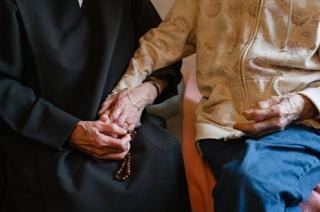
Four Catholic orders of nuns and Bishop John Barres of the Diocese of Rockville Centre have filed a federal lawsuit against New York State, challenging the recently enacted Medical Aid in Dying Act. The lawsuit, filed by the Becket Fund for Religious Liberty in the U.S. District Court for the Northern District of New York, contends that the new law compels religious health care providers to participate in assisted suicide procedures, violating their First Amendment rights to religious freedom.
Explainer The Complex Legal Landscape of Abortion Laws After Dobbs
The dispute centers on whether New York's law, which legalizes physician-assisted suicide for terminally ill patients, adequately protects the religious liberty of faith-based health care providers. The law requires health care professionals and institutions to cooperate in certain aspects of the process, which the plaintiffs argue conflicts with their deeply held religious beliefs.
The case comes at a time when faith-based organizations are facing increasing legal and regulatory scrutiny over their end-of-life care policies. The plaintiffs—the Little Sisters of the Poor, Carmelite Sisters for the Aged and Infirm, Dominican Sisters of Hawthorne, and Missionary Sisters of St. Benedict—have provided care for the elderly and terminally ill in New York for generations, with some orders dating their work back to the 19th century. Bishop Barres and the nuns say their mission is rooted in Catholic doctrine, which holds that life is sacred from conception to natural death.
The Lawsuit’s Claims
According to the Becket Fund's complaint, New York's Medical Aid in Dying Act only exempts individual physicians from directly administering life-ending drugs. However, the law still requires them to inform, counsel, and qualify patients for assisted suicide if requested. Additionally, if a physician objects to participating in the final step, the law obligates them to transfer the patient's medical records to another provider who will carry out the procedure.
Religious health care facilities face similar requirements. If a patient in a religiously affiliated hospital, nursing home, or hospice requests lethal medication, the institution must arrange a prompt transfer to another facility that is willing to provide the drugs. The plaintiffs argue that these requirements force them to be complicit in actions that violate their faith.
The complaint references Catholic doctrine, including the Vatican’s declaration Dignitas Infinita, which states that helping a person end their own life is “an objective offense against the dignity of the person.” The plaintiffs maintain that their religious beliefs prohibit any involvement in assisted suicide, whether direct or indirect.
Bishop Barres emphasized this position in a public statement:
"Our Catholic institutions cannot and will not participate in physician-assisted suicide. We will continue to proclaim the love of God for every individual person, created in His image, that endures every circumstance, and we will never abandon the sick and suffering to death. We will care for them until the end of their natural lives."
— Bishop John Barres, Diocese of Rockville Centre
State Officials’ Position
Governor Kathy Hochul signed the Medical Aid in Dying Act into law in February. She has stated that the law is designed to safeguard personal liberty and bodily autonomy for terminally ill patients who wish to end their suffering. Hochul has emphasized that the law includes religious exemptions, allowing religiously affiliated hospice providers to opt out of directly providing medical aid in dying. According to the governor, no health care professional or religious facility is forced to offer or directly participate in assisted suicide.
"New Yorkers deserve the choice to endure less suffering, not by shortening their lives, but by shortening their deaths—I firmly believe we made the right decision," Hochul said in a statement at the bill signing.
The state maintains that the law strikes a balance between respecting individual choice and accommodating religious objections. Supporters of the law argue that it provides terminally ill patients with more control over their final days, while also including provisions to protect the conscience rights of health care providers who object to assisted suicide on moral or religious grounds.
Religious Objections and Next Steps
Despite these assurances, Bishop Barres and the Catholic orders argue that the law's exemptions are too narrow and do not go far enough to protect religious liberty. Barres has called the law “a tragedy and a grave moral failure,” warning that it could lead to abuse of the elderly and disabled, and undermine the mission of faith-based health care providers.
The Becket Fund asserts that the law forces religious providers to participate in the process in ways that violate their beliefs and freedom of speech, such as counseling patients about assisted suicide or facilitating transfers for the purpose of obtaining lethal medication. The plaintiffs are seeking to have the law struck down on constitutional grounds, arguing that it infringes on their First Amendment rights.
State officials have not yet publicly responded to the lawsuit. Legal experts note that the outcome of the case could set an important precedent for how courts balance religious liberty claims against state laws permitting assisted suicide. Similar debates have played out in other states that have legalized medical aid in dying, but New York’s law is among the most recent and closely watched.
The case will proceed in federal court, with both sides expected to present arguments over the coming months. The decision could have implications not only for New York, but for religious health care providers and assisted suicide laws across the country.