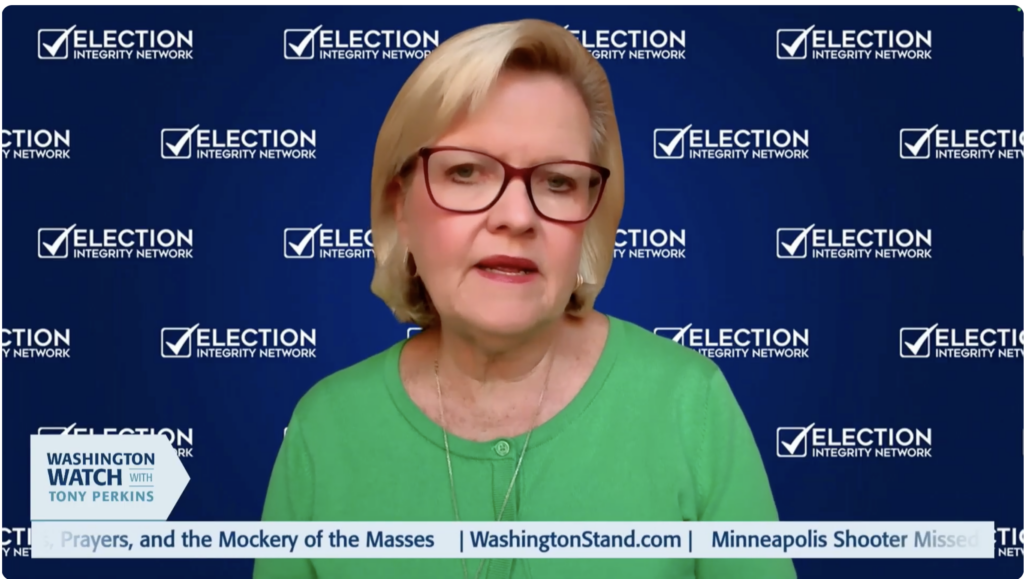
Election law attorney Cleta Mitchell has expanded her Election Integrity Network’s activities this year, releasing new resources aimed at protecting vulnerable voters and advocating for stricter election laws, even as she faces sustained criticism from left-leaning groups and media outlets.
Explainer Unpacking U.S. Election Law: Integrity, Controversies, and Legal Battles
Mitchell’s high-profile advocacy for election integrity has made her a frequent target for critics, who accuse her of voter suppression and extremism, while her supporters argue she is defending transparency and accountability in U.S. elections.
Mitchell, who previously served in the Oklahoma House of Representatives and as director of the Term Limits Legal Institute, has built a national reputation as a Republican campaign finance and election law attorney. She co-counseled with former Carter administration Attorney General Griffin Bell in a landmark Supreme Court case on congressional term limits, according to the Department of Justice biography of Griffin Bell.
Election Integrity Network Initiatives
Mitchell launched the Election Integrity Network (EIN) in 2021, aiming to create a permanent infrastructure of citizen volunteers to monitor elections and advocate for reforms. This year, EIN produced two major resources: the Model Election Laws Handbook, which outlines principles such as voter ID and citizenship verification, and the Toolkit for Protecting Vulnerable Voters. The toolkit references a Centers for Medicare and Medicaid Services update clarifying that nursing home staff must not interfere with residents’ voting rights.
Hundreds of EIN volunteers work nationwide to monitor voter rolls, advocate for legislative changes, and observe polling places. Mitchell said the network’s mission is to restore confidence in U.S. elections, which she argues was damaged during the 2020 presidential contest.
Criticism and Legal Battles
Mitchell has faced repeated accusations from left-leaning organizations and media, including ProPublica, which she claims targets her due to her effectiveness. She told The Federalist, “That’s exactly why ProPublica and the others are attacking me, because we are so effective. That’s what they hate about us.”
She was also criticized for her involvement in a January 2021 call with then-President Donald Trump and Georgia Secretary of State Brad Raffensperger regarding alleged voter fraud. Although Mitchell was not indicted in subsequent legal actions, she and other Trump allies faced public scrutiny and what supporters describe as politically motivated prosecutions. Annette Olson, CEO of the John K. MacIver Institute for Public Policy, said, “Imagine yourself being a target for doing your job and representing your client, a client that people hate. That’s why they’re attacking her, not that she did anything wrong.”
Legislative Push and Recent Cases
Mitchell and EIN have actively supported the SAVE America Act, which would require voter ID and proof of citizenship to register and vote. The bill has been blocked by Democrats in Congress, despite polling cited by Mitchell indicating broad public support. EIN has also advocated for accountability in cases of voter fraud, referencing recent prosecutions in California, including a Costa Mesa woman ordered to pay for anti-voter fraud billboards after registering her dog to vote and casting ballots in its name. Details of the case were confirmed by the Orange County District Attorney’s office press release.
Election law expert Hans von Spakovsky, a former Federal Election Commission member, said Mitchell’s efforts have embarrassed critics of election integrity measures. He cited a 2021 study in The Quarterly Journal of Economics finding that strict voter ID laws do not negatively affect turnout. Von Spakovsky argued, “When folks actually see successful prosecutions and see that election officials, law enforcement and others are actually investigating and prosecuting when crimes are committed, that actually increases confidence.”
Ongoing Debate and Response
Mitchell’s critics argue that her initiatives amount to voter suppression and intimidation, particularly regarding efforts to monitor voting in nursing homes. Supporters counter that these measures are necessary to prevent fraud and protect vulnerable voters. Some media outlets and Democratic officials have not responded directly to Mitchell’s recent claims or the EIN’s new resources.
Mitchell and EIN continue to focus their efforts in battleground states, where they have partnered with local groups to monitor election administration and advocate for reforms. The network’s activities and the broader debate over election laws remain a flashpoint ahead of future elections.