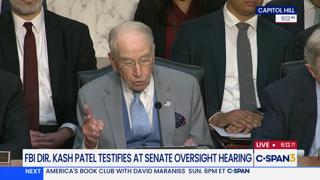
Sen. Chuck Grassley, R-Iowa, has accused the FBI of intentionally misclassifying documents related to "Operation Round River" to conceal evidence of alleged Biden family corruption and restrict congressional oversight. The dispute centers on whether FBI agents used unauthorized classification markings to limit access to information about investigations involving President Joe Biden, his brother James Biden, and his son Hunter Biden.
Grassley outlined his concerns in a letter sent Monday to Attorney General Todd Blanche, FBI Director Kash Patel, and Director of National Intelligence Jay Clayton. In the letter, Grassley cited whistleblower claims that the FBI's Foreign Influence Task Force (FITF) used "Operation Round River" to discredit negative information about Hunter Biden as foreign disinformation and halt investigative activity. The senator has long been a vocal advocate for transparency in federal investigations, especially those involving high-profile political figures.
Alleged Misclassification Practices
According to Grassley, documents obtained from the FBI included classification banners with the term "Round River"—a code not listed in the official Authorized Classification and Control Markings Register. Grassley argued that this suggests agents may have treated the investigation as a Special Access Program (SAP) without proper authorization, thereby restricting access to only a handful of lawmakers. SAPs are typically reserved for the most sensitive national security matters and require high-level approval.
Grassley wrote, "some Round River documents include banner markings to identify classified information; however, the banner markings include ‘Round River’ as a classification code." He continued, "it appears the Wray FBI treated Round River as a Special Access Program when all accounts provided to us so far show no indication that it was in fact such a program."
"Accordingly, it appears the Wray FBI treated Round River as a Special Access Program when all accounts provided to us so far show no indication that it was in fact such a program."
— Sen. Chuck Grassley, R-Iowa
The use of SAP status, Grassley noted, would mean that most congressional requests for documents could be ignored, as only select members are briefed on such programs. He asked for clarification on whether high-level approval was ever granted for this designation and whether the FBI followed proper protocols in assigning such a status to "Round River."
Whistleblower and FITF Claims
Whistleblowers cited by Grassley allege that the FITF sought out confidential human source (CHS) reports from FBI field offices nationwide related to the Biden family, then dismissed them as foreign disinformation. Grassley said the FBI at one point maintained over 40 CHS sources providing criminal information on Joe, James, and Hunter Biden. Sources familiar with "Round River" told The Federalist that the effort was designed to "scuttle any investigative leads into Biden family corruption by discrediting it as Russia disinformation."
Grassley also claimed that the intelligence community downgraded allegations of criminality related to the Biden family without sufficient investigation and compiled a list of supposed "conduits" of disinformation, which included then-Attorney General William Barr. According to Grassley, these actions may have contributed to a broader effort to limit the scope of investigations and shield certain individuals from scrutiny.
Broader Pattern of Restricted Access
This latest allegation follows Grassley's earlier discovery that the FBI, under Director Christopher Wray, used the "Prohibited Access" function in its Sentinel case management system to hide documents related to the Crossfire Hurricane investigation, making them invisible to agents searching the database. The Crossfire Hurricane probe, which examined possible ties between the Trump campaign and Russia, has itself been the subject of extensive congressional and public scrutiny.
Grassley argues that these practices—misclassifying documents and restricting access—may have been used to shield both inculpatory evidence against the Bidens and exculpatory evidence for former President Donald Trump. He has raised concerns that such actions could undermine the integrity of federal investigations and erode public trust in the FBI and the Department of Justice.
The FBI, Department of Justice, and Office of the Director of National Intelligence have not publicly responded to Grassley's letter or the specific allegations regarding "Operation Round River." The lack of response has fueled further calls from Grassley and other lawmakers for increased transparency and accountability in the handling of politically sensitive investigations.
Context and Next Steps
The dispute over "Operation Round River" comes amid ongoing scrutiny of the FBI's handling of politically sensitive investigations. Grassley, as a senior member of the Senate Judiciary Committee, has repeatedly pressed for greater transparency and oversight of the bureau's practices. He is seeking clarification from agency leaders on whether proper procedures were followed in classifying and restricting access to the "Round River" records.
Grassley's letter requests detailed explanations from the Department of Justice, the FBI, and the Office of the Director of National Intelligence regarding the use of the "Round River" classification and whether it was ever formally approved as a Special Access Program. He has also asked for a review of the process by which confidential human source reports were evaluated and whether any legitimate investigative leads were dismissed without adequate consideration.
As of now, it remains unclear how the agencies will respond to Grassley's inquiries or whether additional information about "Operation Round River" will be made public. The senator has indicated that he will continue to pursue answers and advocate for congressional oversight, emphasizing the importance of transparency in maintaining public confidence in federal law enforcement and intelligence agencies.