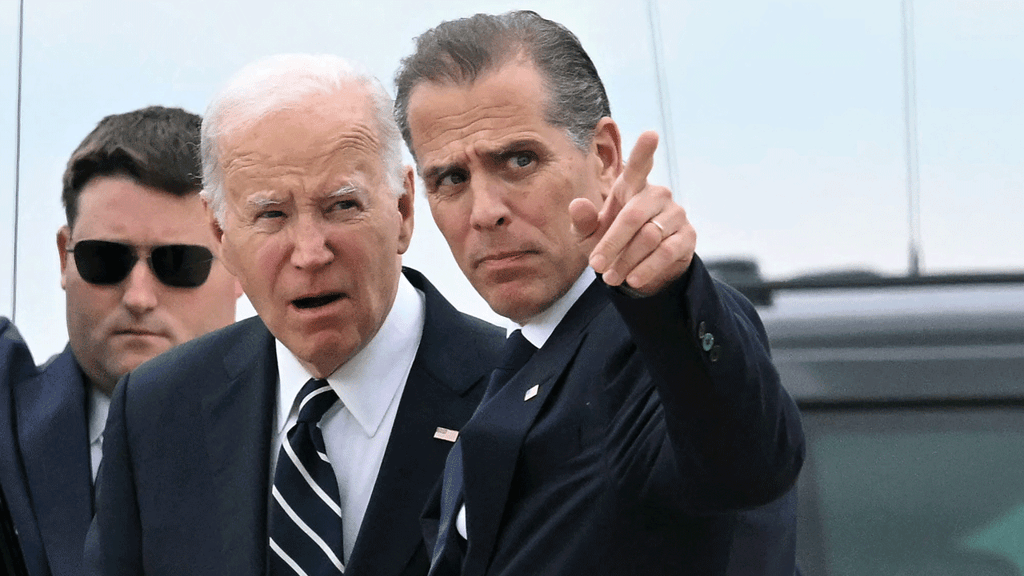
Federal prosecutors were prepared to resolve the investigation into Hunter Biden without filing criminal charges until two IRS whistleblowers publicly alleged that the Justice Department had delayed the probe, according to Hunter Biden’s attorney, Abbe Lowell. In a letter to special counsel David Weiss, Lowell argued that the Justice Department only pursued prosecution after IRS agents Gary Shapley and Joseph Ziegler raised concerns about the handling of the case. This sequence of events has fueled debate over whether outside pressure from whistleblowers and political critics influenced the Justice Department’s decision to prosecute President Joe Biden’s son.
The case drew national attention after a Delaware jury convicted Hunter Biden on tax and gun charges. President Biden later pardoned his son before leaving office, according to documents obtained by The Daily Signal through a Freedom of Information Act request. The developments have intensified scrutiny of the Justice Department’s handling of politically sensitive investigations and the role of whistleblowers in shaping prosecutorial decisions.
DOJ’s Initial Approach
In an August 14, 2023 letter, Lowell wrote that prior to leaks in May 2023, discussions with Weiss’s office had involved a “consensual non-prosecution resolution” that did not require any guilty plea from Hunter Biden. According to Lowell, this approach changed after Shapley was interviewed by CBS News, with prosecutors withdrawing their initial settlement proposal and instead demanding a misdemeanor guilty plea on tax charges. This shift marked a turning point in the case, as the Justice Department moved away from a non-prosecution agreement toward a more punitive resolution.
Tristan Leavitt, president of Empower Oversight and representative for the whistleblowers, commented on the situation: “But Abbe Lowell may be right to say the charges wouldn’t have been brought but for the whistleblowers. Should they have been brought even without the whistleblowers? Absolutely.”
After both sides agreed to a misdemeanor plea on June 20, further disclosures and criticism followed. Lowell accused government agents and political opponents of President Biden of working together to pressure prosecutors to abandon the deal. The special counsel ultimately withdrew the agreement and proceeded with prosecution, leading to Hunter Biden’s eventual conviction.
Whistleblower Allegations and Fallout
Shapley and Ziegler, represented by Empower Oversight’s Leavitt, alleged that the Justice Department slow-walked the investigation into Hunter Biden. They claimed that delays and interference hampered the probe, and their public disclosures brought renewed attention to the case. Leavitt said the whistleblowers were vindicated by the eventual conviction, but agreed with Lowell that the case likely would not have moved forward without their disclosures.
Lowell, however, repeatedly accused the whistleblowers of exceeding the bounds of legal protections. In a February 8, 2023 letter to the Justice Department’s Office of Inspector General, Lowell alleged that their disclosures amounted to “criminal acts.” Shapley and Ziegler later sued Lowell for defamation. The lawsuit was settled, with Lowell acknowledging that their actions were protected by law. This legal dispute underscored the contentious atmosphere surrounding the investigation and the broader debate over whistleblower protections.
DOJ and Legal Responses
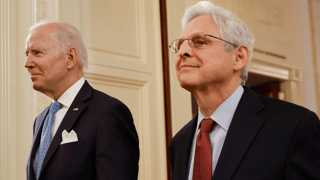
Special counsel Weiss and Attorney General Merrick Garland have denied that the investigation or prosecution was compromised by outside influence. Both officials have maintained that the Justice Department’s actions were guided by the facts and the law, rather than political considerations or external pressure. At the time of the events, Lowell was with the law firm Winston and Strawn, but now operates his own firm. The Daily Signal reported that neither Winston and Strawn nor Lowell’s current firm responded to requests for comment regarding the case.
The Hunter Biden investigation has become a focal point in the ongoing debate over the role of whistleblowers and the influence of political pressure on high-profile federal investigations. Supporters of the Justice Department have maintained that the process was not affected by outside influence, while critics argue that public disclosures and political scrutiny played a decisive role in shaping the outcome. The case continues to prompt questions about prosecutorial independence, the scope of whistleblower protections, and the challenges of conducting investigations involving the families of public officials.