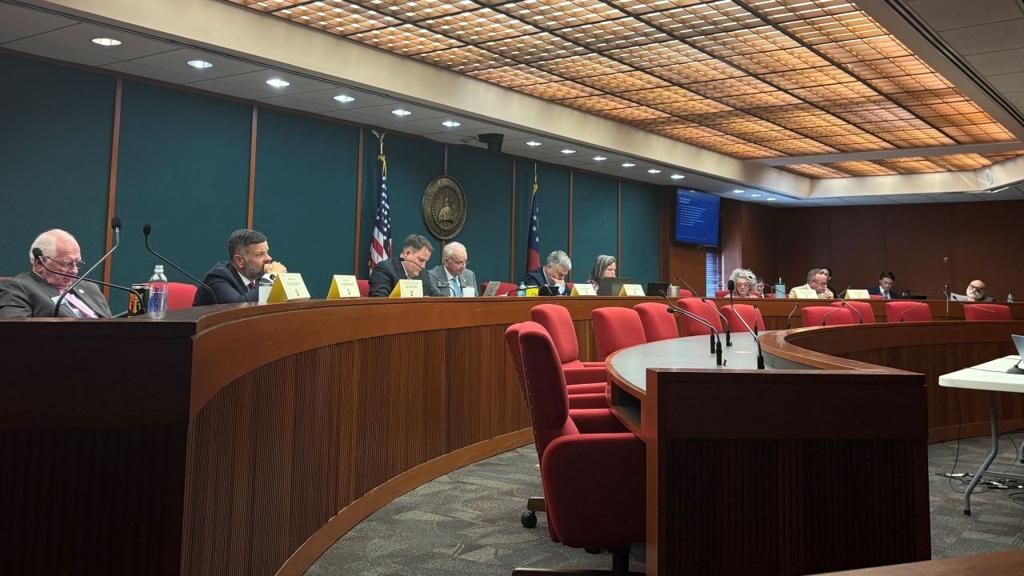
Georgia’s Joint Election Equipment Specifications and Standards Committee convened its third meeting at the General Assembly this week, continuing its evaluation of recommendations for the state’s next voting system. The committee’s focus centers on the potential adoption of hand-marked paper ballots and ballot-on-demand printing, as lawmakers weigh how best to address election security, accessibility, and public trust in the state’s voting process.
Explainer Securing America's Elections: Challenges, Reforms, and the Path Forward
The committee was established through Senate Resolution 3 EX during a special legislative session. It is chaired by Sen. Max Burns (R–Sylvania) and Rep. Victor Anderson (R–Cornelia). The panel includes a range of voices, with testimony from state election officials, cybersecurity experts, and representatives from the voting technology industry. The meeting was open to the public and live-streamed, according to the Georgia Senate Press Office.
Expert Testimony on Security Risks
Geoff Hale, a visiting fellow for election security at the Center for Democracy and Technology, addressed the committee about the ongoing risks facing U.S. elections. Hale warned that elections are subject to “real cyber risks” from foreign adversaries and other threat actors. While he noted that there have been no confirmed cases of foreign nations changing vote tallies, he emphasized that “nearly every other part of election infrastructure has faced adversarial cyber operations.”
Hale also underscored the importance of viewing election security as an ongoing process rather than a one-time purchase. “Election security is a process and not a purchase,” he told the committee, emphasizing the need for continuous vigilance and adaptation to emerging threats.
Deidre Holden, Paulding County elections and voter registration director, echoed concerns about security, telling reporters, “We have to have a system that is absolutely untouchable.”
Michael Barnes, deputy director of information technology for voting systems in the Secretary of State’s office, provided a historical overview of Georgia’s voting systems. He described the state’s transition to a uniform voting system after the 2000 presidential election, as well as subsequent updates, including the introduction of electronic poll books in 2006. Barnes’ testimony highlighted the ongoing evolution of election technology in Georgia and the challenges of keeping systems secure and up to date.
Recommendations for Voting System Changes
Several experts presented recommendations for improving Georgia’s voting system. Jason Wareham, CEO of Mojave Research, stressed the importance of voting machines that can self-check and immediately report discrepancies. This, he argued, would help election officials quickly identify and address any potential issues during voting.
Michael Specter, assistant professor at Georgia Tech’s School of Cybersecurity and Privacy, outlined six recommendations for the committee to consider. These included requiring access for independent researchers to evaluate voting systems, ensuring timely software patches from vendors, and increasing support for election officials responsible for operating and maintaining the equipment.
Mark Lindeman, policy and strategy director for Verified Voting, advocated for the use of voter-verified paper ballots. He argued that paper ballots are essential for accountability and can help reduce reliance on electronic technology, which can be vulnerable to cyberattacks. Lindeman also emphasized the importance of ballot-marking devices to ensure accessibility and fairness for voters with disabilities.
Mark Davis, president of Data Productions, Inc., supported the adoption of hand-marked paper ballots with appropriate backup systems. He also shared findings from his residency analysis, which identified “tens of thousands of voters in each general election who may have cast ballots in a county they no longer lived in.” Davis’ testimony pointed to the need for accurate voter rolls and safeguards to prevent potential irregularities.
Lawmakers and Officials on Next Steps
Deidre Holden described her ideal voting system as one where voters can cast their ballots without encountering issues. However, she cautioned that introducing new technology can also introduce new security concerns. “We have to have a system that is absolutely untouchable,” she reiterated.
Sen. Burns said his goal for Georgia’s elections aligns with Gov. Brian Kemp’s position: “easy to vote, but hard to cheat.” Burns and other lawmakers on the committee are seeking a balance between making voting accessible and ensuring the integrity of the process.
Blake Evans, elections director for the Secretary of State’s office, addressed the logistical challenges of implementing a new voting system. He described the current timeline as “aggressive” and urged that any new equipment be delivered to county officials as soon as possible to allow for adequate training and preparation before future elections.
Rep. Anderson emphasized the committee’s commitment to a fact-based approach. “We’re not in here trying to score political points. We’re here to try to determine the facts, try to look at the options, and decide … what is best for Georgia,” he told reporters.
The committee’s work comes amid ongoing national debates over election security and access. Georgia lawmakers are considering changes that could shape the state’s approach to voting for years to come. The committee is expected to continue gathering input from experts and stakeholders before making formal recommendations to the legislature.
For more information on the committee and its legislative mandate, see Senate Resolution 3 EX: https://www.legis.ga.gov/legislation/74767