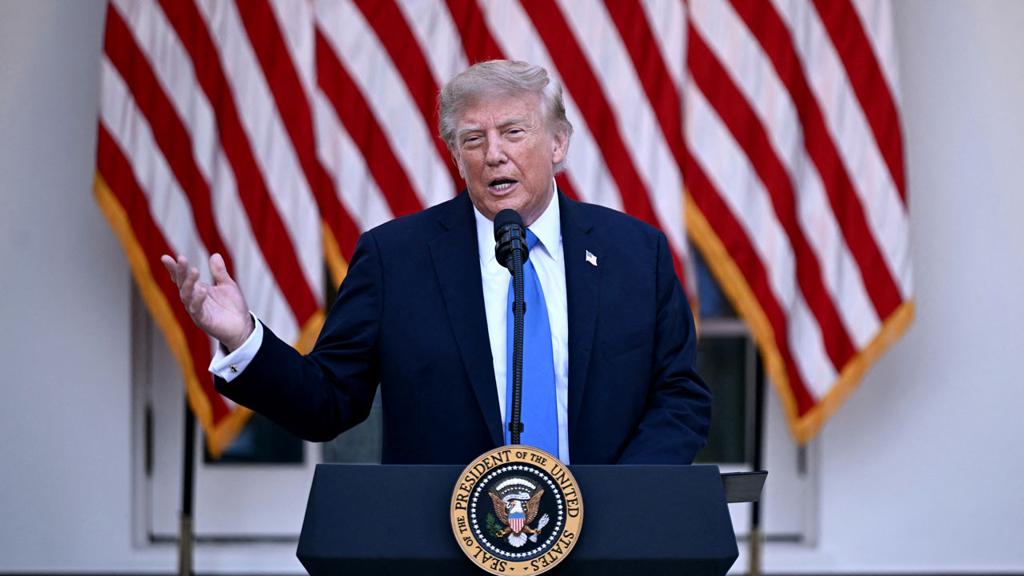
President Donald Trump has announced a major financial commitment to support Republican candidates in the upcoming congressional elections, pledging to spend more than $400 million from his MAGA Inc. super PAC. This funding will be directed toward 35 Republican candidates running in closely contested battleground races this November. Trump, who is not himself on the ballot, outlined his strategy during a dinner held at the White House Rose Garden, where he emphasized his intention to focus resources on districts where Republicans have a strong chance to win or retain seats.
The move marks a significant escalation in the Republican campaign effort, with Trump personally promising to travel to each of the 35 targeted districts. By doing so, he aims to bolster the party’s chances in races that are expected to be highly competitive. This decision also comes amid speculation that Trump might reserve the super PAC’s sizable war chest for his own future political ambitions. Instead, he has chosen to prioritize the immediate goal of strengthening the Republican position in Congress.
Trump stated that he will rely on House Speaker Mike Johnson’s team to help guide the allocation of funds, ensuring that spending is directed toward the most competitive races. He made it clear that he will avoid investing resources in safe Republican districts, such as Johnson’s own district in Louisiana, and will instead concentrate on districts where the outcome remains uncertain.
Focus on Key Contests
During his announcement, Trump named several prominent Republican leaders he intends to support. These include Sen. John Thune, House Majority Leader Steve Scalise, Republican National Committee Chairman Joe Gruters, and Rep. Jim Jordan. He also specifically pledged to back Dan Sullivan in Alaska and Ken Paxton in Texas, both of whom are running for Senate seats.
Trump highlighted his recent campaign efforts as examples of his strategy in action. He pointed to his first MAGA Inc. campaign stop in South Carolina, where he supported Sen. Darline Graham, the sister of the late Sen. Lindsey Graham. According to Trump, his involvement helped secure Graham the Republican nomination. Additionally, Vice President JD Vance has been active on the campaign trail, recently traveling to Michigan to support former congressman Mike Rogers, who is running for Senate against Democrat Abdul El-Sayed.
Trump has committed to an ambitious campaign schedule, stating, “I’m going to go to every one of those 35 places, and we’re going to see if we can get everyone elected.” He plans to use a combination of in-person rallies and remote town halls to reach voters, with the goal of holding up to 10 events per night in the final month before the election. Trump emphasized that most of the targeted races are either tied or very close, but he expressed confidence that Republican candidates will benefit from his direct involvement.
Fundraising and Strategy
Since the beginning of 2024, Trump has raised nearly $800 million for MAGA Inc., according to reports from The Wall Street Journal and the Federal Election Commission. The super PAC currently has over $400 million on hand, which Trump has confirmed will be deployed in the final stretch of the campaign. While he did not provide a detailed breakdown of how the funds will be distributed on a state-by-state basis, he reiterated that the focus will remain on competitive races rather than on districts that are considered safe for Republicans.
Trump’s announcement did not include any response from Democratic leaders or candidates. Additionally, his team has not addressed how this significant spending commitment might impact Democratic fundraising efforts or campaign strategies in the targeted battleground races. The absence of a Democratic response leaves open questions about how the opposing party will adjust its own tactics in light of Trump’s aggressive approach.
Broader Political Stakes
The scale of Trump’s planned spending and his intensive campaign schedule underscore the high stakes for both parties as control of Congress hangs in the balance. The outcome of these 35 battleground races is expected to play a decisive role in determining the legislative agenda and the balance of power in Washington for the next term.
For Republicans, Trump’s direct involvement and financial backing are seen as critical assets in what are likely to be closely fought contests. For Democrats, the challenge will be to counter this influx of resources and high-profile campaigning as they seek to defend or flip key seats. As the election approaches, both parties are expected to intensify their efforts, with the final outcome likely to hinge on the results in these pivotal districts.