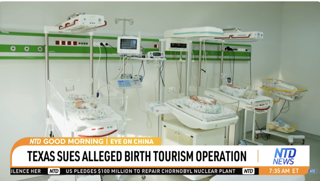
The Trump administration’s recent executive order targeting birth tourism has led to a surge of concern and shifting plans among Chinese nationals, as reports of visa revocations and increased scrutiny circulate widely on Chinese social media platforms.
The new policy’s enforcement is raising questions about the future of birthright citizenship and the use of U.S. surrogacy by foreign nationals, with both national security and child welfare cited as central concerns.
President Trump signed the "Ending Birth Tourism" executive order in early August, defining birth tourism as foreign nationals entering the U.S. on nonimmigrant visas to give birth or helping others do so. The order authorizes the secretaries of state and homeland security to deny or revoke visas, bar entry, and take action against individuals or organizations facilitating the practice. The White House stated that the order enforces existing immigration rules, clarifying that travel to the U.S. primarily for childbirth to secure citizenship is not a permissible basis for a B nonimmigrant visa. Read the executive order
Visa Revocations and Enforcement Actions
Following the executive order, the State Department established a Birth Tourism Prevention Task Force. On August 12, the task force announced it had revoked more than 600 visas from foreign nationals worldwide, aiming to curb what it described as abuse of U.S. birthright citizenship. See the State Department announcement
The Department of Homeland Security and U.S. Immigration and Customs Enforcement (ICE) have previously prosecuted individuals involved in birth tourism schemes. In one case, a Chinese national pleaded guilty to running a scheme that helped foreign nationals give birth in the U.S. to secure citizenship for their children. ICE news release
The crackdown is part of a broader effort to enforce existing immigration laws and address what officials describe as the exploitation of the U.S. immigration system. Authorities have said that birth tourism undermines the integrity of American citizenship and can create security vulnerabilities.
Chinese Social Media Reaction
News of the crackdown, including reports of pregnant Chinese women being turned away at U.S. ports of entry and denied visas, has spread rapidly on Chinese social media. According to the South China Morning Post, this has led some families to reconsider their plans, with uncertainty about the feasibility of giving birth in the U.S. now prompting some to seek alternatives.
Social media users in China have discussed the risks and potential consequences of attempting to travel to the U.S. for childbirth under the new policy. Some posts highlight the financial and emotional investment families make in securing U.S. citizenship for their children, while others question whether the benefits outweigh the new risks.
"It has diminished the value of U.S. citizenship by treating it like a 'commodity' and thereby breaking 'a sacred bond between the American people and the Nation in which they live.'"
— Trump administration executive order
Wealthy Chinese parents have often viewed birth tourism as an investment, believing U.S. citizenship offers their children greater educational and personal opportunities. The recent Fields Medal win by mathematician Hong Wang, who completed her work in the U.S., sparked debate in China about the advantages of American citizenship for talented youth.
Some commentators on Chinese platforms have pointed to the changing landscape, noting that the U.S. is no longer a guaranteed option for birth tourism. Others have speculated about the possibility of stricter enforcement in the future, and whether other countries might follow the U.S. lead.
Shift Toward Surrogacy and Legislative Response
As birth tourism faces new obstacles, some Chinese families are reportedly turning to commercial surrogacy in the U.S., which is banned in China but less regulated in America. High-profile cases have drawn attention to the practice, including reports of Chinese nationals arranging for dozens of children to be born via U.S. surrogates, sometimes under questionable circumstances.
The shift toward surrogacy reflects both the demand for U.S. citizenship and the challenges posed by the new restrictions. Commercial surrogacy in the U.S. is legal in some states and largely unregulated at the federal level, making it an attractive alternative for families seeking American citizenship for their children.
In Congress, Sen. Rick Scott, R-Fla., introduced the SAFE KIDS Act to address concerns about foreign adversaries using American surrogates to obtain citizenship for their children. The bill, which sought to close loopholes in surrogacy and birthright citizenship, was blocked by Senate Democrats in late July. See Sen. Scott's statement
Supporters of tighter restrictions argue that aligning U.S. policy with peer nations—many of which ban or strictly regulate commercial surrogacy—would help protect the integrity of American citizenship. They contend that without stronger laws, the U.S. remains vulnerable to exploitation by those seeking to circumvent immigration rules.
Critics of the crackdown have not issued formal responses to the latest executive order or the SAFE KIDS Act. However, some legal experts and advocacy groups have previously raised concerns about the impact of such measures on families and the potential for discrimination.
The State Department’s task force continues to monitor and enforce the new policy, while debate over surrogacy and birthright citizenship remains active in Congress. The long-term effects of the crackdown on birth tourism and the shift toward surrogacy are still unfolding, with both U.S. and Chinese observers watching closely for further developments.