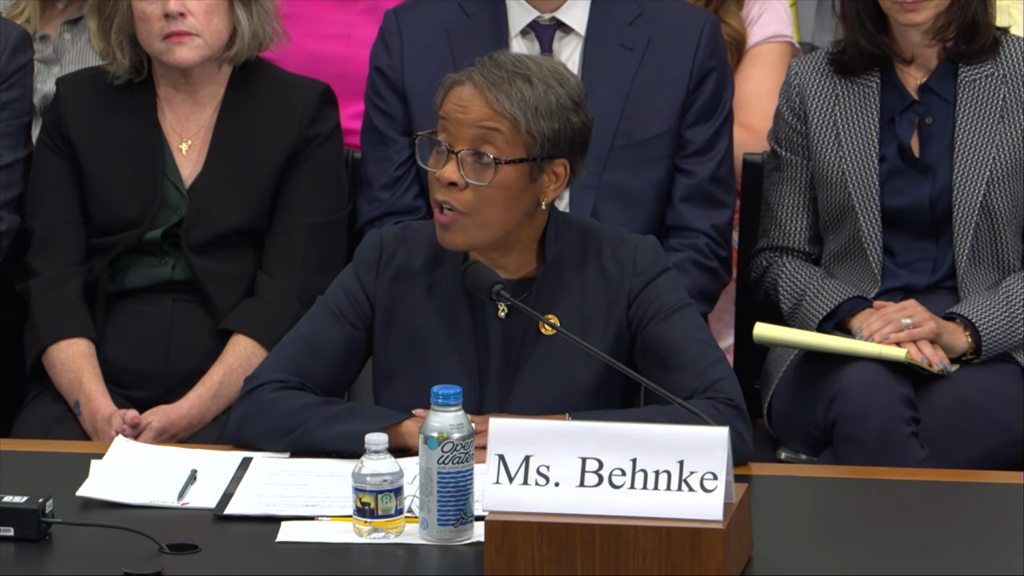
House Republicans pressed American Bar Association (ABA) President Michelle Behnke on the organization's diversity, equity, and inclusion (DEI) policies and its claims of political neutrality during a House Oversight Committee hearing on Wednesday.
The hearing, convened by the Task Force on Defending Constitutional Rights and Exposing Institutional Abuses, focused on the ABA's influence over law school accreditation and the broader legal profession. Lawmakers questioned whether the association's DEI initiatives and policy advocacy align with its stated nonpartisan mission, raising concerns about fairness and ideological balance in legal education and practice.
The ABA holds a significant role in the U.S. legal system. It accredits law schools, sets professional standards for attorneys, and regularly files amicus briefs in major court cases. Critics argue that the association's recent policy positions and DEI requirements reflect a partisan agenda, potentially impacting the fairness of legal education and the profession as a whole.
Lawmakers Challenge ABA's Neutrality
Task Force Chairman Brandon Gill, R-Texas, opened the hearing by accusing the ABA of pursuing “discriminatory DEI practices” that, in his view, “seek to pit Americans against one another on account of their immutable characteristics.” Gill repeatedly questioned Behnke about the ABA's support for implicit bias training and whether race should be considered in law school admissions. Behnke, however, did not provide a definitive answer on these points.
"I spent two minutes asking the American Bar Association's President if race should be considered in law school admissions decisions. She refused to give a definitive answer."
— Brandon Gill, Task Force Chairman
House Judiciary Chair Jim Jordan, R-Ohio, also pressed Behnke on the ABA's claim of nonpartisanship. Jordan cited the association's support for abortion rights, opposition to certain immigration detention policies, and advocacy on transgender participation in sports as examples of what he described as partisan positions. Rep. Michael Cloud, R-Texas, referenced reporting that more than 80 percent of ABA amicus briefs in Supreme Court cases over the past decade favored liberal or progressive outcomes, further questioning the group's neutrality.
ABA's Defense and Supporters' Response
During her testimony, Behnke reaffirmed her support for DEI in the legal profession. She maintained that the ABA is a “nonpartisan membership organization open to all American lawyers.” Behnke did not directly address several questions regarding the organization's positions on race in admissions and implicit bias training, instead emphasizing the ABA's commitment to fairness and professional standards.
Democratic members of the task force defended DEI policies and criticized the hearing as a "waste" of time, according to reporting from The Federalist. They argued that DEI initiatives are essential for promoting fairness and inclusion within the legal field. The hearing also included testimony from Zach Smith, a senior legal fellow at the Heritage Foundation’s Legal Policy Center, and David Blackman, a former law student and Texas State Guard member, who provided additional perspectives on the impact of ABA policies.
Broader Debate Over DEI in Legal Education
The hearing is part of a broader, ongoing debate over the role of DEI in law school accreditation and the legal profession. The ABA's policies have drawn scrutiny from Republican lawmakers, who argue that such initiatives undermine merit-based advancement and introduce ideological bias into legal education and practice. Supporters of DEI, including Democratic lawmakers and some legal professionals, contend that these policies are necessary to ensure fairness, equal opportunity, and representation in the legal field.
The House Oversight Committee has not announced any immediate legislative action following the hearing. However, the ABA continues to defend its accreditation standards and DEI policies, while critics in Congress signal that further oversight and inquiry may be forthcoming. The debate over the role of DEI in the legal profession is likely to continue as lawmakers and legal organizations grapple with questions of fairness, merit, and inclusion.
For more details, see the House Oversight Committee hearing summary and The Federalist's coverage.