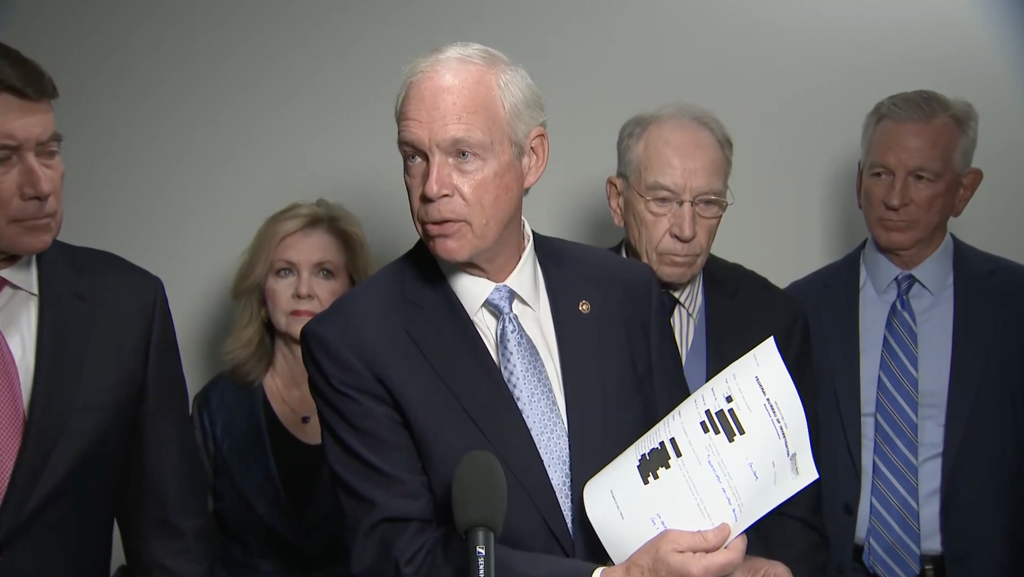
The FBI conducted surveillance on nine Republican lawmakers, including Sen. Ron Johnson of Wisconsin, as part of its Arctic Frost investigation, according to a document released by Senate Judiciary Committee Chairman Chuck Grassley, R-Iowa. The document reveals that the FBI obtained tolling data from the lawmakers' personal cell phones between January 4 and January 7, 2021.
Grassley described the findings as indicative of a troubling trend in federal law enforcement under President Joe Biden, suggesting that the situation may be "worse than Watergate." (Grassley Senate) The Arctic Frost investigation is linked to Special Counsel Jack Smith's inquiry into former President Donald Trump's actions surrounding the 2020 election.
In an interview, Johnson stated, "What I’ve uncovered today is disturbing and outrageous political conduct by the Biden FBI." (Grassley Senate) He emphasized that the FBI's actions reflect a broader pattern of targeting political opponents.
The document indicates that the FBI's operation was covert, with records stored in a Prohibited Access file, limiting who could review them. Grassley criticized the FBI for attempting to conceal its surveillance activities.
The congressional targets included prominent figures such as Sen. Lindsey Graham, R-S.C., Sen. Bill Hagerty, R-Tenn., and Sen. Marsha Blackburn, R-Tenn. Grassley noted that the data collected did not include the content of the calls but did provide information on call duration and recipients.
Johnson expressed little surprise at the revelations, recalling previous encounters with FBI agents who allegedly sought to undermine investigations into Hunter Biden's laptop. He stated, "If these recent whistleblower revelations are true, it would strongly suggest that the FBI’s August 6, 2020 briefing was indeed a targeted effort to intentionally undermine a Congressional investigation." (Grassley Senate)
Critics of the FBI's actions argue that such surveillance represents a dangerous precedent for government overreach. Johnson contended that accountability should not be equated with weaponization, stating, "You’ve got a [Trump] Justice Department trying to clean itself up, trying to root out the deep state partisan actors within." (Grassley Senate)
The FBI has not publicly commented on the specific allegations made by Grassley and Johnson. The investigation into the lawmakers is part of a broader scrutiny of the agency's practices and its perceived politicization under the current administration.
As the political landscape continues to evolve, the implications of these findings may resonate in the upcoming 2024 elections, particularly as Trump remains a leading candidate for the Republican nomination. Grassley and Johnson's claims highlight ongoing concerns regarding the integrity of federal law enforcement and its role in political matters.