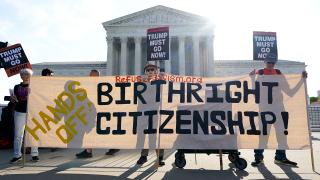
Sen. Jim Banks has introduced the Citizenship Act, a bill that seeks to deny birthright citizenship to children born to people entering the U.S. unlawfully, labeling them as 'invaders' under federal law. The move follows the Supreme Court's decision in Trump v. Barbara, which struck down a Trump-era executive order but left open the possibility for Congress to legislate within certain exceptions to birthright citizenship.
Explainer Understanding the Supreme Court’s Impact on Law and Liberty
The core debate centers on whether Congress can use existing Supreme Court precedent to limit automatic citizenship for children of unauthorized immigrants, a question left unresolved by the Court's latest ruling.
The Supreme Court's decision in Trump v. Barbara reaffirmed the framework set by the 1898 case United States v. Wong Kim Ark, which established that children born on U.S. soil are citizens except in three categories: children of diplomats, members of Indian tribes, and children of enemies during a hostile occupation. The Court found President Trump's executive order unconstitutional for exceeding these exceptions, but indicated that Congress retains the authority to legislate within them. Justice Brett Kavanaugh, in a concurring opinion, wrote that changing the law to deny birthright citizenship to additional groups would not require a constitutional amendment if done by statute within the Wong Kim Ark framework, according to The Federalist.
Details of the Citizenship Act
Sen. Banks' Citizenship Act aims to use the 'invader' exception from Wong Kim Ark by designating people who enter unlawfully or for birth tourism as invaders, thereby excluding their children from automatic citizenship. The bill grounds its authority in the Constitution's mandate for the federal government to protect states against invasion and Congress's exclusive power over naturalization. The act asserts that Congress can define the scope of citizenship for these categories, as the Supreme Court left this legislative space open in Trump v. Barbara.
"If the Supreme Court says birthplace citizenship is governed by Wong Kim Ark, then Wong Kim Ark’s own exceptions are fair game."
— Eric Wessan, solicitor general of Iowa
The bill also argues that judicial review should be limited in this context, citing the Supreme Court's view that determining what constitutes an invasion is a 'political question' reserved for the legislative and executive branches. This position draws on Judge James Ho's opinion in United States v. Abbott, which stated that whether a surge of illegal entry amounts to an invasion is not a legal question for courts to decide.
Legal Precedents and Interpretations
The Wong Kim Ark decision is widely recognized as the foundation for birthright citizenship in the U.S., but it explicitly excluded certain groups from this guarantee. The Supreme Court, in both Trump v. Barbara and prior cases, has reaffirmed that children of diplomats, members of Indian tribes, and those born to enemies during a hostile occupation are not automatically citizens. Justice Sonia Sotomayor, in Trump v. CASA, Inc., acknowledged that children born of 'alien enemies in hostile occupation' fall outside the 14th Amendment's guarantee.
The debate over the scope of the 'invader' exception is contentious. Critics argue that the exception applies only to traditional military occupations, while supporters of the Citizenship Act point to cases like Ex parte Quirin—where the Supreme Court classified Nazi saboteurs as enemy belligerents despite their covert entry—as evidence that the definition can be broader. The act's proponents contend that Congress has the authority to define 'invaders' for the purposes of citizenship law.
Political and Judicial Responses
Sen. Banks' proposal has drawn criticism from those who say the 'invader' designation is overly broad and could be used to deny citizenship to children born in the U.S. under circumstances far removed from wartime occupation. Skeptics maintain that the Constitution and existing precedent do not support such an expansive interpretation. Supporters argue that the bill is a textually and historically grounded response to the Supreme Court's guidance.
The Supreme Court's ruling in Trump v. Barbara did not address the merits of legislative changes to birthright citizenship, leaving the issue open for Congress. Justice Kavanaugh's concurrence suggested that a statute targeting the exceptions recognized in Wong Kim Ark could be upheld, potentially shifting the Court's majority if such a law were challenged.
The Biden administration and Democratic leaders have not issued formal responses to the Citizenship Act as of publication. The bill's progress and any legal challenges it may face will likely determine whether the Supreme Court revisits the scope of birthright citizenship in the future.