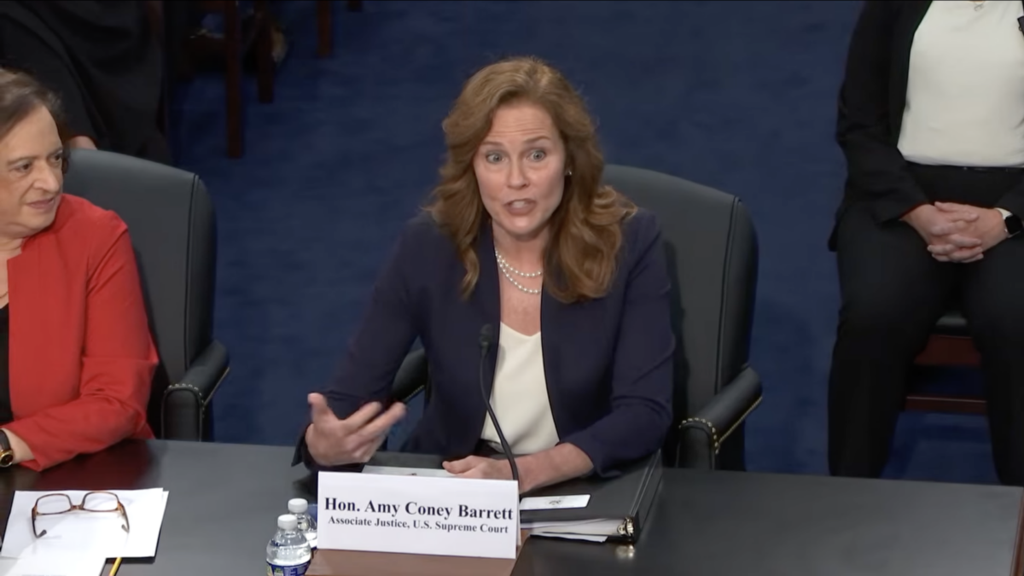
Supreme Court Justice Amy Coney Barrett recently revealed to lawmakers that she and her family were the targets of a swatting incident, highlighting the growing security threats faced by members of the nation’s highest court. Barrett described the event during testimony before the House Appropriations Subcommittee on Financial Services and General Government, where she appeared alongside fellow Justice Elena Kagan to discuss the Supreme Court’s budget and security needs.
Explainer Understanding the Supreme Court’s Impact on Law and Liberty
Barrett recounted that just six weeks prior, her teenage son encountered a street filled with police cars after officers responded to a false report of gunshots and raised voices at their home. "Six weeks ago, I was the victim of a swatting incident. At that point, my teenage son … opened the door to go out with friends and saw in our street, it was full of police cars who had responded to a false report of gun shots and raised voices in my home," Barrett testified. She credited the Supreme Court police for their quick response, noting that their presence prevented a potentially dangerous forced entry. Barrett expressed gratitude for the security detail assigned to her family, emphasizing the seriousness of such threats.
Barrett’s testimony comes amid a broader climate of heightened threats and intimidation directed at Supreme Court justices, particularly following the leak of the draft opinion in Dobbs v. Jackson Women's Health Organization in 2022. The leak, which signaled the Court’s intention to overturn Roe v. Wade, sparked a wave of protests and security concerns for the justices, especially those perceived as part of the Court’s conservative majority. Barrett recalled that after the Dobbs leak, she was sent home with a bulletproof vest due to concerns for her safety and that of her family.
Other conservative justices have also faced significant threats. Justice Brett Kavanaugh, for example, was the target of a near-assassination attempt when an armed individual was apprehended outside his home. Barrett noted that she and her colleagues have received anonymous deliveries intended to intimidate and harass them. "Many of us, me included, have received threatening anonymous deliveries designed to intimidate and harass us," she said.
Activist Protests and Security Concerns
Activist groups have played a prominent role in organizing demonstrations at the homes of Supreme Court justices. Ruth Sent Us, a group that has advocated for the prosecution of Republican politicians and justices, has published the addresses of six justices and encouraged protests at their residences. According to Influence Watch, Ruth Sent Us coordinated protests at the homes of Justices Barrett, Kavanaugh, Neil Gorsuch, Samuel Alito, Clarence Thomas, and John Roberts. Vigil for Democracy, another activist group, has supported these efforts by organizing rallies and strikes in opposition to Supreme Court decisions, as reported by Influence Watch.
The security risks have not been limited to protests. Barrett referenced an incident in which a man was arrested on bomb charges after bringing a Molotov cocktail to a Mass attended by justices. These incidents have prompted calls for increased security resources for the Supreme Court. Justice Kagan, who testified alongside Barrett, echoed the need for enhanced protection, citing the rise in threats against members of the Court and their families.
Lawmakers Shift Focus to Ethics Allegations
Despite the justices’ accounts of escalating threats, some lawmakers at the hearing shifted the conversation to questions of judicial ethics and the acceptance of gifts. Rep. Rosa DeLauro, D-Conn., used her time to press Barrett and Kagan on the Supreme Court’s ethics rules. DeLauro argued that, unlike members of Congress who are subject to strict gift and ethics regulations, Supreme Court justices operate without a binding code of ethics. She questioned whether it was time to impose stricter standards on the justices, referencing the voluntary code of ethics adopted by the Court in 2023.
"As members of Congress, we follow very strict gift and ethics rules... But as justices of the Supreme Court, you can and do accept these gifts without any committee or without hesitation," DeLauro said. She expressed concern that the current system lacks sufficient oversight and transparency.
Barrett responded by clarifying that Supreme Court justices are subject to restrictions from the Judicial Conference of the United States and must make financial disclosures similar to those required of members of Congress. She emphasized that there are limits on the value of gifts justices can accept and that they are required to disclose such gifts. "There are restrictions," Barrett stated, noting that the justices take their ethical obligations seriously.
Ongoing Debate Over Security and Ethics
The hearing underscored a core tension between concerns over the safety of Supreme Court justices and ongoing debates about judicial ethics. While Barrett and Kagan focused their remarks on the real and growing threats to their personal safety and that of their families, DeLauro and other lawmakers highlighted the need for greater transparency and accountability in the judiciary.
Supporters of stricter ethics rules argue that a binding code is necessary to maintain public trust in the Court, especially in light of recent controversies over undisclosed gifts and travel. Critics of the current system contend that voluntary guidelines are insufficient and that the Supreme Court should be held to the same standards as other branches of government.
Barrett, however, maintained that the justices are already subject to meaningful disclosure requirements and that additional rules may not be necessary. She reiterated her gratitude for the security measures in place and called attention to the seriousness of the threats faced by the Court.
Notably, DeLauro did not address the specific threats described by Barrett in her follow-up remarks, instead keeping the focus on the issue of judicial ethics. The exchange highlighted the divisions within Congress over how best to address both the security and ethical challenges confronting the Supreme Court.
"Six weeks ago, I was the victim of a swatting incident. At that point, my teenage son … opened the door to go out with friends and saw in our street, it was full of police cars who had responded to a false report of gun shots and raised voices in my home."
— Amy Coney Barrett, Supreme Court Justice
As threats against the Supreme Court justices continue to mount, the debate over how to balance their security with demands for greater transparency and accountability is likely to persist. The hearing made clear that both issues remain at the forefront of discussions about the future of the nation’s highest court.