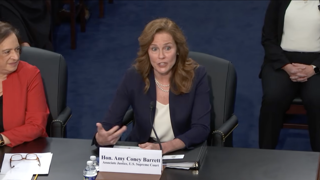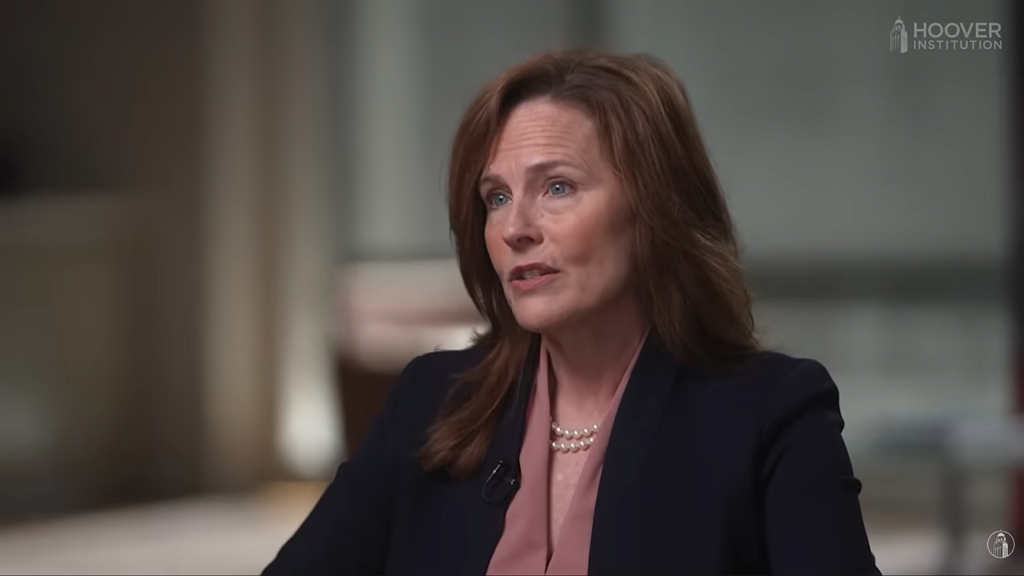
U.S. Supreme Court Associate Justice Amy Coney Barrett emphasized the importance of originalism and the role of the judiciary in a recent interview with the Hoover Institution's Peter Robinson. The discussion, which aired on October 31, covered a range of topics including constitutional interpretation, judicial activism, and the significance of citizen engagement in democracy.
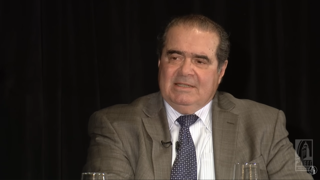
Barrett highlighted the historical context of originalism, stating, "When you look back at the 19th century, originalism is what the court was doing in most cases." She noted that originalism gained prominence during the tenure of former Justice Antonin Scalia, for whom she clerked. Barrett explained that the rise of living constitutionalism in the mid-20th century prompted originalists to articulate their philosophy more clearly.
Addressing criticisms of originalism, Barrett responded to a claim made by Harvard Law Professor Jill Lepore, who suggested that originalism emerged from conservatives' failure to amend the Constitution through democratic means. Barrett pointed out a correlation between the decline in constitutional amendments and the rise of living constitutionalism, suggesting that judicial activism has reduced the perceived need for amendments. "I think the conventional view is that … the main reason that amendments kind of died out was that the court was doing the work of amendment," she said.
The conversation also touched on the doctrine of stare decisis, with Barrett aligning more closely with Scalia's cautious approach to reexamining precedent, as opposed to Justice Clarence Thomas's more aggressive stance. "If the question is called, that’s one thing. Then it’s front and center in front of the court and the court has to decide: Should we overrule this case or not?" Barrett explained.
Barrett addressed the Supreme Court's controversial 2022 decision in Dobbs v. Jackson Women’s Health Organization, which overturned Roe v. Wade. She argued that the ruling did not undermine democracy but rather expanded it by returning the issue of abortion regulation to the states. "What Dobbs did is say, ‘This is not a pro-life or a pro-choice decision. We’re just throwing it to the democratic process,’" Barrett stated.
The interview also explored the issue of nationwide injunctions, with Barrett referencing the Supreme Court's recent decision in Trump v. CASA, which limited the ability of lower courts to issue nationwide injunctions. She emphasized the need for the judiciary to remain within its constitutional boundaries, stating, "You can’t criticize one branch for being outside of its lane by veering outside of your lane to take it down."
In discussing the role of Congress, Barrett expressed concern about the legislative body's failure to fulfill its constitutional responsibilities. She remarked that all branches of government must perform their roles effectively to maintain a proper balance of power. "If one of the other branches is either not doing what they should be or exceeding their powers, the answer to that counterweight can’t be that we exceed ours," Barrett said.
Concluding the interview, Barrett stressed the importance of an engaged citizenry in upholding the rule of law. She stated, "The Supreme Court and the courts cannot do everything, and it is incumbent upon the American people to be engaged in the body politic in order for the country to thrive." Barrett's remarks underscore the ongoing dialogue about the judiciary's role in American democracy and the need for active participation by citizens.