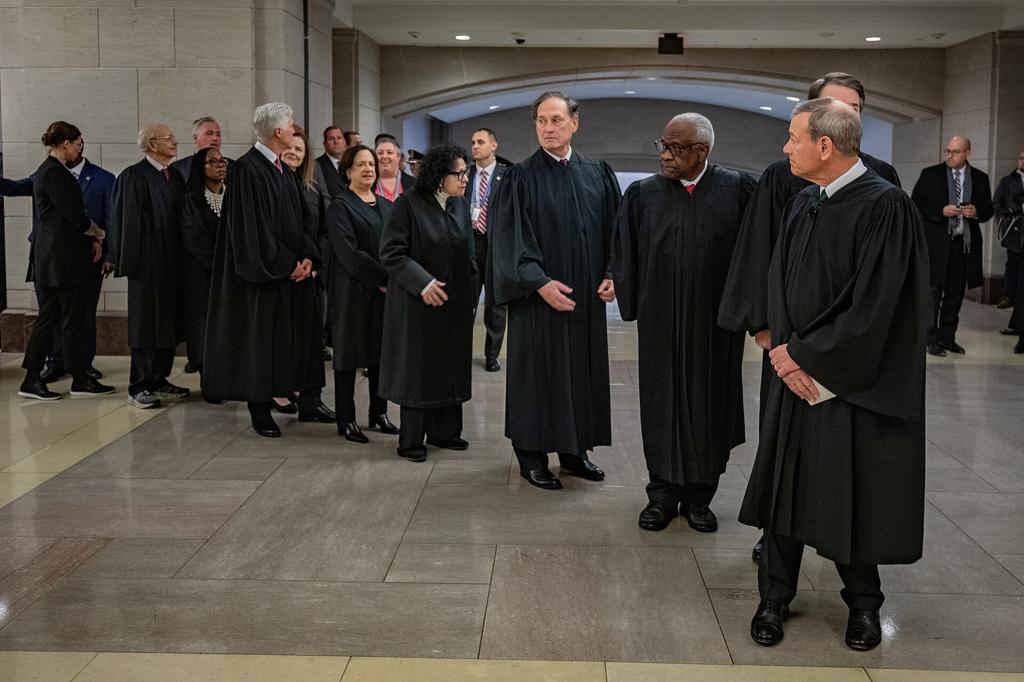
The Washington Post published an article on Thursday criticizing the U.S. Supreme Court's recent rulings, claiming that the conservative majority is undermining civil rights protections. The piece, authored by Justin Jouvenal, argues that the court, remade by former President Donald Trump’s appointees, has shifted sharply to the right, resulting in significant defeats for women and minorities.
The central tension in the article lies in the assertion that the Supreme Court's decisions reflect a partisan agenda that favors conservative viewpoints over civil rights, as defined by the authors of a study cited in the piece. Jouvenal's analysis suggests that the court's rulings have increasingly favored positions that critics argue are detrimental to marginalized groups.
The article references a study conducted by professors from Washington University and Penn State, which examined 270 Supreme Court decisions from 2020 to 2024. According to the study, the share of cases won by advocates for civil rights has fallen to 44 percent since Trump's appointees—Justices Neil Gorsuch, Brett Kavanaugh, and Amy Coney Barrett—joined the court. This marks a significant decline compared to previous decades, where civil rights advocates typically won a majority of such cases.
Claims of Partisanship
Jouvenal describes the current Supreme Court as entering a new era of extreme partisanship, stating, "None over the past seven decades has been as starkly polarized." He cites specific cases, including U.S. v. Skrmetti and Mahmoud v. Taylor, which upheld laws limiting certain medical procedures for minors and parental rights in educational settings, respectively. He argues that these rulings exemplify a trend of the court siding against civil rights protections for LGBTQ+ individuals.
In addition, Jouvenal highlights the 2023 decision in 303 Creative LLC v. Elenis, where the court ruled against a Christian web designer who refused to create websites for same-sex weddings. He warns that the court appears poised to continue this trend in upcoming terms, particularly referencing a recent decision against Colorado's ban on conversion therapy for minors, which was decided by an 8-1 vote, including support from Justices Sonia Sotomayor and Elena Kagan.
Reactions and Perspectives
Critics of the article argue that the Washington Post's framing of these rulings as anti-civil rights is overly simplistic and fails to consider the broader legal context. Supporters of the Supreme Court's decisions contend that the justices are adhering to originalist interpretations of the Constitution, which they argue is essential for maintaining judicial integrity.
The article also touches on the court's ruling in SFFA v. Harvard, which ended racial discrimination against white and Asian American applicants in college admissions. Jouvenal characterizes this decision as a reduction of civil rights protections, a claim that has drawn criticism from those who argue that it promotes fairness in admissions processes.
In response to the article, representatives from the Supreme Court did not provide comments regarding the claims made by Jouvenal or the study referenced. Legal experts have noted that the interpretation of civil rights can vary significantly based on political and ideological perspectives, suggesting that the debate over the court's direction may continue to be contentious.
The Broader Implications
The Washington Post's article reflects ongoing tensions surrounding the Supreme Court's role in American society, particularly as it relates to civil rights and social issues. As the court continues to issue rulings that align with conservative principles, the implications for various groups and legal precedents remain a focal point of discussion.
The framing of the Supreme Court's actions as extreme or partisan raises questions about the future of civil rights litigation and the balance of power within the judiciary. As the court prepares for its next term, the scrutiny of its decisions is likely to intensify, particularly from media outlets and advocacy groups concerned about the implications of its conservative majority.