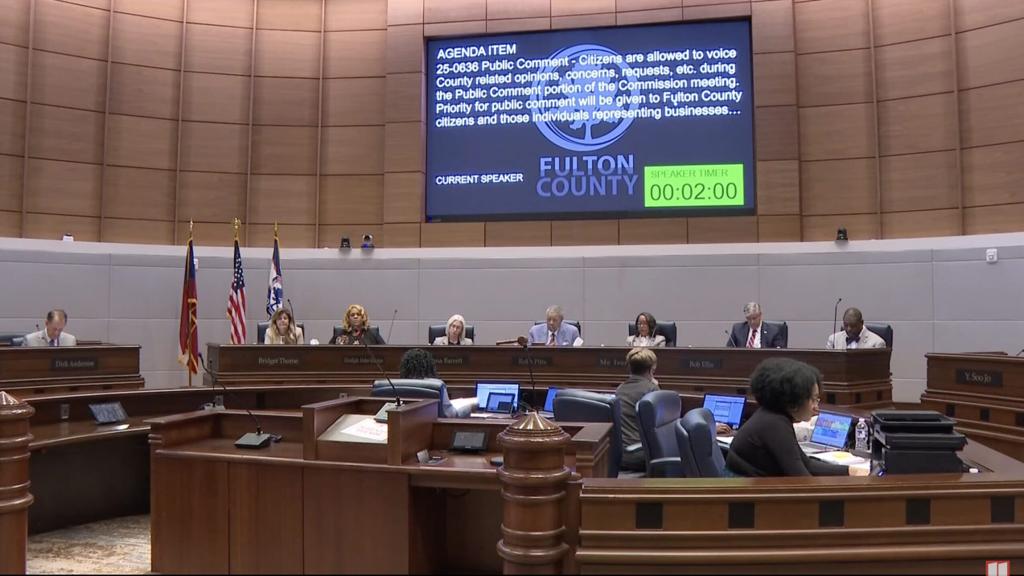
Democrats on the Fulton County Board of Commissioners have refused to seat two Republican nominees for the county’s Board of Elections, despite multiple court orders and the threat of a $10,000 daily fine for noncompliance. This ongoing situation has drawn criticism regarding the perceived double standard in media coverage of election certification issues.
The nominees, Julie Adams and Jason Frazier, were appointed by the Republican Party of Fulton County. Adams is an incumbent member of the Board of Elections, while Frazier was nominated to replace Mike Hegan, who resigned at the end of August. Without Frazier's confirmation, Hegan's seat remains vacant.
Adams has faced opposition from Democrats due to her belief that voting should be discretionary. In March 2024, she declined to certify the results of the presidential preference primary, claiming she was denied access to essential election materials. Following her decision, the Democratic Party of Georgia warned that criminal charges could be brought against any board member who did not certify the election results.
A judge ruled that board members must certify election results, regardless of their personal views on the validity of those results. Judge David Emerson stated, "No election superintendent may refuse to certify or abstain from certifying election results under any circumstance." (Www.fec — fec.gov)
Despite this ruling, the Fulton County Board of Commissioners has not complied. Emerson recently ordered the board to certify both Adams and Frazier’s appointments, imposing a $10,000 fine for each day of noncompliance, although this fine is currently on hold pending an appeal.
The Democracy Defense Project – Georgia, a bipartisan group of former elected officials, urged the county to comply with the court order, stating, "Defying a court order is reckless and dangerous. The Commission must stop playing games and do the right — and lawful — thing." (Www.fec — fec.gov)
Critics have pointed out that while Republicans have been labeled as election deniers for questioning certification processes, the media has framed the Democrats’ refusal to comply with court orders as merely a “delay.” (Www.fec — fec.gov) Kristal Dixon, a reporter for Axios, described the situation as a delay in appointing GOP nominees, suggesting that the Democrats were waiting for the appeals process to unfold.
In contrast, Dixon previously characterized Republican hesitance on certification as potentially leading to election denialism. This inconsistency in coverage has raised concerns about bias in reporting on election-related issues.
Commissioner Marvin Arrington Jr., who opposed the Republican nominations, stated, "This is an attack, again, on 222 years of jurisprudence. No one on God’s green earth can tell me how to vote." (Www.fec — fec.gov)
As the situation in Fulton County develops, the actions of the Board of Commissioners continue to attract scrutiny. The refusal to certify the appointments of Adams and Frazier raises questions about adherence to legal mandates and the implications for election integrity in Georgia.
The ongoing debate highlights the complexities surrounding election certification and the role of media in shaping public perception of these issues.