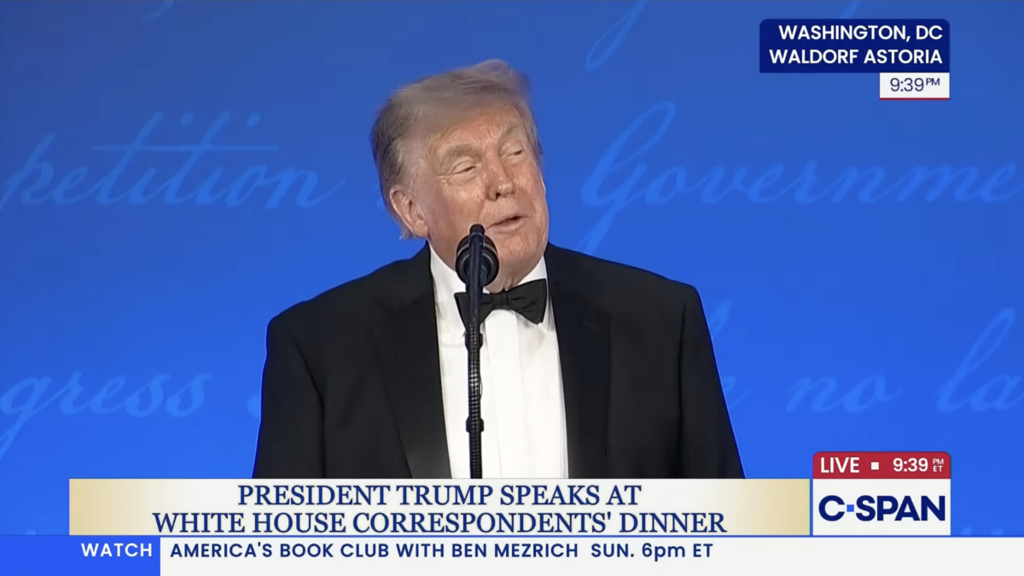
Donald Trump’s remarks at the rescheduled White House Correspondents’ Dinner, in which he compared CNN anchor Kaitlan Collins to transgender actress Dylan Mulvaney, have drawn widespread criticism from media outlets and public figures. The incident has reignited debate over the media’s handling of transgender issues and the boundaries of political humor in high-profile settings.
During his speech, Trump joked, “I thought Kaitlan had really made it big with a major new sponsorship, but then I informed her that it wasn’t her on the Bud Light can; it was Dylan Mulvaney.” Mulvaney, who became widely known after a Bud Light promotion, was referenced by Trump as he criticized Collins’ appearance and suggested she should “smile more.” The joke alluded to the controversy surrounding Bud Light’s partnership with Mulvaney, which previously sparked a boycott and national discussion about transgender representation in advertising.
Media and Public Responses
The reaction from media outlets was swift and largely critical. Publications including Rolling Stone, People Magazine, The Independent, and The Daily Beast described Trump’s comments as an “attack” or a “transphobic gibe” directed at both Collins and Mulvaney. The Advocate reported that Trump “weaponized trans actress Dylan Mulvaney’s image to attack Kaitlan Collins,” accusing him of attempting to demean the CNN journalist by making the comparison. AL.com also characterized the joke as an “insult” and noted that Trump doubled down on his remarks the following day, further fueling the controversy.
Kaitlan Collins responded indirectly to the incident by posting a quote from Eleanor Roosevelt on Instagram: “No one can make you feel inferior without your consent.” She also highlighted her recent award for coverage of Ukrainian President Volodymyr Zelensky’s Oval Office visit, emphasizing the importance of the First Amendment and the role of journalists in challenging those in power. Collins did not directly address Trump’s comments beyond her social media post.
“No one can make you feel inferior without your consent.”
— Kaitlan Collins, CNN anchor
Dylan Mulvaney also addressed the incident, stating, “I am free in a way that they will never have the privilege to experience, and they want to use their power to take away my freedom,” according to Rolling Stone. Mulvaney’s response highlighted the personal impact of being referenced in political jokes and the broader challenges faced by transgender public figures.
Debate Over Transgender Coverage
The incident has fueled criticism from conservative commentators, who argue that the media’s reaction reveals inconsistencies in their coverage of transgender issues. Mollie Hemingway, Editor-In-Chief of The Federalist, questioned why media outlets would consider the comparison an insult if, as they have asserted, “trans women are women.” Hemingway argued that the reaction from left-leaning media tacitly acknowledges a distinction between Collins and Mulvaney that their coverage has previously denied.
Hemingway stated, “If, as they have always asserted, Dylan Mulvaney isn’t just a woman (‘trans women are women’) but a spokesmodel, where EXACTLY is the insult from their perspective?” She further argued, “It is an insult if you recognize that men can’t be women, but left-wing media daily spread propaganda and lies of ‘transwomen are women.’”
This line of criticism reflects a broader debate over how transgender individuals are represented in the media and how political figures use such issues for rhetorical effect. The controversy over Trump’s joke has become a flashpoint in ongoing disputes about the language and framing used in coverage of transgender topics.
Context and Ongoing Tensions
Trump’s comments come amid persistent disputes over transgender representation in both media and politics. Mulvaney’s earlier Bud Light promotion led to a boycott and significant backlash, which Trump referenced in his remarks at the dinner. Media outlets have previously criticized public figures, such as J.K. Rowling and Chimamanda Ngozi Adichie, for making distinctions between transgender women and women, often labeling such comments as “transphobic.”
While Trump’s supporters and conservative commentators argue that the media’s reaction exposes inconsistencies in their stance on transgender issues, outlets like Rolling Stone and The Advocate maintain that the remarks were offensive and targeted both Collins and Mulvaney. The incident did not end with the dinner; Trump continued to highlight the controversy by sharing a photoshopped image of Collins’ face on Mulvaney’s body in the Bud Light ad after the event, further drawing attention to the exchange.
Collins has not directly addressed Trump’s comments beyond her social media post, and representatives for the media outlets involved have not issued further statements. The episode underscores the ongoing tensions surrounding transgender representation and the ways in which political figures use such issues to provoke reactions from both supporters and critics.
The debate over Trump’s joke and the subsequent media coverage reflects broader societal divisions over gender identity, political discourse, and the responsibilities of public figures when addressing sensitive topics. As the conversation continues, the incident remains a focal point in the ongoing discussion about the intersection of politics, media, and transgender rights.