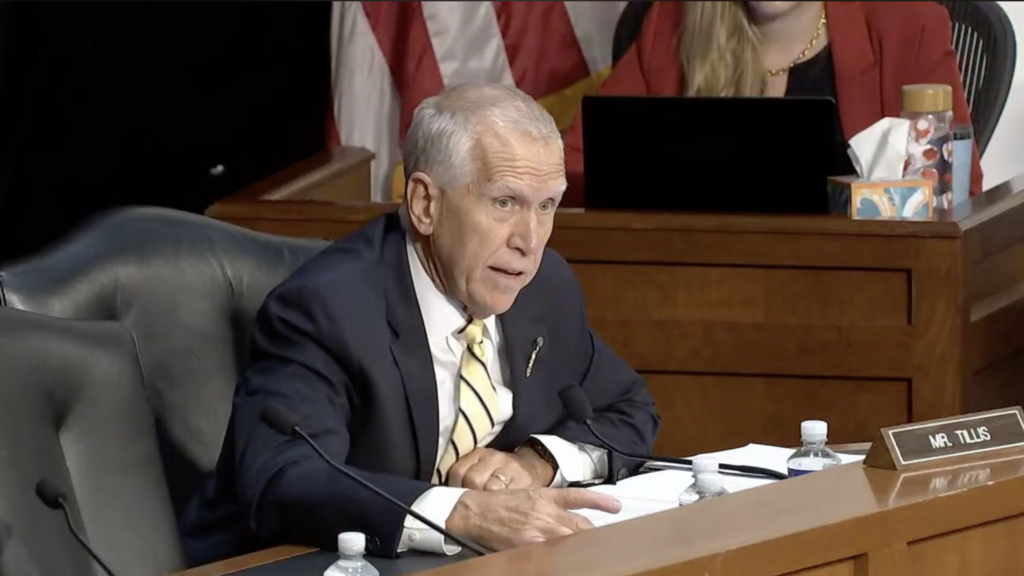
Sen. Thom Tillis, R-N.C., faced criticism from fellow Republicans after drawing a parallel between the Biden administration’s alleged weaponization of the Justice Department and actions taken under the Trump administration. The exchange occurred during a Senate confirmation hearing for Acting Attorney General Todd Blanche, highlighting ongoing divisions within the GOP over how to address claims of political retribution and the appropriate role of the Justice Department.
The debate comes at a time when Republicans have repeatedly accused the Biden administration of using the Justice Department to target political opponents. Democrats, along with some Republicans like Tillis, have cautioned against responding to such claims with similar tactics if political power shifts, arguing that doing so could further erode trust in federal law enforcement and the justice system.
Tillis’s Comments and GOP Response
During the hearing, Tillis noted that Democrats had not denounced what he described as the “weaponization” of the DOJ under President Biden. He then warned that the Trump administration risked repeating those same alleged abuses, stating, “I was against that and I’m also against some of the decisions of the president.”
Tillis questioned Blanche about the events of January 6, specifically asking whether Capitol police officers harmed that day were victims of crime. Blanche agreed, emphasizing that individuals involved in violence had been prosecuted. Tillis used the exchange to call for a de-escalation of partisan conflict, urging for leadership that would “ratchet things down and not make the heinous mistakes that the Biden administration did.” He encouraged Republicans to “set an example and stop this spiraling.”
"Let’s set an example and stop this spiraling."
— Thom Tillis, U.S. Senator
However, Tillis’s remarks drew pushback from other Republicans on the committee. Sen. Eric Schmitt, R-Mo., responded by drawing a distinction between targeting political opponents and holding individuals accountable for weaponizing the justice system. “When you go after your political opponents, that is weaponization. When you hold people accountable who weaponize the justice system, that’s not the same thing,” Schmitt said, underscoring a key divide within the party over how to respond to perceived abuses.
Anti-Weaponization Fund and Legal Cases
Tillis also raised concerns about the $1.776 billion Anti-Weaponization Fund, which was established as part of a settlement in President Donald J. Trump v. Internal Revenue Service. The fund is intended to address claims from individuals who say they were targeted by the Biden DOJ. According to the Justice Department, the fund was created as part of a settlement agreement. Plaintiffs agreed to drop their lawsuit in exchange for a formal apology and the creation of the fund, but no monetary damages were awarded directly to them.
The hearing also referenced several high-profile legal cases that have fueled Republican criticism of the Biden DOJ. Among them was the appointment of Jack Smith as special counsel, who indicted former President Trump on 40 felony counts related to classified documents. That case was ultimately dismissed by Judge Aileen Cannon, who ruled Smith’s appointment unconstitutional. Smith also brought charges against Trump related to his actions following the 2020 election, but the Supreme Court narrowed the scope of the case, and Smith later dismissed the charges after Trump’s election victory.
Another case discussed was that of Douglass Mackey, who was prosecuted for posting memes during the 2016 election. Mackey’s conviction was overturned by a unanimous appellate court, which found insufficient evidence of conspiracy, according to Jones Day.
Broader Allegations Against Biden DOJ
Republican critics at the hearing cited additional actions by the Biden DOJ as evidence of political targeting. These included prosecutions of Christian pro-life activists under the FACE Act, FBI raids on individuals such as Mark Houck, and reported retaliation against whistleblowers. A 2024 Inspector General report and transcripts from the House Judiciary Committee were referenced as evidence that the FBI had suspended security clearances for agents with conservative beliefs.
Other allegations raised included the prosecution of a Texas doctor who reported on gender surgeries at a Houston hospital, and the labeling of parents attending school board meetings as potential “domestic terrorists.” The Biden administration was also accused of targeting the cell phone data of Republican lawmakers as part of the FBI’s Arctic Frost investigation.
Supporters of the Biden administration did not directly address these specific criticisms during the hearing. The Justice Department has stated that the Anti-Weaponization Fund is intended to provide a process for redressing claims of political targeting, rather than serving as an admission of wrongdoing.
The internal GOP dispute over how to respond to perceived abuses at the Justice Department remains unresolved. Further hearings and the administration of the Anti-Weaponization Fund are expected to keep the issue in the spotlight, as lawmakers continue to debate the line between political accountability and retribution.
The Bottom Line
- Sen. Tillis compared Biden and Trump DOJ actions, drawing criticism from Sen. Schmitt and other Republicans at the Blanche confirmation hearing.
- The $1.776 billion Anti-Weaponization Fund was established as part of a DOJ settlement to address claims of political targeting.
- Douglass Mackey's meme-related conviction was overturned by a unanimous appellate court, highlighting scrutiny of Biden DOJ prosecutions.