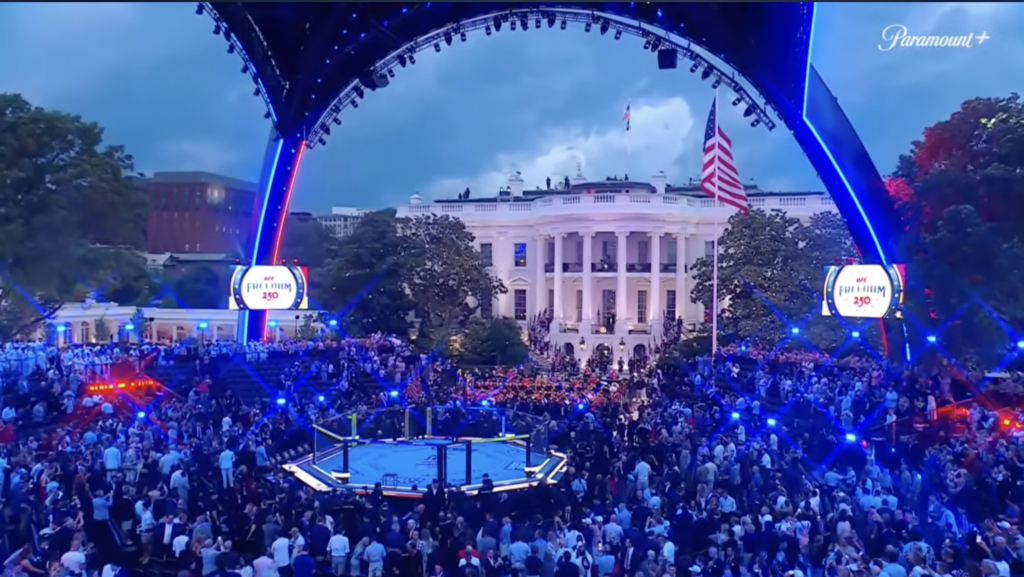
President Donald Trump’s decision to host a UFC event at the White House to celebrate America’s 250th birthday has drawn significant media scrutiny, with critics labeling it inappropriate for the presidential residence. This backlash highlights a perceived inconsistency in media coverage regarding events at the White House, particularly in comparison to past incidents involving LGBTQ activists.
The core tension arises from contrasting media reactions to the UFC event and a previous incident involving Rose Montoya, a transgender activist who posed topless during a Pride Month celebration at the White House in 2023. Critics argue that the media's outrage over the UFC event underscores a bias against Trump, while downplaying or ignoring similar controversies involving the Biden administration.
In recent articles, various media outlets have expressed concern over the UFC event. MS Now published a piece titled "Plaintiffs Call UFC 250 event a ‘volcano of corruption’ in bid to halt White House fights," framing the event as a degradation of the White House. The article primarily served as a platform for left-wing activists to voice their opposition, with little mention of the Montoya incident.
Conversely, NBC News covered the topless incident involving Montoya but focused more on the backlash she faced rather than the appropriateness of the act itself. The network reported, "Many of Montoya’s critics misgendered her by referring to her with male pronouns and called her anti-trans slurs," emphasizing the hostility toward the LGBTQ community rather than condemning the actions at the White House.
Media Reactions
The Chicago Sun-Times also weighed in, with columnist Scoop Jackson warning that the UFC event sends a troubling message about the intersection of sports and politics. Jackson stated, "Sports is being used as another tool to present a troubling theme," suggesting that the UFC's association with certain political ideologies could be problematic. However, there was no mention of the Montoya incident in the Sun-Times archives.
The New York Times joined the chorus of criticism, with writer Shawn McCreesh stating that the UFC event "seems wildly out of touch" and citing a Reuters/Ipsos poll indicating that only 16 percent of Americans found it appropriate for Trump to hold such an event at the White House. McCreesh argued that this move appears to be a provocative strategy amid rising gas prices and low approval ratings for the president.
Interestingly, a search of The Times’ archives revealed no coverage of the Montoya incident, raising questions about the consistency of the outlet's reporting on events at the White House. Critics argue that the lack of condemnation for Montoya’s actions reflects a selective outrage that favors certain narratives.
Contrasting Perspectives
The Guardian also expressed opposition to the UFC event, with Sidney Blumenthal citing the Public Integrity Project, which claimed the event does not materially celebrate American independence. However, the publication did not address the topless incident involving Montoya, which some argue is a more significant affront to the dignity of the White House.
Supporters of the UFC event argue that it is a legitimate celebration of American culture and sports, with some suggesting that the media's focus on Trump is politically motivated. They contend that the criticism lacks a balanced perspective, especially when compared to the media's treatment of past events involving the Biden administration.
As the debate continues, the contrasting media reactions to the UFC event and the Montoya incident raise important questions about bias and accountability in political reporting. Critics assert that the media's selective outrage reflects broader political divides, while supporters of the UFC event maintain that it is a celebration of American values.
In summary, the media's response to the UFC event at the White House has sparked a broader conversation about the consistency of coverage regarding presidential events, particularly in relation to LGBTQ issues. As both sides of the debate present their arguments, the implications for media integrity and public perception remain significant.