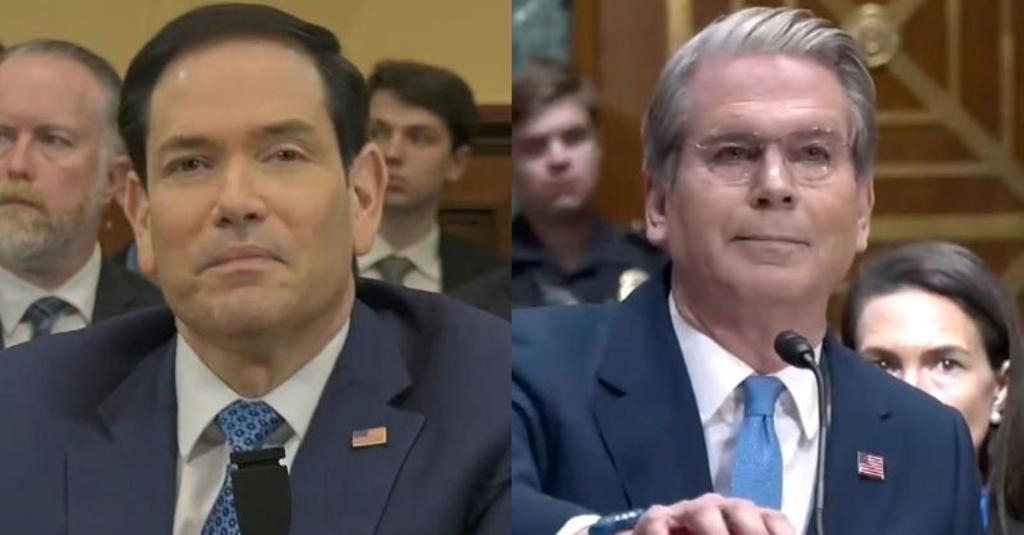
Treasury Secretary Scott Bessent and Secretary of State Marco Rubio engaged in confrontational exchanges with Democratic lawmakers during recent congressional hearings, showcasing a more aggressive Republican stance. This shift reflects a broader transformation within the GOP since Donald Trump's presidency, emphasizing a willingness to confront perceived weaknesses in both Democratic and Republican ranks.
The tension arose as Bessent faced off against Senator Ron Wyden, D-Ore., during a Senate Finance Committee hearing. Bessent criticized Wyden for allegedly using slander to distract from his son’s investment dealings with Jeffrey Epstein. "Senator Wyden has mendaciously slandered the Treasury building in an attempt to cover up his son having an investment meeting with Jeffrey Epstein to ask for funding," Bessent stated. In response, Wyden dismissed the accusation, saying, "Nobody is interested in the ramblings of a capo in the most corrupt regime in American history."
Confrontations in the Senate
Bessent's sharp remarks were part of a broader trend of Republican officials adopting a more combative approach in congressional hearings. He further challenged Wyden by questioning the nature of his son's investments, stating, "And we would like to hear what Adam Wyden and Jeffrey Epstein talked about. Your son’s largest investment position was Rick’s Cabaret. So, did your son and Jeffrey Epstein talk about pole dancing as he begged him for money using your limited credibility?"
This aggressive style was echoed by Rubio during a House Foreign Affairs Committee hearing, where he faced interruptions from Representative Sydney Kamlager-Dove, D-Calif. Kamlager-Dove accused the Trump administration of corruption, claiming it was the "most corrupt administration in American history." Rubio, however, pushed back, questioning the fairness of the hearing process. "What kind of process is this? They get to ask questions and you don’t get to answer?" he asked, visibly frustrated by the interruptions.
A Shift in Republican Strategy
The exchanges highlight a significant shift in Republican strategy since Trump’s election, with party members increasingly willing to confront Democrats directly. Bessent and Rubio's remarks reflect a departure from the more conciliatory approach that characterized previous Republican leadership. This new dynamic has led to a more combative atmosphere in Congress, where GOP members are less inclined to accept criticism without response.
Rubio's interactions with Kamlager-Dove escalated as she repeatedly interrupted him, prompting him to remark, "This is a joke. … Can I reclaim my time?" The tension culminated in Kamlager-Dove leaving the room amid Rubio's taunts, illustrating the heightened emotions and confrontational nature of the hearings.
While some Republican leaders and supporters praise this new approach as necessary for standing up to Democratic criticism, critics argue that it undermines the decorum expected in congressional proceedings. A spokesperson for the Democratic Party did not respond to requests for comment regarding the exchanges.
Implications for Future Hearings
The confrontations led by Bessent and Rubio may signal a lasting change in how Republicans engage with Democrats in Congress. As the GOP continues to embrace a more aggressive stance, the potential for increased partisan conflict in future hearings appears likely. This shift may also influence how constituents perceive their representatives, as voters react to the more combative exchanges.
The recent hearings serve as a reminder of the evolving political landscape in Washington, where traditional norms of civility are increasingly challenged. As both parties navigate this new environment, the implications for legislative effectiveness and bipartisan cooperation remain uncertain.