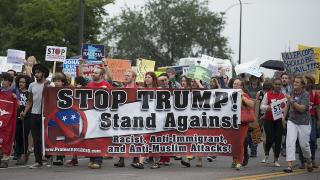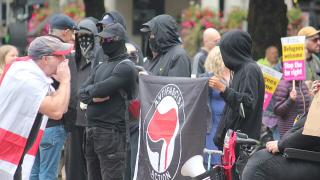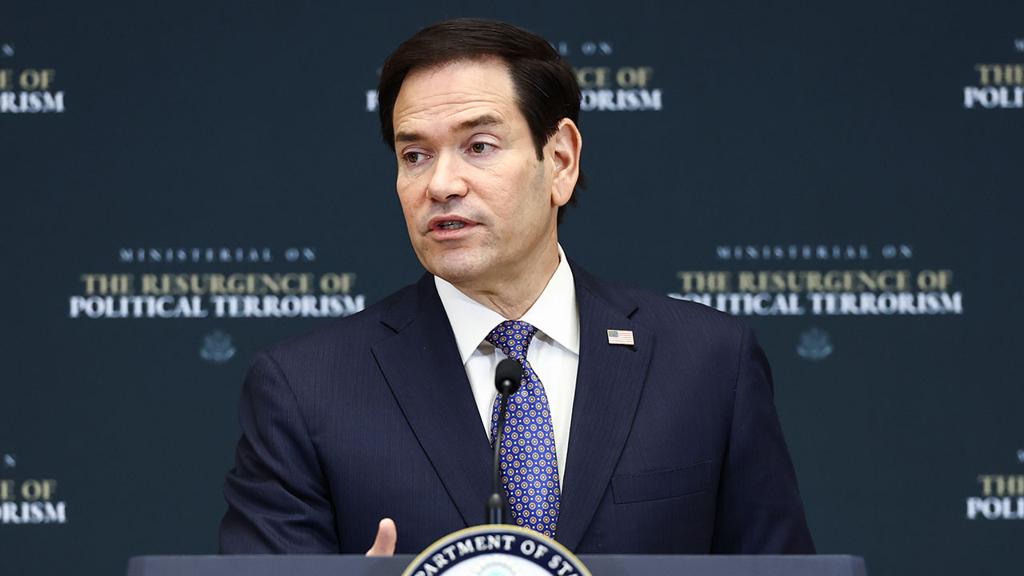
Secretary of State Marco Rubio has called on leaders from more than 60 countries to confront what he described as a persistent and under-acknowledged threat from leftist terrorism. In his remarks, Rubio argued that academic, media, and policy institutions have minimized or excused violence from the political left, while focusing scrutiny and condemnation on right-wing incidents.
Rubio’s comments come at a time of heightened debate over whether political violence is being addressed evenly across the ideological spectrum. Critics, including Rubio, allege that both data collection and institutional responses are skewed, leading to a distorted public understanding of the sources and nature of political violence in the United States and abroad.
The controversy has intensified following several high-profile attacks, including assassination attempts against President Donald Trump and the killing of Turning Point USA founder Charlie Kirk. These incidents have renewed scrutiny of how political violence is tracked, reported, and discussed by influential organizations and the media.
Rubio’s Critique of Institutional Response
Rubio contended that many prominent organizations and academic projects have treated right-wing violence as uniquely dangerous, while minimizing or overlooking leftist attacks. As an example, he cited the University of Cincinnati’s Prosecution Project, which is frequently referenced in media coverage of political violence.
According to NewsNation host Batya Ungar-Sargon, the Prosecution Project’s data omitted major incidents, including the assassination attempts on Trump, the murder of Charlie Kirk, and violence during the George Floyd riots. At the same time, the project amplified cases involving right-wing actors. Ungar-Sargon noted that the project’s methodology and omissions have been widely cited by outlets such as The Economist to support the claim that most political violence comes from the Right. She argued that these omissions distort the true picture of political violence in the United States.
Rubio also referenced a recent Justice Department indictment involving the Southern Poverty Law Center (SPLC), an organization that has long positioned itself as an authority on extremism. The indictment alleges that the SPLC funded remnants of the Ku Klux Klan through shell companies and lied to a bank about these activities. The SPLC has moved to dismiss the charges, stating that it was paying informants within the groups, and has not further addressed Rubio’s criticism.
"Left-wing violence was not just excused. It was treated as sacrosanct, a protected class unto itself."
— Marco Rubio, Secretary of State
Historical and Recent Examples
In his speech, Rubio drew on both historical and recent cases of leftist political violence to illustrate his concerns. He cited the Shining Path in Peru and the Red Brigades in Italy as examples of Marxist groups responsible for brutal acts, including the murder of Italy’s prime minister in 1978. In the United States, Rubio pointed to the Weather Underground’s bombings of federal buildings and the conviction of Assata Shakur, a Black Panther Party member, for the murder of a New Jersey state trooper. Rubio noted that Shakur’s autobiography is now assigned in nearly 500 university courses, suggesting that certain figures associated with leftist violence are being celebrated or legitimized in academic settings.
Recent events, such as the assassination attempts on Trump and the killing of Kirk, have further intensified the debate over the sources and handling of political violence. Ungar-Sargon reported that polling shows a correlation between liberal ideology and support for political violence, though left-leaning commentators continue to cite studies suggesting the opposite. This ongoing disagreement reflects broader disputes over how political violence is defined, measured, and interpreted.
Rubio’s Warning on Ideology
Rubio concluded his remarks by warning that the ideological roots of leftist terrorism are often ignored due to what he described as a “deep hatred of America” in certain intellectual circles. He argued that communism is driven by “a hatred of civilization itself,” and called on institutions to take the threat of leftist terrorism seriously, regardless of political orientation.
He said, “Communism does not sound good in theory. The world it envisions for all of us is small, flat, gray, leveled of all exceptionalism, drained of all that is good and noble in the human soul.”
While Rubio’s speech drew strong criticism of left-leaning institutions, organizations like the SPLC have denied wrongdoing and moved to dismiss federal charges. Meanwhile, outlets such as The Economist continue to report that most political violence is perpetrated by right-wing actors, citing available data from projects like the Prosecution Project.
The debate over how political violence is measured and addressed is expected to continue as new incidents and data emerge. As policymakers, academics, and the public grapple with these questions, the challenge of ensuring even-handed and accurate reporting on political violence remains a central concern.