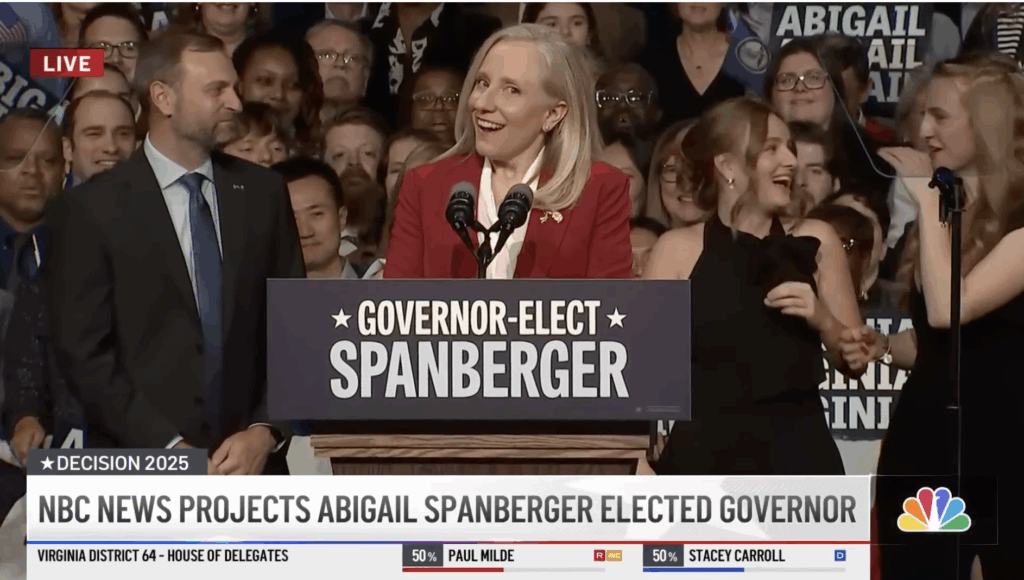
Democrats achieved significant victories in the recent gubernatorial elections in Virginia and New Jersey, reinforcing their control in these traditionally blue states. In Virginia, Abigail Spanberger defeated Republican Lt. Gov. Winsome Earle-Sears by a margin of 15 percentage points, reclaiming the governorship for the Democrats after Glenn Youngkin's victory in 2021. Spanberger's win marks her as the first woman to lead the commonwealth, while Earle-Sears would have been the first Black governor of Virginia.
Explainer Navigating Virginia's Electoral Landscape: Key Issues and Reforms
In New Jersey, Democrat Rep. Mikie Sherrill triumphed over Republican Jack Ciattarelli, winning by 13 points with 95 percent of the votes counted. Sherrill garnered 56.2 percent of the vote compared to Ciattarelli's 43.2 percent. NBC News reporter Bridget Bowman noted that Sherrill's victory sends a signal that Republicans may face challenges in the upcoming midterms, particularly in light of President Trump's influence.
Despite the Democratic wins, some analysts argue that these results should not be interpreted as a definitive rejection of Trump or a bellwether for the 2026 midterms. The Democratic National Committee characterized Spanberger's victory as indicative of voters rejecting Trump's agenda, which they claim is raising costs and harming job growth. However, critics suggest this interpretation is overly simplistic and fails to account for the unique political dynamics in these states.
Turnout played a crucial role in the election outcomes. Spanberger attracted approximately 1.96 million votes, significantly outpacing Earle-Sears, who received about 1.44 million votes. In New Jersey, Sherrill's 1.77 million votes surpassed Ciattarelli's 1.36 million. This disparity highlights a troubling trend for Republicans, as Ciattarelli's numbers fell short of Trump's performance in the previous presidential election, where Trump received nearly 2 million votes in New Jersey.
Republicans are now facing calls to reassess their strategies ahead of the 2026 elections. The GOP has acknowledged the need to improve its ground game and voter outreach efforts, particularly among low-propensity voters who supported Trump in 2024. As one commentator noted, "All of politics depends on control of the air (media) and control of the ground (ballot operations)."
The election results also saw notable firsts in Virginia, with Ghazala Hashmi becoming the first Muslim woman elected to a statewide office in the U.S. Her victory was celebrated by the Council on American-Islamic Relations, which expressed hope that it would inspire greater political engagement among American Muslims.
As the GOP reflects on these election outcomes, party leaders are urged to take meaningful actions to motivate voters and address concerns about the direction of the party. With the midterms approaching, Republicans will need to articulate a clear vision that resonates with voters disillusioned by the current political landscape.