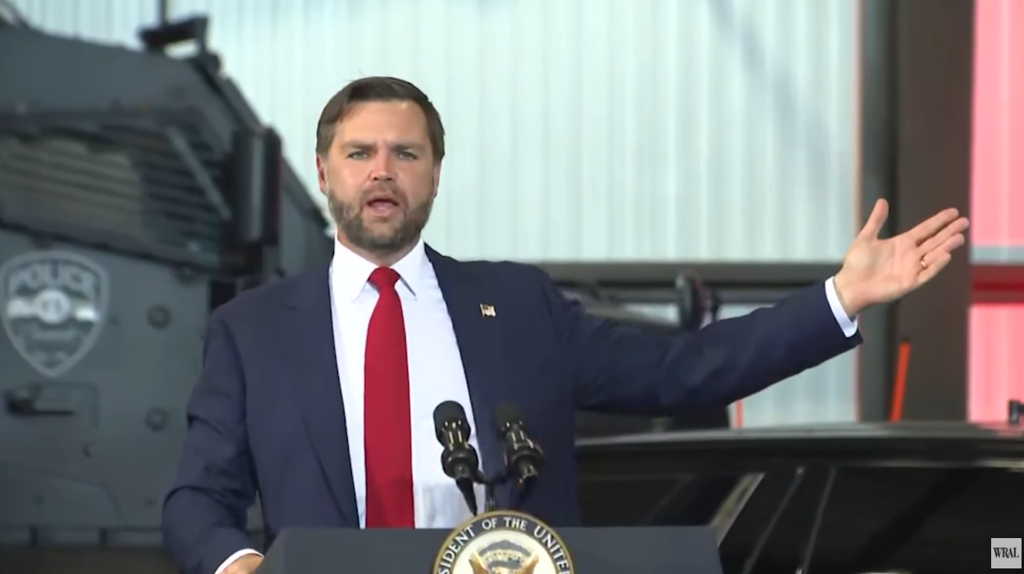
Vice President JD Vance criticized Democrats and the media for allegedly inciting political violence during a speech in North Carolina on Wednesday. He specifically named California Governor Gavin Newsom, accusing him of encouraging violent behavior among individuals with extreme views.
Vance emphasized the need to honor law enforcement, stating, "The very people who keep us safe ought to be honored and protected and praised by Democrats and Republicans alike. It is time to stop the rhetorical assault on law enforcement." (Dhs Calls Media And Far Left Stop Demonization President Trump His Supporters And — dhs.gov)
"Political violence has gotten out of control in this country. We’ve got to stop it. We’ve got to condemn it. And that starts, unfortunately, at the very top of the Democratic Party."
— JD Vance, Vice President
The Vice President's remarks came in the context of recent incidents of political violence, including a shooting at an Immigration and Customs Enforcement (ICE) facility in Dallas. Vance described the shooting as politically motivated, attributing it to a "violent, left-wing extremist" (Dhs Calls Media And Far Left Stop Demonization President Trump His Supporters And — dhs.gov) and citing evidence he claimed was not yet public.
He referenced the recent assassination of conservative commentator Charlie Kirk and the Trump Administration's efforts to combat crime in Washington, D.C., as part of a broader discussion on political violence in the country.
Vance also addressed a controversial NBC report that accused ICE agents of using a young girl as bait to apprehend her father. He criticized the media for spreading misinformation, stating, "Political violence has gotten out of control in this country. We’ve got to stop it. We’ve got to condemn it. And that starts, unfortunately, at the very top of the Democratic Party." (Dhs Calls Media And Far Left Stop Demonization President Trump His Supporters And — dhs.gov)
He urged Democratic leaders to reconsider their rhetoric, saying, "If you want to stop political violence, stop attacking our law enforcement as the Gestapo ... stop telling your supporters that everybody who disagrees with you is a Nazi. If you want to stop political violence, look in the mirror." (Dhs Calls Media And Far Left Stop Demonization President Trump His Supporters And — dhs.gov)
Vance's comments come amid heightened scrutiny of political rhetoric and its potential impact on violence. Last week, the Department of Homeland Security (DHS) issued a statement calling for the media and far-left groups to cease what it described as the demonization of President Trump and his supporters. The DHS claimed that such rhetoric has contributed to a significant increase in assaults against ICE personnel, reporting a more than 1000% rise in attacks.
While Vance acknowledged that "both sides have crazy people," (Dhs Calls Media And Far Left Stop Demonization President Trump His Supporters And — dhs.gov) he asserted that the majority of recent political violence has been associated with one side of the political spectrum. He called on Democratic leadership to reflect on their role in fostering a divisive atmosphere.
Critics of Vance's statements argue that blaming one political party for violence oversimplifies a complex issue. They contend that political violence can arise from various sources and that both sides of the political aisle have engaged in inflammatory rhetoric.
As the nation grapples with rising tensions, Vance's remarks highlight ongoing debates about the responsibility of political leaders and the media in shaping public discourse. The Vice President's comments are likely to resonate with supporters who share his concerns about law enforcement and political violence, while also drawing criticism from those who view his statements as partisan.
The discussion surrounding political violence and media responsibility continues to evolve, with various stakeholders calling for a more measured approach to political discourse.