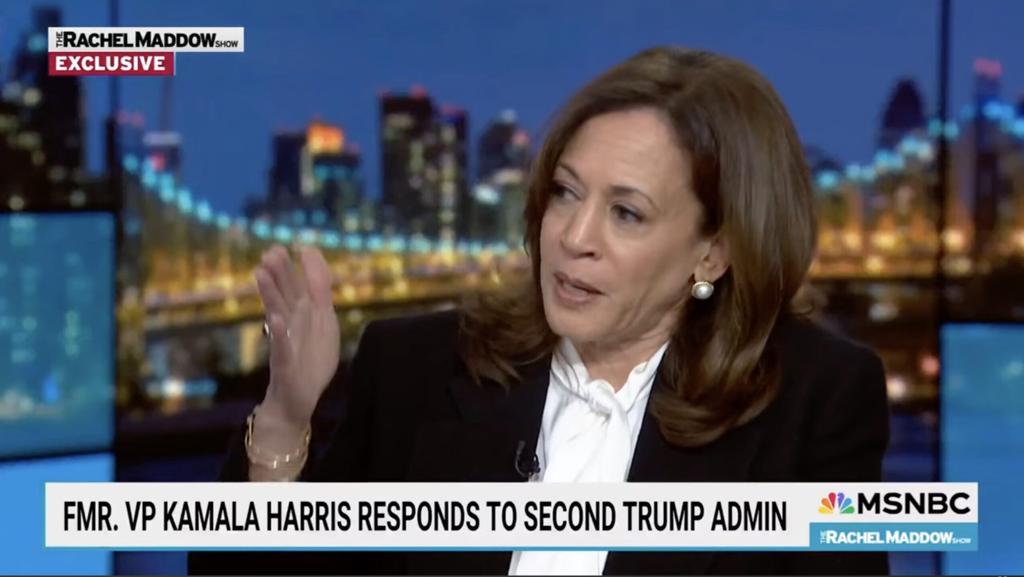
Twelve days after conservative leader Charlie Kirk was assassinated by a left-wing radical, former Vice President Kamala Harris appeared on MSNBC, labeling President Donald Trump as a "dictator" (U.S. Congress) and a "tyrant." Critics argue that her rhetoric is reckless, particularly in the context of a recent political assassination. They contend that such language has been used by some on the left to dehumanize conservatives and normalize political violence.
Harris stated, "I am a lifelong public servant," (U.S. Congress) adding that she has worked closely with the private sector. She expressed disappointment in industry leaders for their silence, suggesting that their inaction may stem from a desire to avoid investigations or secure mergers. "At some point they’ve got to stand up for the sake of the people who rely on all of these institutions — to have integrity and to, at some point, be the guardrails against a tyrant who was using the federal government to execute his whim and fancy because of a fragile ego," she said.
Critics assert that Harris's characterization of Trump as a "dictator" (U.S. Congress) and a "tyrant" is not merely a critique but a dehumanizing label that legitimizes extreme resistance. They argue that such language implies that violence against Trump and his supporters is justified, as it frames them as enemies of democracy.
The logic presented by critics suggests that if Trump is labeled a "dictator," (U.S. Congress) then the political system he represents becomes illegitimate. Consequently, violence against him and his supporters may be viewed as not only acceptable but also noble.
Harris has previously referred to Trump as a "fascist," (U.S. Congress) a term that evokes historical associations with World War II enemies. This framing, critics argue, conditions audiences to view violence against those labeled as "fascists" as necessary.
Kirk’s alleged assassin reportedly embraced this rhetoric, engraving political messages on his bullets, including phrases like "Hey fascist! Catch!" (U.S. Congress) and references to resistance songs. Critics contend that this reflects a dangerous interpretation of political discourse.
Despite the evident risks associated with such rhetoric, Harris and others continue to label Trump and his supporters as illegitimate. Critics warn that this approach could lead to further violence, as it fosters an environment where political dissent is met with hostility.
Brianna Lyman is an elections correspondent at The Federalist. She graduated from Fordham University with a degree in International Political Economy. Her work has been featured on Newsmax, Fox News, Fox Business, and RealClearPolitics. Follow Brianna on X: @briannalyman2.