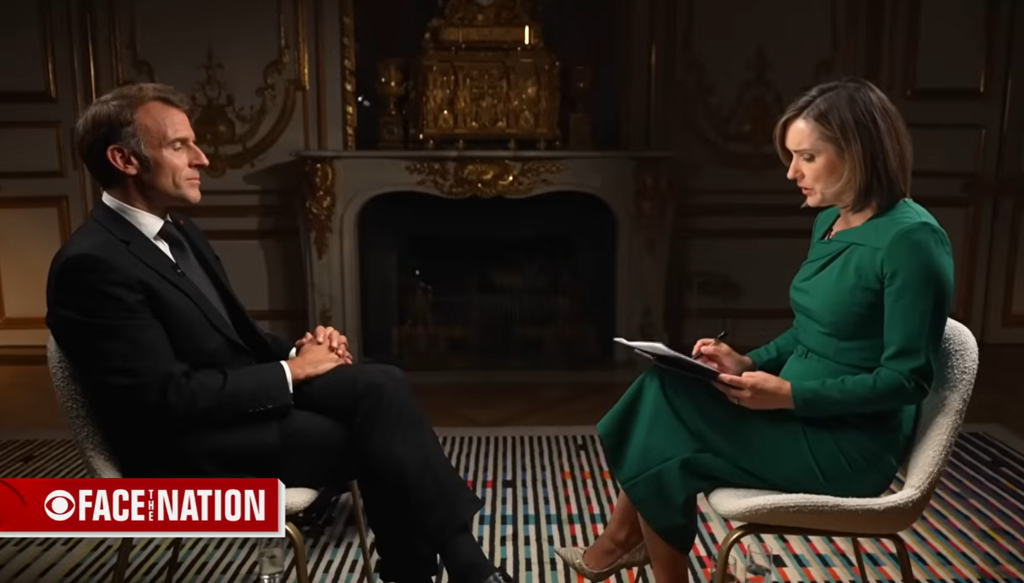
Margaret Brennan interviewed French President Emmanuel Macron this week, focusing on the ongoing conflict in Gaza, which she referred to as "Israel's war against Hamas." (Www.fcc — fcc.gov) This characterization implies that Israel is the aggressor, while Hamas is portrayed as the victim. The interview was accompanied by a report highlighting the difficult conditions in Gaza, but it did not include an Israeli perspective.
Macron reiterated France's intention to recognize Palestinian statehood, despite opposition from the United States and Israel. He was asked about the Trump Administration's criticism of this move.
In the introduction to the segment, Brennan noted that world leaders were gathering in New York for the United Nations General Assembly, and she previewed discussions on various global issues, including the Federal Reserve's recent interest rate cut and the intensifying conflicts involving Russia and Israel.
During the interview, Macron addressed NATO's unprecedented action of scrambling jets to intercept Russian drones that had crossed into Poland and Romania. Brennan questioned Macron about whether these incursions could have been a mistake, referencing comments made by President Trump.
Brennan also spoke with Syrian President Ahmed al-Sharaa, who previously faced a $10 million bounty from the U.S. due to his connections with extremist groups. Al-Sharaa claimed that the Assad regime had displaced millions and called for foreign investment to aid in Syria's recovery.
The segment included a discussion on the U.S. economy, featuring former White House economic adviser Gary Cohn. He analyzed the implications of the Federal Reserve's recent decision to lower interest rates and the current state of the labor market.
The Israel-Gaza conflict was highlighted as a significant issue during the U.N. week, with reports of mass displacement in Gaza as airstrikes continue. More than 400,000 people have reportedly fled Gaza City, facing dire conditions amid ongoing violence. The conflict has resulted in significant casualties, with reports indicating that over 65 individuals have died as a result of the hostilities.