The Supreme Court on Friday lifted a lower court injunction, allowing states to again use a modified federal database to check whether registered voters are U.S. citizens. The decision comes as the Cybersecurity and Infrastructure Security Agency (CISA) released its first public election-security plan since federal support was paused last year, urging states to adopt paper ballots and manual audits.
Explainer Understanding the Supreme Court’s Impact on Law and Liberty
The moves mark a renewed federal push on election integrity, with the Supreme Court's order clearing the way for expanded citizenship verification and CISA's guidance emphasizing traditional security measures amid ongoing concerns about voter fraud and cyber threats.
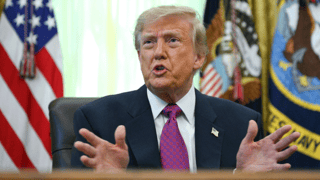
The legal battle began when President Donald Trump directed the Department of Homeland Security and Social Security Administration to expand the Systematic Alien Verification for Entitlements (SAVE) program, adding Social Security records and enabling bulk searches to verify citizenship status for voter rolls. Voting-rights groups challenged the expansion, and U.S. District Judge Sparkle L. Sooknanan, a Biden nominee, blocked the system in June, citing privacy concerns and the risk of removing eligible voters due to flawed matches. An appeals court kept her order in place until the Supreme Court's intervention.
In its unsigned opinion, the Supreme Court stated that federal law already requires the government to answer state requests to verify citizenship and that Judge Sooknanan’s order "prevents the Federal Government from using the program it believes is best suited to the task." Justices Sonia Sotomayor, Elena Kagan, and Ketanji Brown Jackson dissented. The stay is not a final decision on the merits, but it allows states to resume using the SAVE database for individual citizenship checks before the upcoming election and for broader roll maintenance afterward. Federal law still bars systematic voter-roll purges within 90 days of an election.
Rep. Claudia Tenney, R-N.Y., praised the ruling, noting that even New York's left-leaning Court of Appeals had unanimously affirmed that only citizens can vote. "Our New York State Court of Appeals—they're all left-leaning, all appointed by either Cuomo or Governor -- ruled unanimously that only citizens can vote in our elections. So why would we let people who are ineligible to vote get on our voter rolls?"
Voting-rights advocates have argued that the SAVE expansion risks disenfranchising eligible voters and violates privacy rights. The Justice Department, however, called the lower court ruling indefensible and sought emergency relief from the Supreme Court.
CISA's Election Security Blueprint
On Thursday, CISA released its 2026 Election Infrastructure Security Plan, a 13-page document titled "Securing the Next 250," about 40 days before the midterm elections. The plan recommends paper ballots, post-election manual audits, multi-factor authentication, tighter access controls, and log retention for at least a year. CISA also plans to offer a no-cost information-sharing platform for fusion centers and election officials, and to assign regional directors as security advisers.
The new guidance follows a year-long pause in federal election-security assistance, during which CISA cut about 1,000 employees and lost dedicated election-adviser capacity. Officials from both parties said the cuts weakened support for state and local election offices. CISA warns that hackers have attempted to breach voter-registration systems in all 50 states, with confirmed incidents in at least 20.
CISA's recommendations do not change voter eligibility rules but urge election offices to treat infrastructure as a year-round target for both cyber and physical threats. The agency highlights risks from weak software patching, insider threats, and databases accessible from public lookup tools.
Broader Context and Next Steps
The Supreme Court's decision and CISA's plan reflect renewed federal involvement in election security after a period of reduced support. The SAVE program, managed by U.S. Citizenship and Immigration Services, is now again available for states to verify citizenship status for voter registration purposes. The CISA plan, available on the agency's official website, emphasizes traditional safeguards long advocated by election-integrity groups.
The Supreme Court's stay is expected to have its greatest impact on individual voter checks before the November 3 election and on broader voter roll maintenance after the midterms. The case remains pending for a final decision on the merits.
"Our New York State Court of Appeals—they're all left-leaning, all appointed by either Cuomo or Governor -- ruled unanimously that only citizens can vote in our elections. So why would we let people who are ineligible to vote get on our voter rolls?"
— Rep. Claudia Tenney, R-N.Y.